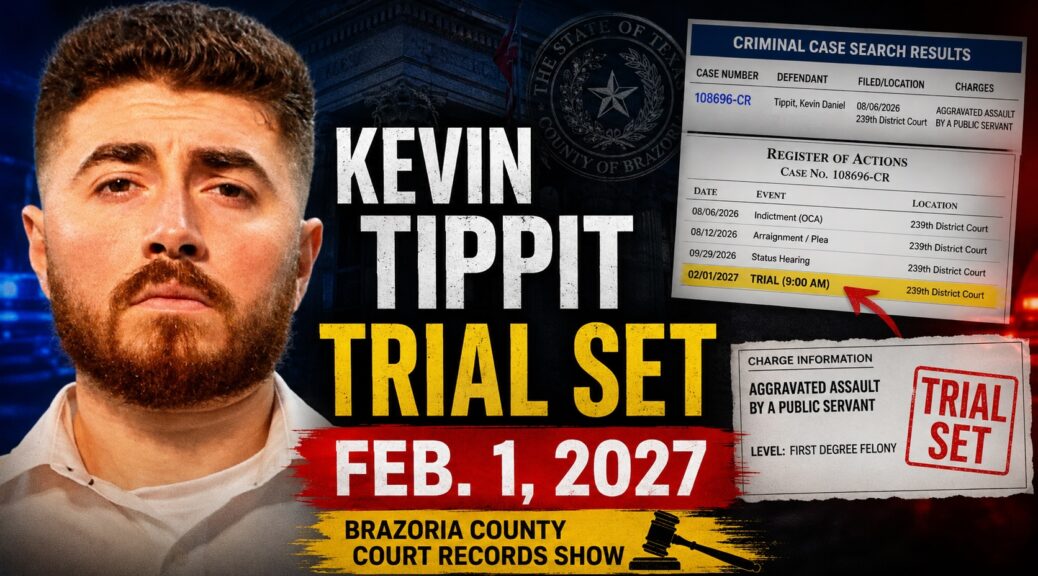
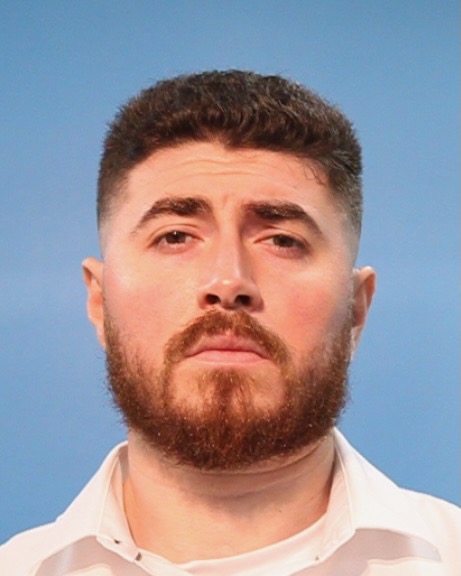
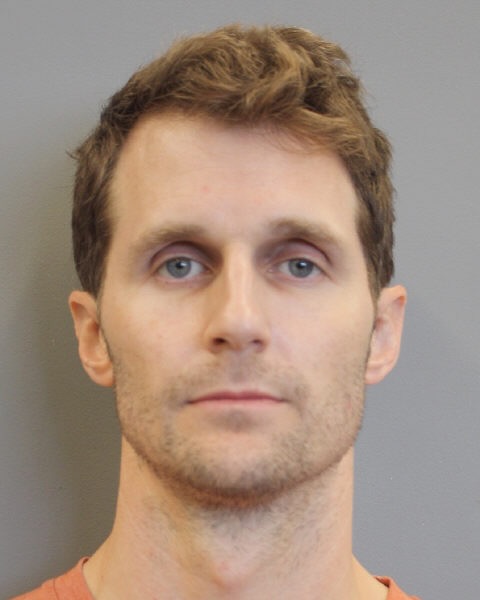
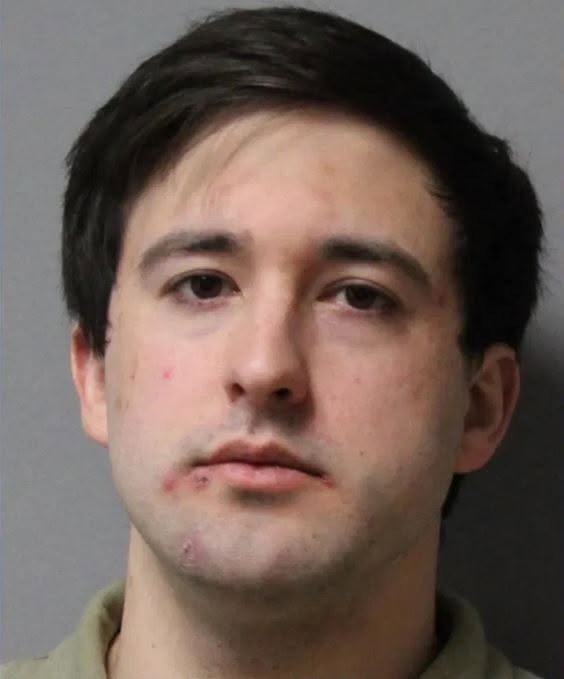
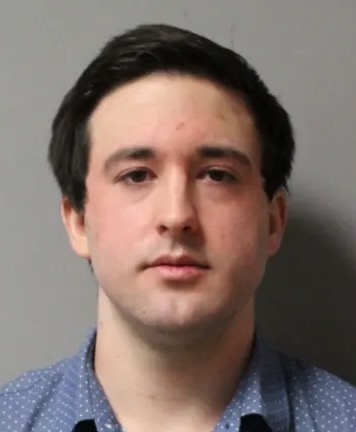
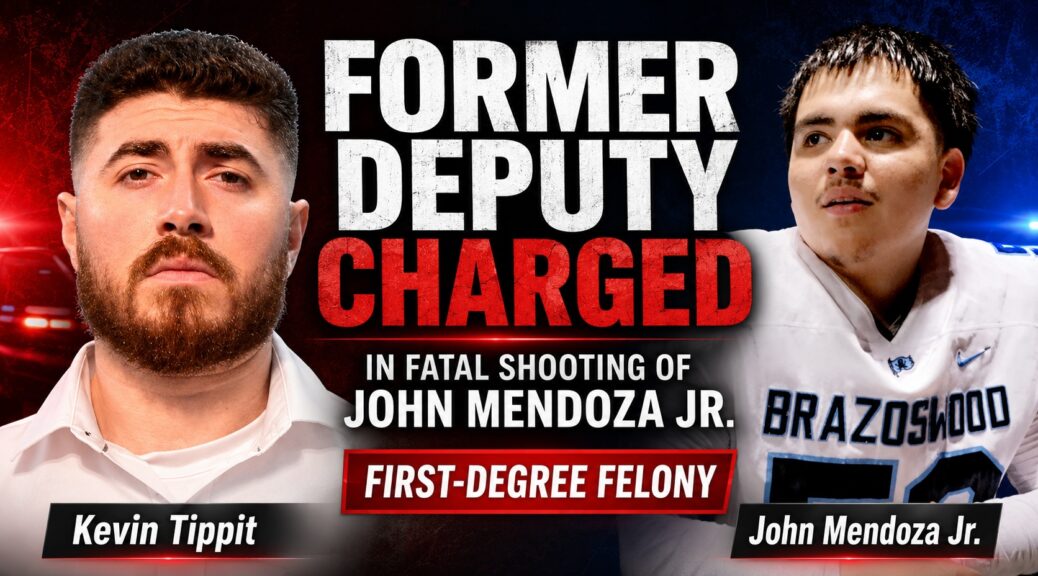
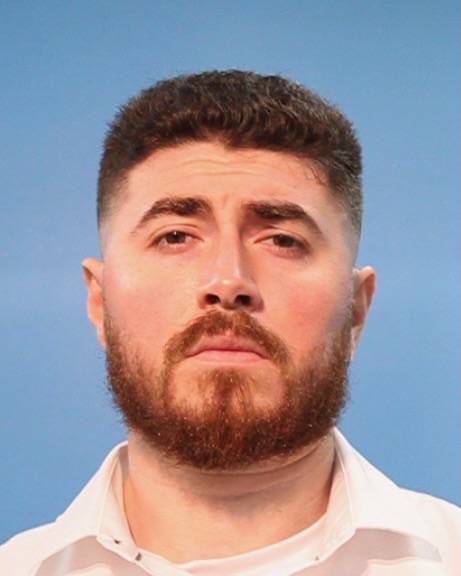
Brazoria County court records show a Feb. 1, 2027 trial date in the criminal case against former deputy Kevin Daniel Tippit. Mugshot photo credit: Brazoria County Sheriff’s Office.
Kevin Tippit trial date set in Brazoria County
Court records show prosecutors filed the case against Tippit on Aug. 6, 2026, in Brazoria County’s 239th District Court.
The docket lists several hearings before the scheduled trial:
Sept. 29, 2026 at 8:30 a.m. — Status hearing
Oct. 28, 2026 at 9 a.m. — Pretrial hearing
Jan. 21, 2027 at 9 a.m. — Announcement hearing
Feb. 1, 2027 at 9 a.m. — Trial
The court entered an Order for Pretrial Hearing and Setting Case for Trial on Aug. 12.
The February date remains the current trial setting. Court schedules can change as the case moves forward.
Former deputy released on bond
Texas Rangers arrested Tippit on Aug. 11.
Brazoria County court records show the judge set his bond at $250,000. Tippit later posted bond and was released from jail.
The court docket lists defense attorneys Guy L. Womack and Geoff L. Womack.
John Mendoza died after June police pursuit
John Gabriel Mendoza Jr., 18, was a Texas State University student who died following the June 1, 2026 shooting involving former Brazoria County deputy Kevin Daniel Tippit.
The criminal case stems from the June 1, 2026 shooting of John Gabriel Mendoza Jr.
Mendoza was 18 and attended Texas State University.
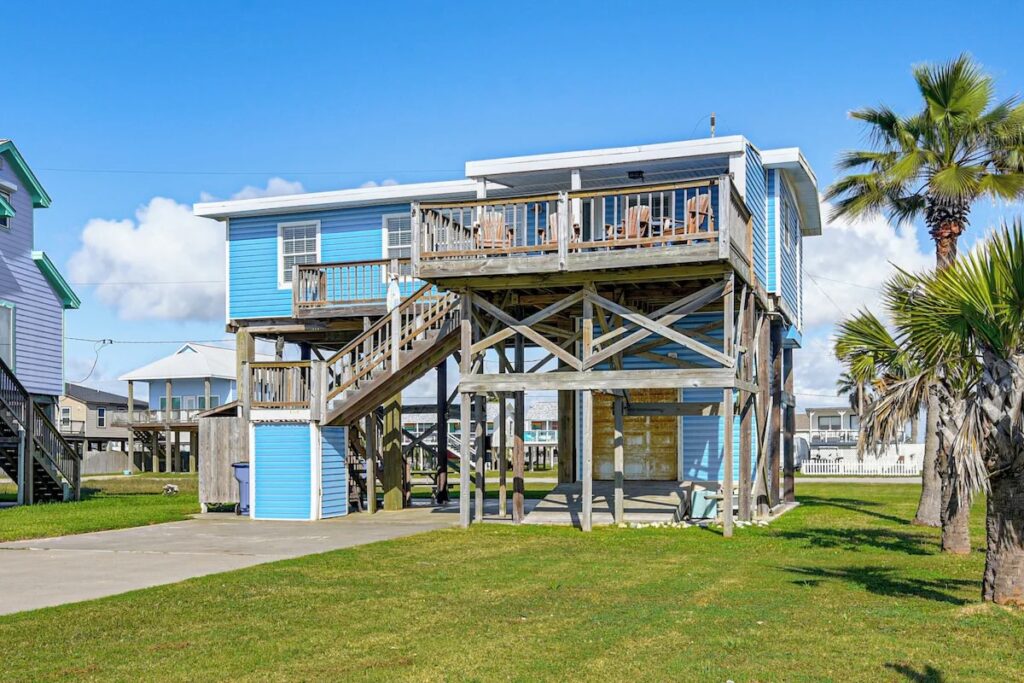
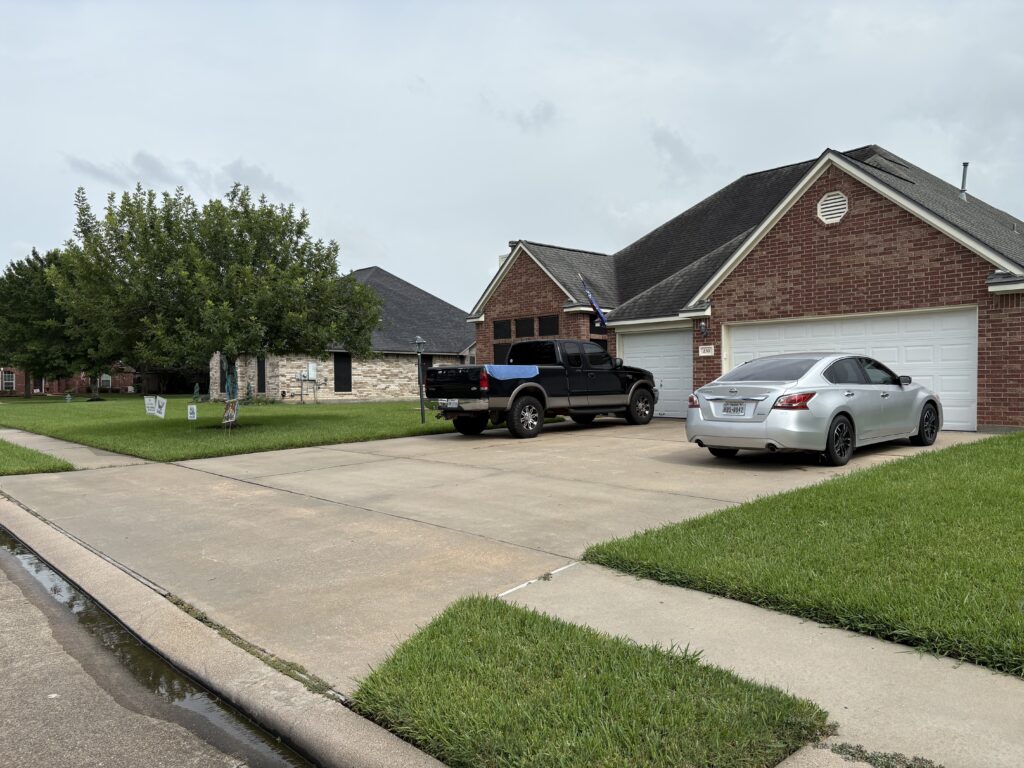
The incident began with a pursuit in Lake Jackson. The chase ended when Mendoza reached his home and pulled into the garage.
Tippit fired through the driver’s side window.
Radio traffic following the shooting captured Tippit reporting an “accidental discharge.”
Mendoza later died.
The Brazoria County Sheriff’s Office fired Tippit days after the shooting.
The Texas Rangers later investigated the case.
Grand jury indicted Kevin Tippit
Former Brazoria County Sheriff’s Deputy Kevin Daniel Tippit faces a charge of aggravated assault by a public servant in connection with the June 1, 2026 shooting of John Gabriel Mendoza Jr. Photo credit: Brazoria County Sheriff’s Office.
A Brazoria County grand jury indicted Tippit on the charge of aggravated assault by a public servant.
Court records identify the charge under Texas Penal Code 22.02(b)(2)(A) and classify it as a first-degree felony.
The case number is 106968-CR.
The next hearing is currently scheduled for Sept. 29.
Investigative Reporter Tammy Rose will continue following the case and any changes to the trial schedule.
If you’re traveling to Brazoria County for a court hearing, trial or visit, you can compare nearby hotel options through Hotels.com. Staying close to Angleton can make early court mornings a little easier.
Traveling to Brazoria County? Visitors can find hotels and vacation rentals near Angleton, Lake Jackson and the surrounding Gulf Coast area.
If you’re heading to Brazoria County, a few simple travel essentials can make the trip easier. I also share useful travel gear through my Amazon affiliate links.
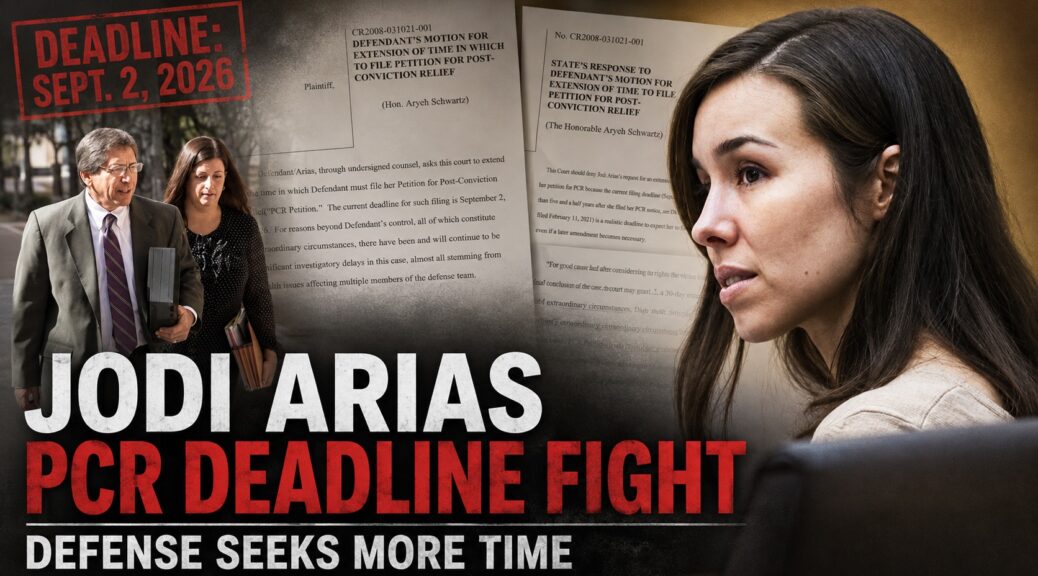
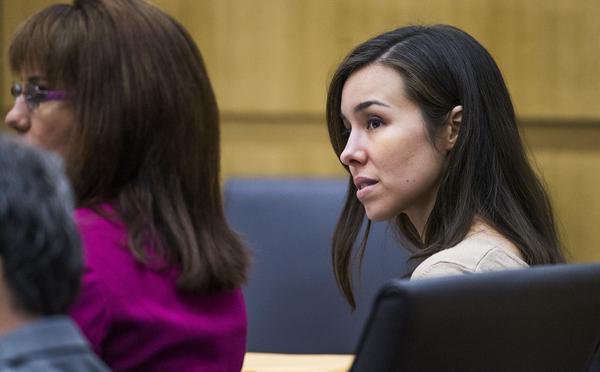
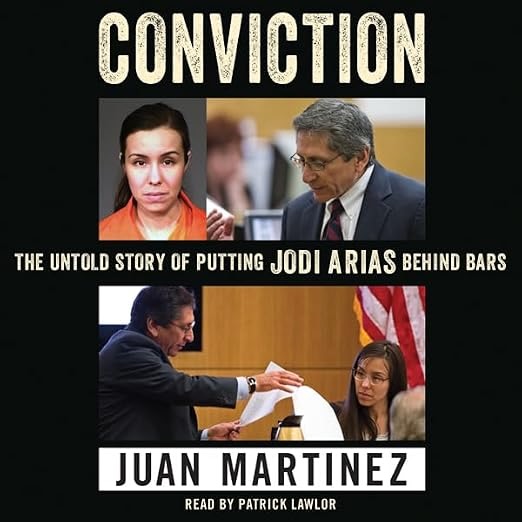
Jodi Arias appears in court during proceedings in her Arizona murder case.
Jodi Arias court fight erupts over mystery evidence and looming deadline
By Investigative Reporter Tammy Rose
A new court fight in the Jodi Arias case centers on a looming deadline, health problems and an unidentified piece of evidence.
Arias faces a September 2, 2026 deadline to file her petition for post-conviction relief, or PCR petition.
Her attorney wants much more time.
Defense attorney Christopher Stavris asked the court to extend the Jodi Arias PCR deadline to January 29, 2027.
Prosecutors strongly oppose that request.
Now, newly reviewed court filings reveal another twist. Arias’ defense says it still awaits information about an item of evidence involving the State and/or Mesa Police Department.
The defense says it first asked about that evidence almost one year ago.
Jodi Arias PCR deadline sparks court battle
Stavris filed the extension request on June 16, 2026.
He told the court that several defense team members face significant health problems.
According to the filing, one key team member needs more than three months of surgical medical leave.
Another team member also needs surgical leave and can only work in a limited capacity.
The defense says two other team members face serious health problems that have slowed their work.
Another team member may need replacement because of ongoing medical issues.
Stavris argues those problems qualify as extraordinary circumstances under Arizona court rules.
He says his team cannot complete the necessary investigation before September 2.
Prosecutors say Arias has had enough time
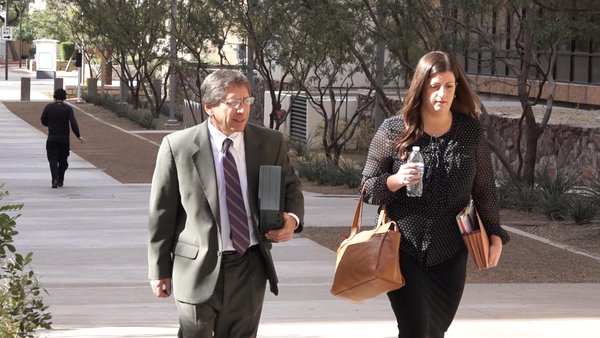
Prosecutor Juan Martinez walks into court with a witness during Jodi Arias’s resentencing trial.
The Maricopa County Attorney’s Office pushed back.
Deputy County Attorney Jordan Smith argued that Arias has already had years to prepare her petition.
Arias filed her PCR notice on February 11, 2021.
Prosecutors say the September deadline gives her more than five and a half years from that filing.
The State called the deadline realistic.
Prosecutors also argued that Arias could file her petition and seek changes later if new evidence develops.
The State took an even stronger position in its filing.
Prosecutors argued that failure to meet the September 2 deadline should support dismissal of Arias’ PCR notice.
Defense reveals unresolved evidence issue
In a June 25, 2026 filing, Jodi Arias’s defense said it was still waiting for a status update on an item of evidence first raised nearly a year earlier.
The defense responded on June 25.
That filing contains one of the most interesting details in the latest court battle.
Stavris says Arias still waits for a status update involving an item of evidence.
The filing does not publicly identify the evidence.
The defense says it first asked about the item almost a year ago.
Stavris also says the State and Mesa Police Department have communicated about the evidence.
However, he says the defense still does not know its status.
The defense sent another status request several weeks before filing its reply.
According to Stavris, nobody had answered that request.
Defense says records from 2021 remain outstanding
The defense also raised another issue.
Stavris says Arias submitted a public records request through the Maricopa County Attorney’s Office in 2021.
The office partially fulfilled that request.
However, the defense says some records remain outstanding.
Arias’ team submitted a narrower request in February 2026.
The defense hoped that move would speed up the process.
Stavris says prosecutors told the defense that they continue to process the request.
Those outstanding records now form part of the defense argument for more time.
Arias attorney says PCR investigation remains active
Stavris argues that post-conviction work requires more than reviewing old court transcripts.
He says PCR claims often require new investigation outside the original trial record.
That work can involve attorneys, investigators and experts.
The defense also challenged the State’s description of the affected team members.
Prosecutors referred to them as investigators.
Stavris says several of them serve as experts in specialized fields.
He argues that those experts play a critical role in developing possible PCR claims.
The defense also says it continues to conduct discovery and investigate possible claims.
Defense offers closed hearing with judge
Stavris told the court he could provide more information if the judge wants it.
However, he asked to present those details during a sealed, ex parte hearing.
That type of hearing could allow the defense to discuss sensitive investigative information without publicly revealing its strategy.
The filing does not disclose what claims Arias may eventually raise in her PCR petition.
State asks for oral argument
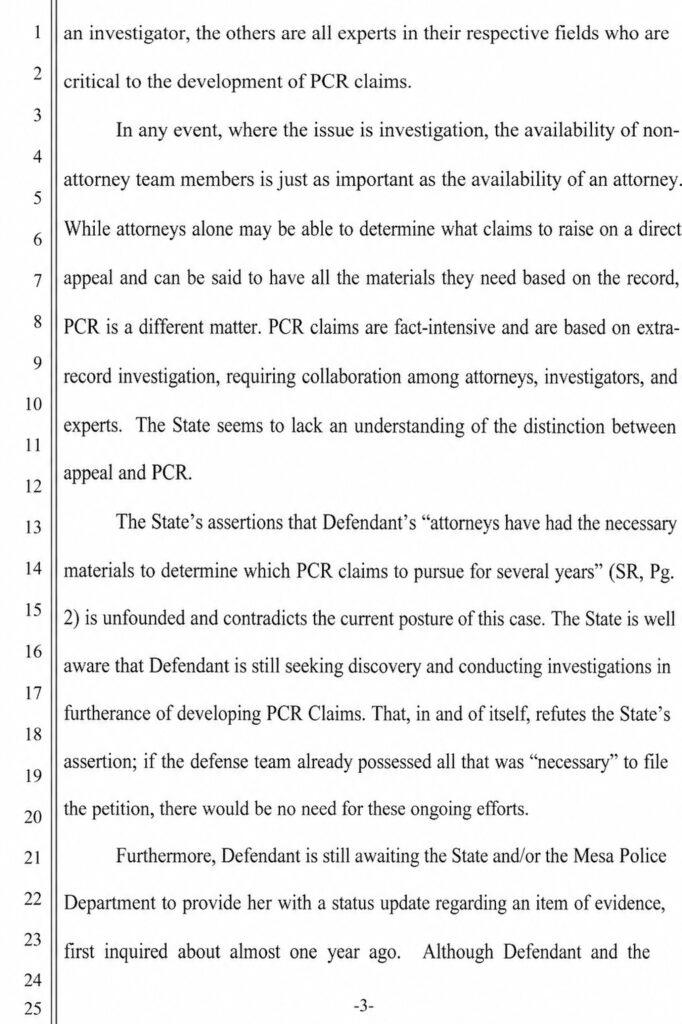
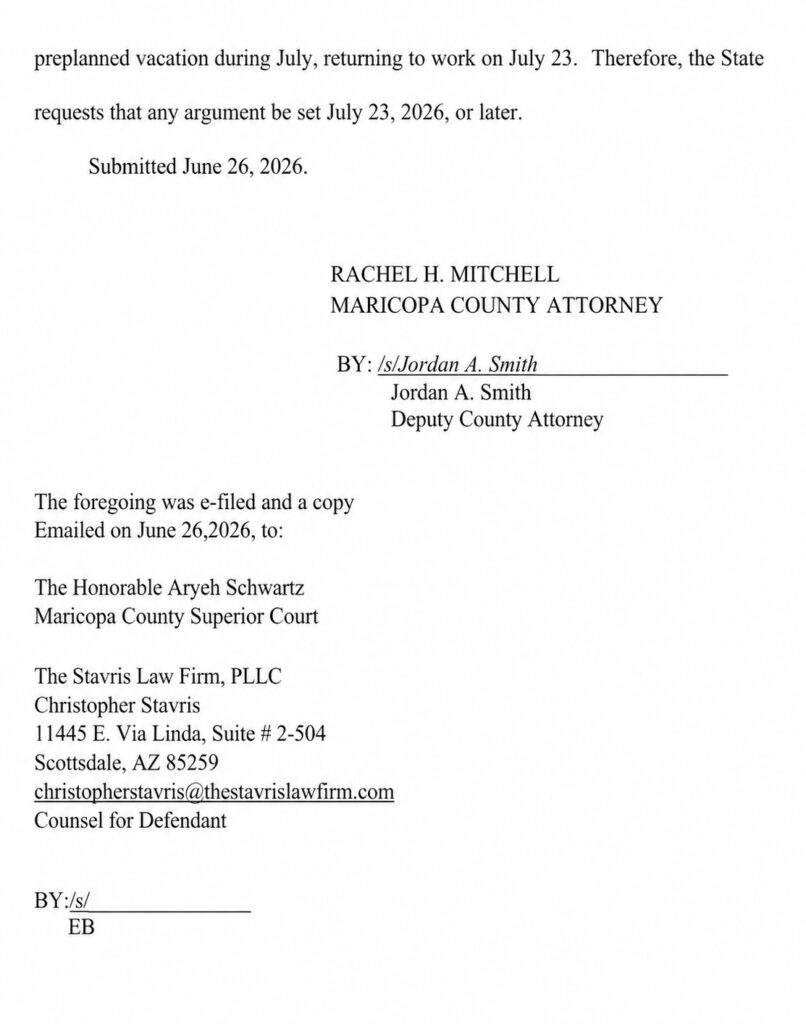
In a June 26, 2026 filing, prosecutors asked Judge Aryeh Schwartz to schedule oral argument on Jodi Arias’s request for more time, with any argument set for July 23 or later.
The fight did not end with the defense reply.
On June 26, prosecutors asked the judge to hold oral arguments about the requested extension.
The State said it needs time to contact next of kin who may want to address the court.
Prosecutors cited victims’ rights to a prompt and final conclusion of the case.
The State asked the court to schedule any argument for July 23, 2026 or later.
The filing says the prosecutor assigned to the matter planned to return from vacation on July 23.
Will Jodi Arias get more time?
The filings reviewed for this story show both sides digging in.
The defense wants until January 29, 2027.
The State wants the September 2 deadline to remain in place.
The defense points to serious medical problems, unfinished investigative work, outstanding records and unresolved evidence.
Prosecutors point to the amount of time Arias has already had.
The biggest unanswered question now centers on the judge.
These filings do not include a final ruling on the extension request.
That ruling could determine whether Arias must file her long-awaited PCR petition within weeks or gets several more months to prepare it.
The mystery surrounding the unidentified evidence also adds a new question to one of Arizona’s most closely watched criminal cases.
No ruling yet on Jodi Arias PCR deadline request
As of August 17, 2026, the Maricopa County Clerk of the Superior Court says there is no minute entry or court order yet ruling on Jodi Arias’s request to extend her September 2, 2026 PCR filing deadline.
A court operations specialist told Investigative Reporter Tammy Rose that she had sent everything currently in the case and did not see a minute entry or order addressing the extension request.
That means the September 2 deadline remains the current filing date unless Judge Aryeh Schwartz issues a new order.
Read the court filings: Below are the June 2026 filings in State v. Jodi Arias, including the defense motion for more time, the State’s response, the defense reply and the State’s request for oral argument.
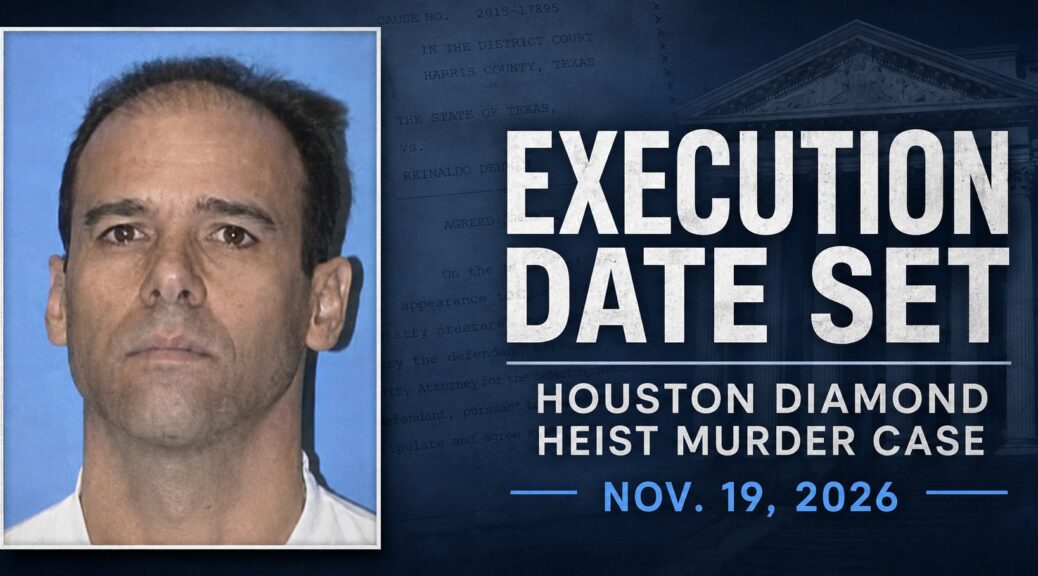
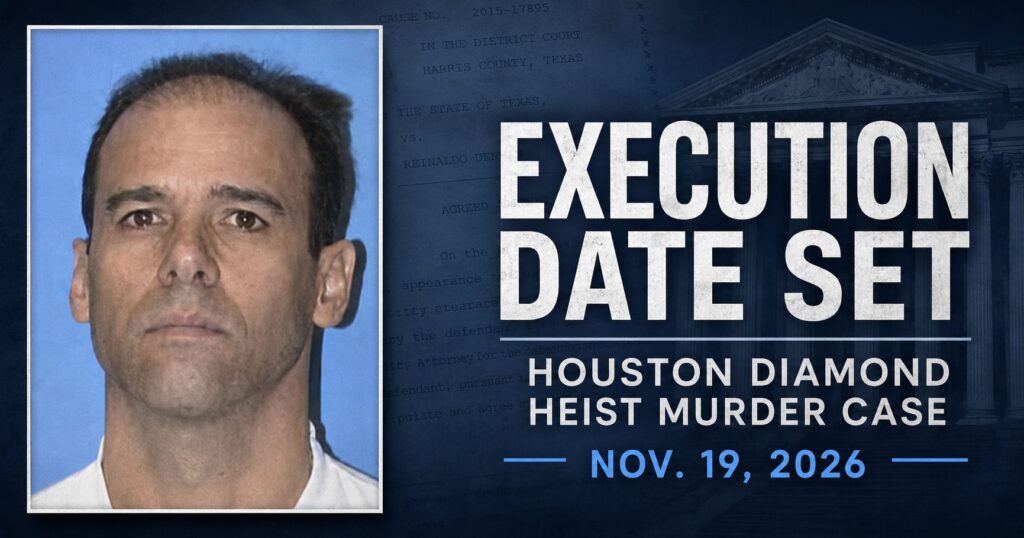
Houston death row inmate set for November execution after $3.5 million diamond heist
By Investigative Reporter Tammy Rose
A Houston capital murder case that began with a multimillion-dollar diamond heist nearly 30 years ago is moving toward an execution.
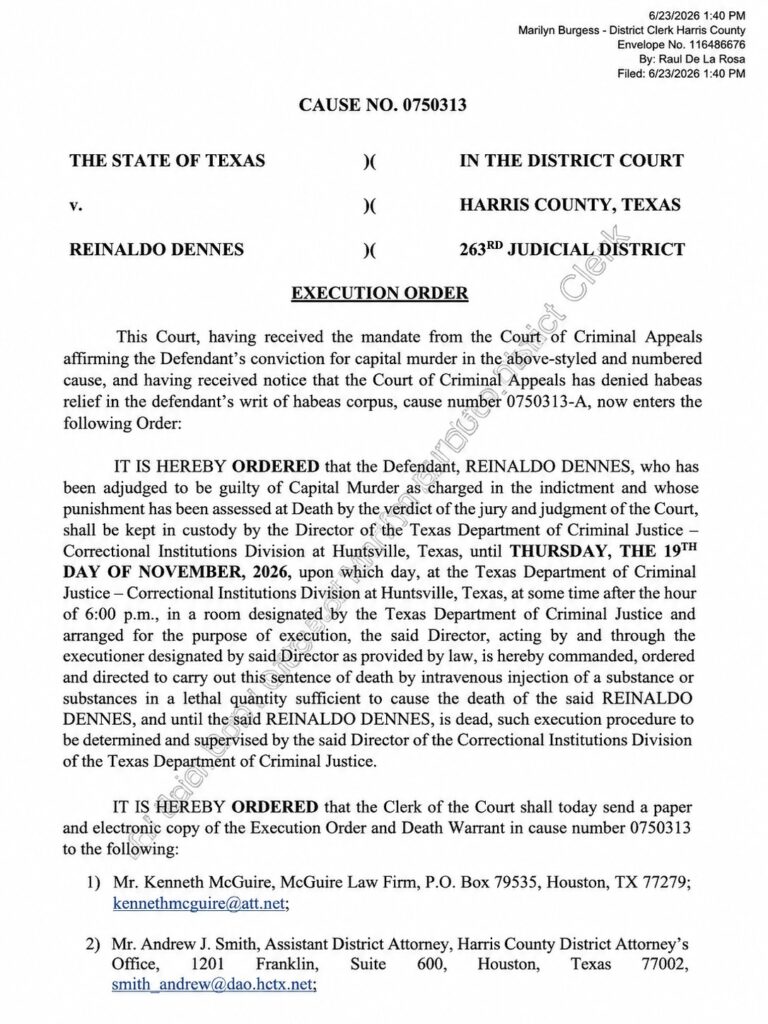
Harris County court records show Reinaldo Dennes now faces execution on Nov. 19, 2026, at the Huntsville Unit.
The case dates back to Jan. 24, 1996. Prosecutors said Dennes helped carry out a robbery that left Houston jeweler Janos “Johnny” Szucs dead and security guard David Copeland seriously wounded.
The thieves took more than $3.5 million in diamonds and about $200,000 in cash, according to court records.
The diamonds have never been recovered.
Harris County records show execution date
A Harris County court filing lists Nov. 19, 2026, as the execution date for Reinaldo Dennes. Source: Harris County District Clerk.
Court records show prosecutors filed a proposed execution order, death warrant and notice on June 23, 2026.
Those documents listed Nov. 19 as the proposed execution date.
However, the copies filed in June did not contain the judge’s signature.
The Harris County docket later recorded new activity on Aug. 14. Those entries included an execution order, a death warrant and an execution date of Nov. 19, 2026.
The order directs the Texas Department of Criminal Justice to carry out the execution sometime after 6 p.m. in Huntsville.
Dennes has remained eligible for execution since December 2020, according to the state’s filing.
Prosecutors say robbery involved months of planning
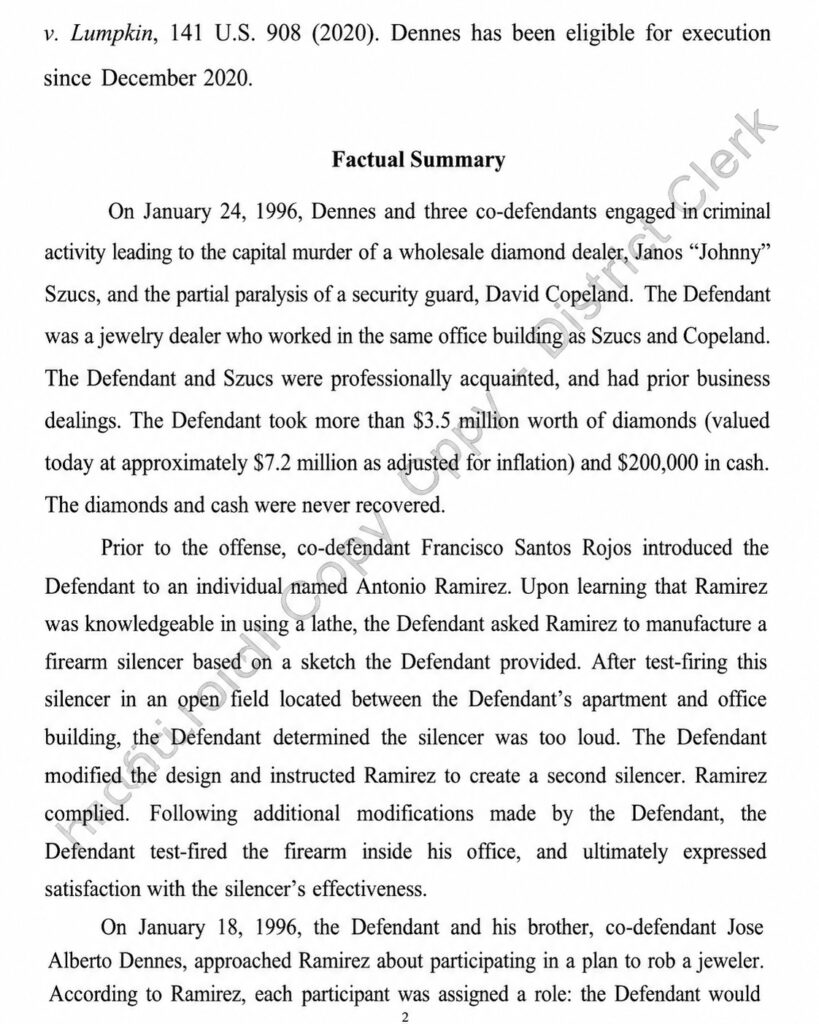
A Harris County court filing says more than $3.5 million in diamonds and $200,000 in cash were taken during the 1996 robbery. The filing also describes alleged planning involving a firearm silencer. Source: Harris County District Clerk
The court filing describes a detailed plan that started before the January 1996 robbery.
Prosecutors said Dennes knew Szucs through previous business dealings. Dennes also worked as a jewelry dealer in the same office building as Szucs and Copeland.
According to the filing, co-defendant Francisco Santos Rojos introduced Dennes to Antonio Ramirez.
Prosecutors said Dennes asked Ramirez to build a firearm silencer from a sketch.
Ramirez built the device and later modified it after Dennes complained that it made too much noise, according to the filing.
Court records say Dennes eventually tested the silencer inside his office.
Witness backed out before robbery
The filing says Dennes and his brother, Jose Alberto Dennes, approached Ramirez on Jan. 18, 1996.
Prosecutors said they asked Ramirez to participate in the robbery.
According to the filing, Dennes planned to obtain the surveillance tapes. Ramirez would take the diamonds. Jose Alberto Dennes would shoot the jeweler.
Ramirez realized why Dennes wanted the silencer and asked him to return it, according to the court record.
Dennes refused.
Ramirez later traveled to Ecuador and was outside the country when the robbery happened.
Neither the firearm nor the silencer was ever recovered, according to prosecutors.
Cleaning employee helped provide access
Court records also identify Estrella Martinez as a cleaning employee at the office building.
Prosecutors said Martinez had a romantic relationship with Dennes.
The filing says Martinez agreed to allow Dennes and his brother into the building through a loading dock entrance after business hours.
Dennes bought Martinez a cell phone so he could tell her when to open the door and when to distract the security guard, prosecutors said.
The filing says Dennes warned Martinez that he would have to shoot the guard if she failed to distract him.
Prosecutors said Dennes postponed the robbery for two days before moving forward on the third day.
Security guard survived shooting
Security guard David Copeland later testified about the attack.
According to the filing, Dennes approached Copeland and told him, “I have something I want to show you.”
Prosecutors said Dennes then shot Copeland in the chest.
After Copeland fell, Dennes shot him again in the back.
Copeland survived but suffered partial paralysis.
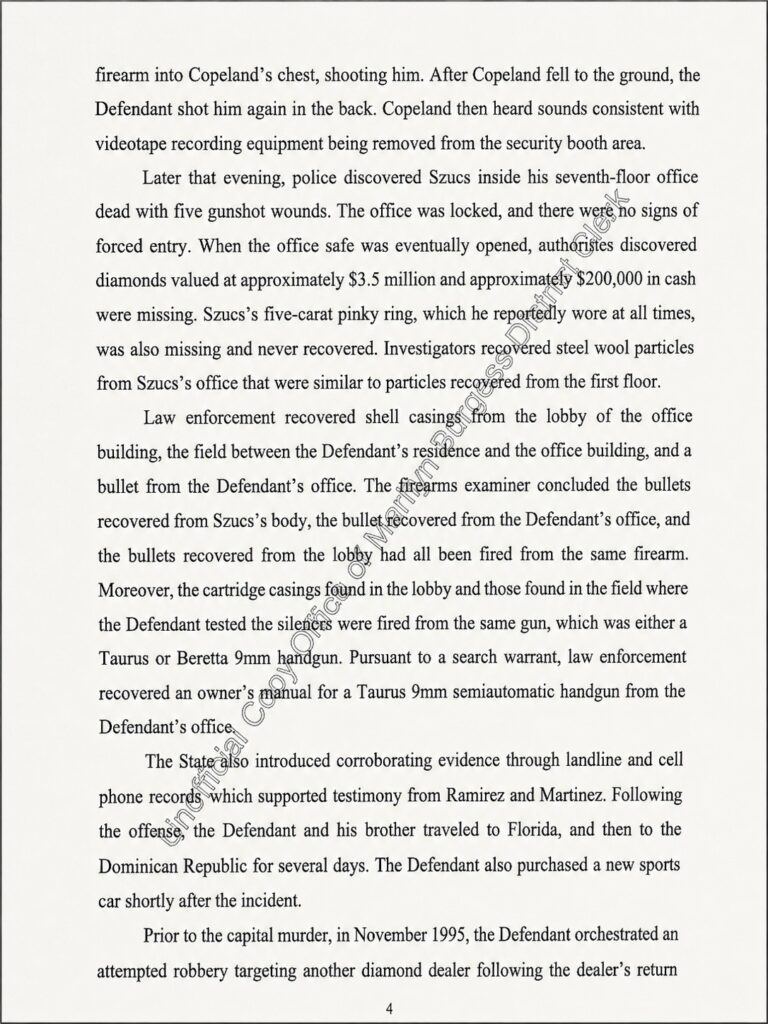
The filing says Copeland later heard sounds consistent with someone removing video recording equipment from the security booth.
Jeweler found dead with five gunshot wounds
Police later found Szucs dead inside his seventh-floor office.
Court records say he suffered five gunshot wounds.
Investigators found no signs of forced entry.
When authorities opened Szucs’ safe, they discovered the diamonds and roughly $200,000 in cash missing.
The filing also says Szucs regularly wore a five-carat pinky ring.
That ring disappeared too.
Investigators never recovered it.
Prosecutors said the stolen diamonds would equal approximately $7.2 million today when adjusted for inflation.
Ballistics evidence connected the shootings
Harris County court records say Janos Szucs was found with five gunshot wounds and that investigators linked bullets and shell casings to the same firearm. The filing also says $3.5 million in diamonds, $200,000 in cash and a five-carat pinky ring were missing. Source: Harris County District Clerk.
Investigators recovered shell casings from the building lobby, a field between Dennes’ home and the office building, and other locations.
A firearms examiner concluded that bullets recovered from Szucs, Dennes’ office and the lobby came from the same firearm, according to the filing.
The weapon was either a Taurus or Beretta 9mm handgun.
Police later searched Dennes’ office.
Officers found either a Taurus 9mm semiautomatic handgun or an owner’s manual for one, according to the court record.
Prosecutors also used landline and cell phone records to support testimony from Ramirez and Martinez.
Dennes left Texas after the killing
The filing says Dennes and his brother traveled to Florida after the crime.
They later went to the Dominican Republic for several days.
Prosecutors also said Dennes bought a new sports car shortly after the killing.
Prosecutors told jury about earlier diamond robbery plot
The court filing also describes another robbery plot from November 1995.
Prosecutors said Dennes targeted diamond courier Albert Ohayon.
Dennes allegedly knew Ohayon through previous employment and believed he would carry between $500,000 and $1 million in diamonds.
Two men recruited for the robbery entered the wrong house, according to the filing.
They invaded the home of another family instead.
The filing says the men terrorized a couple and their 9-year-old daughter for about two and a half hours before fleeing with property and the family’s vehicle.
Jury convicted Dennes of capital murder
A Harris County jury convicted Dennes of capital murder on Aug. 28, 1997.
Court records show the trial judge sentenced him to death on Sept. 4, 1997.
The Texas Court of Criminal Appeals later affirmed the conviction and sentence.
Dennes continued to challenge his conviction through state and federal courts.
The state’s 2026 filing says reviewing courts found no due process violations that blocked his execution.
Nearly $4 million in diamonds and cash still missing
The execution date closes one chapter in a case that has remained active for decades.
One mystery remains.
Investigators never recovered the more than $3.5 million in diamonds taken from Szucs’ safe.
They also never recovered his five-carat pinky ring.
Dennes is scheduled for execution on Nov. 19, 2026, in Huntsville.
If you’re traveling to Houston for court, business or a weekend visit, you can compare hotels near downtown, the Harris County Criminal Justice Center and other Houston attractions through Hotels.com.
Court records, breaking news and long reporting days mean I spend plenty of time working from my phone and laptop. I keep a few travel and reporting essentials with me, including portable chargers, phone accessories and compact gear that fits easily in my bag.
Lee Gilley remains in Italy as his extradition case faces another court hearing.
Lee Gilley Extradition Hits New Roadblock as Italian Court Questions Texas Death Penalty Guarantees
By Investigative Reporter Tammy Rose
A new ruling from Italy could delay Lee Gilley’s return to Houston.
The Turin Court of Appeal wants stronger guarantees from the United States before it decides whether to extradite Gilley.
The Italian court raised two major concerns. It wants answers about the death penalty and life without parole.
Gilley faces a capital murder charge in Harris County in connection with the death of his pregnant wife.
He remains accused and has not been convicted.
Christa Bauer Gilley, whose husband Lee Gilley is charged in connection with her 2024 death. Photo: Facebook
Italian Court Questions Death Penalty Assurances
The Turin Court of Appeal issued its order on July 17, 2026.
An Italian legal publication released details of that order on Aug. 12.
The court reviewed information connected to the Harris County District Attorney’s Office.
According to the Italian court’s order, Harris County prosecutors indicated that they had not requested the death penalty.
However, the Italian judges found that statement did not clearly rule out a future request.
That distinction matters in Italy.
Italian law does not allow extradition when a person could face the death penalty without firm guarantees that prosecutors will not seek or carry it out.
The Turin court now wants additional assurances from the U.S. government.
Life Without Parole Also Raises Questions
The Italian judges also raised concerns about a possible sentence of life without parole.
The court reviewed European human rights standards that address whether a life sentence must include some meaningful chance for review.
The judges want more information about what options Gilley could have if a Texas court sentenced him to life without parole.
The extradition case remains unresolved while Italy waits for those answers.
Harris County Court Records Show Bond Revoked
Lee Gilley is charged in Harris County in connection with the death of his pregnant wife. He remains in Italy while extradition proceedings continue.
A review of Harris County District Clerk records shows major changes in Gilley’s Texas case after he left the country.
The records show that Gilley originally posted a $1 million bond in October 2024.
The court required GPS monitoring before his release.
Court records also show that Gilley surrendered his passport on Oct. 22, 2024.
Judges continued to impose pretrial supervision and bond conditions during 2025 and early 2026.
Judge Granted Emergency Travel Request
The Harris County docket shows another important development on April 1, 2026.
The court granted an emergency request to travel.
The docket does not explain the full terms of that order on the public activity page.
Public reporting later showed that Gilley traveled through Canada before reaching Italy.
Authorities allege he used false Belgian travel documents while traveling to Milan.
Italian authorities detained him after discovering problems with those documents.
Bond Revoked and Capias Issued
The Harris County case changed quickly after Gilley left the United States.
Court records show a May 5, 2026 motion hearing with the result:
An alias capias directs authorities to take a defendant into custody.
“Bond Revoked Alias Capias Issued.”
The docket also shows bond denied entries on May 4 and May 8.
The current case summary lists Gilley as not in custody in Harris County.
It also shows his bond as denied.
Gilley Missed Houston Court Settings
Christa Bauer Gilley and Lee Gilley on their wedding day. Photo: Facebook
Court records show Gilley missed several settings after his departure.
The docket lists him as absent from a May 21 status conference.
It also lists him as absent from a June 5 status conference.
The court reset that hearing for Sept. 15.
On July 29, attorneys filed a motion for a show cause hearing.
The court held that hearing on Aug. 3.
The docket again lists Gilley as absent.
Next Harris County Hearing Set for September
Gilley’s next Harris County setting is scheduled for:
Sept. 15, 2026 at 9 a.m.
The docket identifies the hearing as a status conference in the 497th District Court.
Judge Peyton Peebles currently presides over the case.
Gilley’s capital murder case remains active.
What Happens Next in Italy?
The biggest question now sits with the United States.
The Turin Court of Appeal wants clear guarantees about the punishment Gilley could face in Texas.
The court specifically wants clarity on the death penalty.
It also wants answers about life without parole.
Until those questions receive satisfactory answers, Italy could delay a final extradition decision.
That leaves Gilley’s Harris County prosecution in limbo as his next Texas court date approaches.
Lee Gilley Case Timeline
Christa Bauer Gilley and Lee Gilley on their wedding day. Photo: Facebook
Oct. 2024: Harris County files the capital murder case.
Oct. 2024: Gilley posts a $1 million bond and surrenders his passport.
April 1, 2026: Court grants an emergency request to travel.
May 2026: Gilley leaves the United States and later reaches Italy.
Soon after, on May 5, 2026: Harris County court records show his bond revoked and an alias capias issued.
Three days later, on May 8, 2026: Court records show bond denied.
July 17, 2026: Turin Court of Appeal issues an order seeking additional U.S. assurances.
July 29, 2026: Motion for show cause hearing filed in Harris County.
Aug. 3, 2026: Show cause hearing held. Docket lists Gilley as absent.
Aug. 12, 2026: Italian legal publication releases details of the Turin court order.
Sept. 15, 2026: Next Harris County status conference scheduled.
The Bottom Line
Lee Gilley’s extradition now depends on more than whether Italy believes Texas has a valid criminal case.
Italian judges want firm assurances about what could happen if Gilley returns to Houston and receives a conviction.
The death penalty remains the biggest issue.
The Harris County docket also shows that Gilley’s legal situation changed sharply after he left the country.
His bond is now denied. A capias remains tied to the case. His next Houston court date is Sept. 15.
The Italian extradition fight could determine when, or whether, he returns to Harris County to face the capital murder charge.
If the Lee Gilley case has you following developments in Italy, you may also be planning a trip there yourself. I’ll be traveling to Italy soon, with stops in Rome and Sardinia. If you’re planning your own visit, you can compare hotels, locations and prices on Hotels.com before you book.
I may earn a commission if you book through my link, at no extra cost to you.
For long travel days, I like to keep things simple and comfortable. I look for lightweight gear, a good backpack, comfortable walking shoes and other travel essentials that are easy to carry through airports and around cities.
You can shop some of the travel gear I use on Amazon.
As an Amazon Associate, I may earn from qualifying purchases at no extra cost to you.
Mitchell Wasek faces felony charges in Travis County as his defense challenges evidence and seeks dismissal of the indictment.
Buc-ee’s Co-Founder’s Son Fights Felony Case as New Court Hearing Nears
By Investigative Reporter Tammy Rose
The criminal case against the son of a Buc-ee’s co-founder is heading back to court.
Mitchell Wasek now wants a judge to suppress evidence in his felony child pornography case. His defense also wants the indictment dismissed.
Court records reviewed by Investigative Reporter Tammy Rose show a pretrial hearing set for August 18, 2026, at 1:15 p.m. in Travis County’s 167th District Court.
The latest filings reveal a significant new legal fight.
Mitchell Wasek Case Update: Defense Challenges Evidence
Wasek faces a felony charge of possession of child pornography in Travis County.
The current court docket lists the offense as a second-degree felony.
His attorney filed a motion to suppress on April 14, 2026.
The docket describes the filing as a:
“Motion to suppress evidence obtained by theft and breach of computer security.”
The wording raises a major question.
What evidence does the defense want thrown out, and how was it obtained?
The court docket does not answer that question by itself.
The actual motion could provide those details.
Defense Also Wants Indictment Dismissed
Another filing could have an even bigger impact on the case.
On June 2, 2026, Wasek’s defense filed a motion asking the court to dismiss the indictment.
The stated reason:
An expired statute of limitations.
The judge has not dismissed the case based on the docket reviewed for this report.
The State also requested several subpoenas that same day.
One went to Detective Keith McManus.
Court records show that subpoena was executed on June 5.
Pretrial Hearing Set for August 18
The next scheduled hearing could determine what happens with those defense challenges.
The Travis County Odyssey Portal lists a:
Pretrial Hearing August 18, 2026 1:15 p.m. 167th District Court
The hearing could bring new arguments over the evidence and the defense request to dismiss the indictment.
It could also provide the clearest update yet on where the case stands.
Wasek Also Faces 21 Invasive Recording Counts
Mitchell Wasek faces felony charges in Travis County as his defense seeks to suppress evidence and dismiss the indictment.
The child pornography case came after an earlier investigation involving allegations of secret recordings.
The Travis County District Attorney’s Office announced in May 2024 that a grand jury returned six indictments against Wasek.
Those indictments contained 21 counts of invasive visual recording involving 13 alleged victims.
Prosecutors said the alleged recordings occurred over roughly two years in Travis County.
Those cases also remain listed in Travis County court records.
Wasek has not been convicted of the allegations discussed in this report. He remains presumed innocent unless proven guilty in court.
Why the Buc-ee’s Name Draws Attention
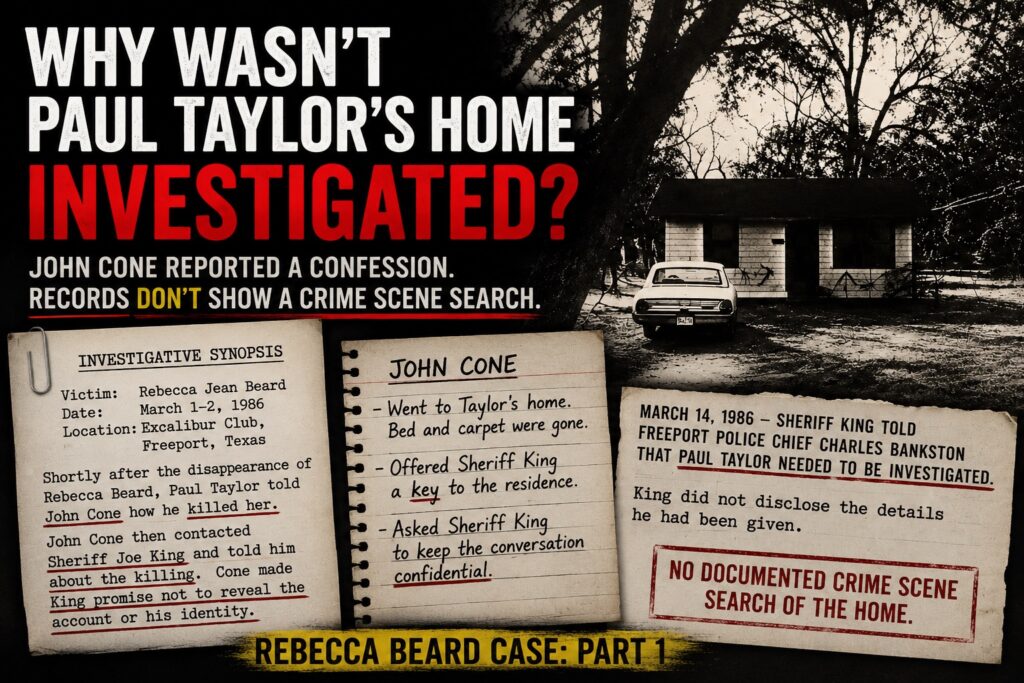
Arch Aplin remained in contact with investigators as questions continued about the Rebecca Beard case timeline.
Mitchell Wasek is the son of Buc-ee’s co-founder Don Wasek.
That connection has pushed the criminal case into headlines across Texas.
It also creates an unusual overlap with another story I have covered extensively.
Not because the criminal cases have anything to do with each other.
My reporting has also examined conflicting information in historical records about when Aplin last saw Becky and who investigators reported seeing at the Excalibur Club around the time of her disappearance.
Again, there is no known connection between Mitchell Wasek’s criminal case and Rebecca Beard’s murder case.
The common thread is that both stories involve members of the families behind one of Texas’ most recognizable brands.
Related Rebecca Beard Coverage
Exclusive: Arch Aplin Responds to Rebecca Beard Question
Nearly 40 years after Rebecca “Becky” Beard disappeared from Freeport, Texas, her family is still searching for the answer that matters most.
Where is Becky?
Rebecca “Becky” Beard disappeared in March 1986. Her family continues searching for information that could help locate her remains.
Now, her family wants the public to hear information from a woman known as “Rio.” Her account includes disturbing claims about what may have happened to Becky and where someone may have taken her remains.
However, an important warning comes with Rio’s story.
According to Becky’s family, prosecutors recently presented information involving Rio to a Brazoria County grand jury. Family members say the grand jury took no action.
Becky’s family also says the Brazoria County District Attorney’s Office told them investigators did not consider Rio a credible witness.
I am not presenting Rio’s statements as established facts.
Still, Becky’s family believes parts of her account could contain accurate information. They hope releasing these details reaches someone who knows what happened or where to find Becky.
Who Was Rebecca “Becky” Beard?
Rebecca “Becky” Beard pictured with her daughter before Becky disappeared from Freeport, Texas, in March 1986.
Becky Beard was 22 years old when she disappeared after spending the night at the Excalibur Club in Freeport on March 1, 1986.
She never came home.
Investigators have never recovered her body.
Years later, Paul Taylor Jr. pleaded guilty in connection with Becky’s death. Despite that conviction, her family has spent decades trying to find her remains.
That search continues today.
Who Is the Witness Known as Rio?
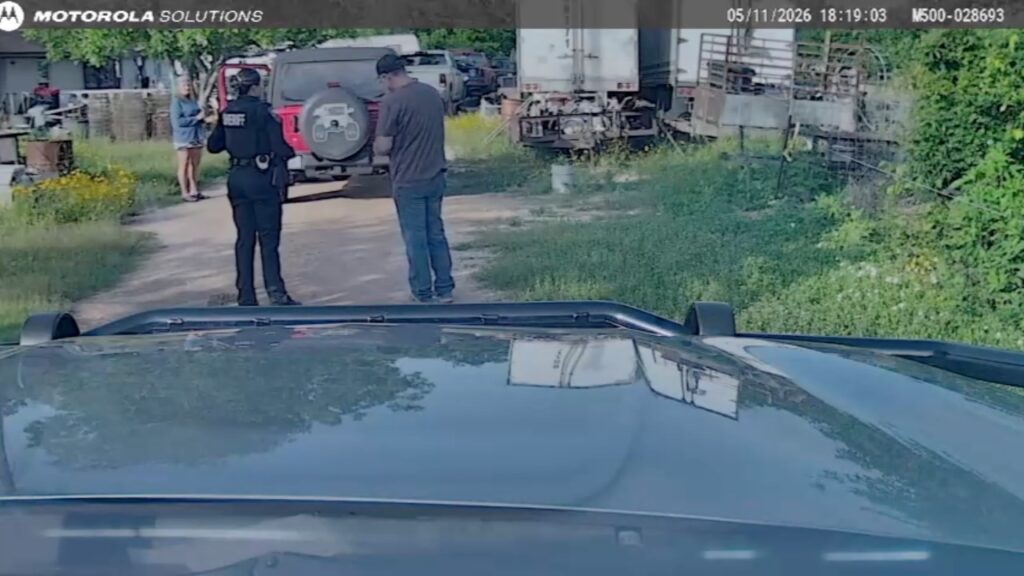
Cherie “Rio” Starr stands near Tammy Rose’s Jeep during an interview connected to the Rebecca “Becky” Beard investigation.
During my investigation, I tracked down Cherie “Rio” Starr, a woman who has provided an account of events surrounding Becky’s disappearance.
Rio made several specific and disturbing claims. Some involve what allegedly happened to Becky’s body and where people may have taken her remains.
Investigators have not established those claims as fact.
According to Becky’s family, the district attorney told them authorities did not find Rio credible.
Still, one reason the family has not completely dismissed her story is that some details appear to connect with information they already knew about Becky’s life before she disappeared.
The Galveston Weekend in Becky’s Planner
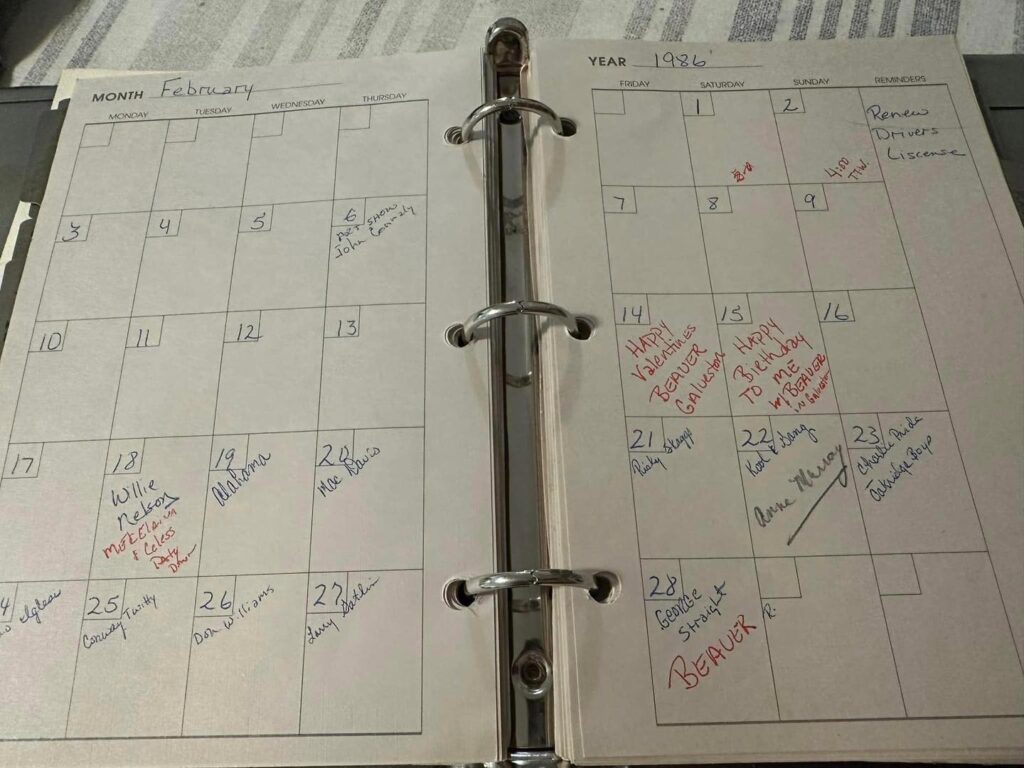
Becky Beard’s personal planner contains entries documenting events and trips in the weeks before her March 1986 disappearance.
One detail deserves closer examination.
Becky kept a planner. An entry documents a weekend trip to Galveston from February 14 through February 16, 1986, just weeks before she disappeared.
Becky was dating Beaver Aplin at the time.
Rio described an incident involving Aplin during which she said he got down on his knees with a dozen roses, jewelry and bottles.
That detail caught the family’s attention because Becky’s mother, Linda Barnes, already knew about Becky’s Galveston weekend.
Linda recalled Becky returning from the trip and throwing away roses.
Her mother asked her why she was throwing them away.
According to Linda, Becky did not want to talk about it.
That does not prove Rio’s account.
It does, however, raise a question for the family: How much of Rio’s story, if any, could be independently verified?
Becky’s planner documents the Galveston weekend. Her mother remembers the roses. Rio later provided an account involving roses and the man Becky was dating.
The family believes those details are worth examining rather than ignoring.
Family Says Evidence Was Presented to a Grand Jury
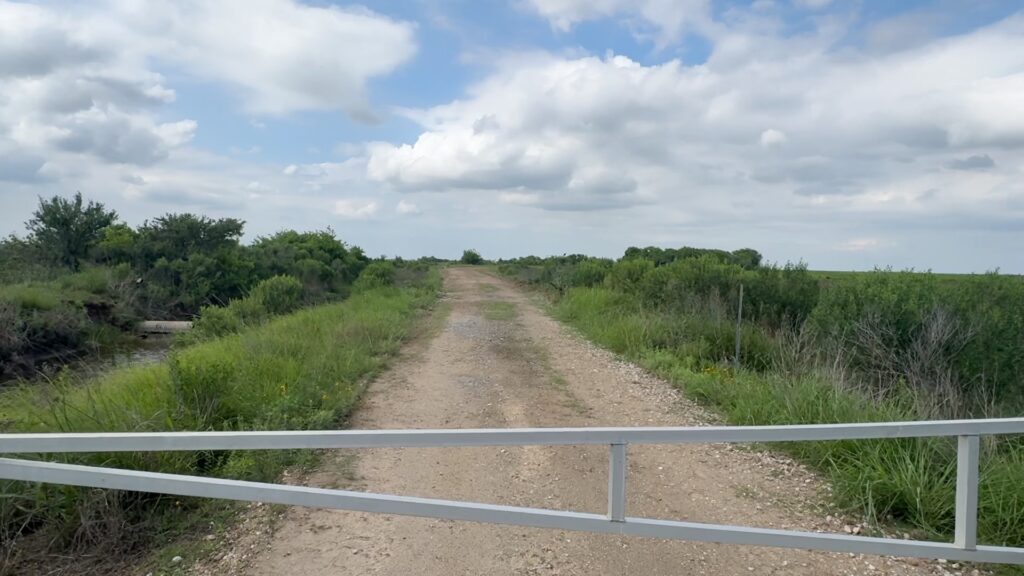
A remote dirt road in the Brazoria National Wildlife Refuge near the area where witness Cherie Lynette “Rio” Starr claims Rebecca “Becky” Beard was buried.
Becky’s family says prosecutors recently presented evidence involving Rio to a Brazoria County grand jury.
According to family members, the grand jury took no action.
They also say the district attorney told them authorities did not consider Rio a credible witness.
Those details matter.
Rio’s claims are not established facts.
I am not presenting them as proof of what happened to Becky.
Instead, the family wants to know whether someone else can independently confirm any part of her account.
Why Release Rio’s Story?
There is a simple reason.
Becky still has not been found.
Almost four decades have passed since she disappeared. People who were young adults in 1986 are now much older. Some witnesses have died. Properties have changed. Memories have faded.
That makes information from people who were there increasingly important.
The family understands authorities have questioned Rio’s credibility. They also understand that a grand jury took no action after hearing information related to her account, according to what family members say they were told.
Still, they cannot get past the possibility that one detail could be true even if other parts of a witness’s story are not.
The Galveston weekend is one reason they continue asking questions.
Someone May Remember Something
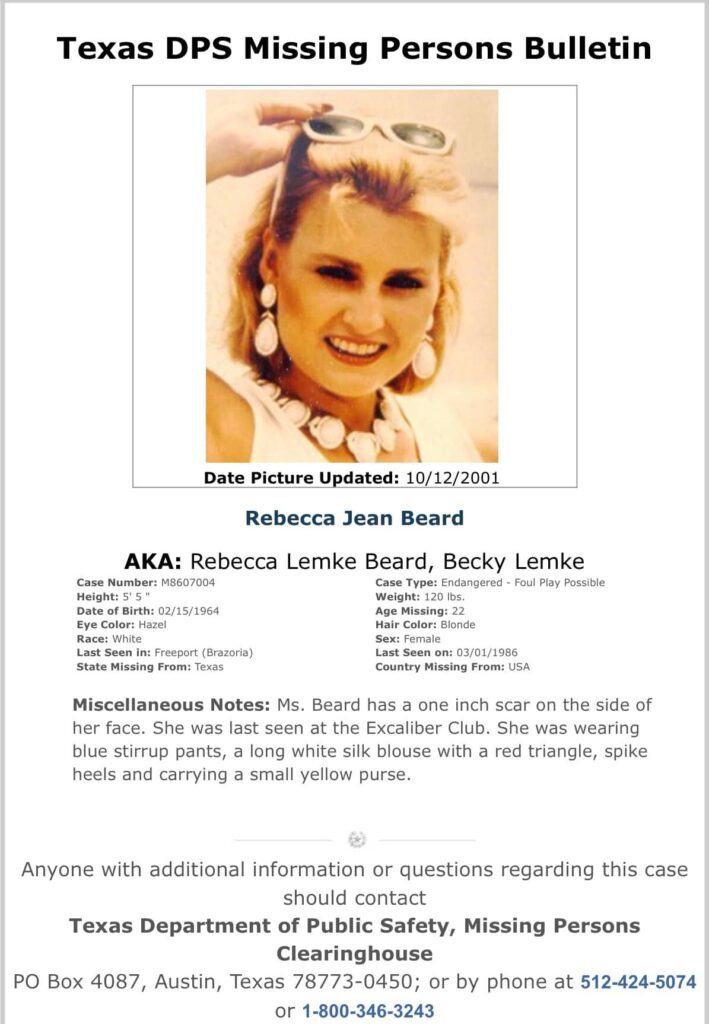
Texas Department of Public Safety missing person bulletin for Rebecca “Becky” Beard, who disappeared in 1986.
Maybe you were at the Excalibur Club.
Maybe you knew Becky, Paul Taylor Jr., Beaver Aplin or Rio.
Maybe you remember the Galveston weekend in February 1986.
Maybe you heard a conversation afterward.
Or perhaps you know something about a location connected to the case.
The family isn’t asking people to speculate. They are looking for firsthand information that can be independently checked.
If you know something, even if it seemed insignificant at the time, consider coming forward.
After nearly 40 years, Becky’s family isn’t looking for rumors.
They are looking for Becky.
Carol Mize shows areas she has searched while continuing to look for answers in the 1986 disappearance of her sister, Rebecca “Becky” Beard.
This article is part of my continuing independent investigation into the disappearance and death of Rebecca “Becky” Beard. Statements attributed to witnesses represent their accounts unless independently corroborated. The inclusion of any person’s name does not imply criminal conduct or involvement in Becky’s death.
Former Brazoria County Sheriff’s Deputy Kevin Daniel Tippit was arrested by Texas Rangers on August 11, 2026, in connection with the fatal shooting of 18-year-old John Gabriel Mendoza Jr. Photo credit: Brazoria County Sheriff’s Office.
Former Brazoria County Deputy Kevin Tippit Indicted in Fatal Shooting of 18-Year-Old
By Investigative Reporter Tammy Rose
Former Brazoria County Sheriff’s Deputy Kevin Daniel Tippit now faces a first-degree felony charge and the possibility of decades in prison following the fatal shooting of 18-year-old John Gabriel Mendoza Jr.
A Brazoria County grand jury indicted Tippit on aggravated assault by a public servant in connection with the June 1, 2026 shooting in Lake Jackson, according to the Brazoria County District Attorney’s Office. Texas Rangers arrested Tippit Tuesday, August 11.
Brazoria County jail records list his bond at $250,000.
If convicted as charged, Tippit faces five to 99 years or life in prison, according to the district attorney’s office.
Pursuit Ends at John Mendoza Jr.’s Home
The Lake Jackson home where John Gabriel Mendoza Jr., 18, was fatally shot on June 1, 2026, after a pursuit ended at the residence. Photo by Investigative Reporter Tammy Rose.
The shooting happened early June 1 after Tippit attempted to stop Mendoza while he was driving in Lake Jackson.
Mendoza did not immediately stop and instead drove to his father’s home in the 100 block of Indian Warrior Trail. The pursuit ended at the home, where Tippit encountered Mendoza near or inside the garage and fired his weapon. Mendoza later died from his injuries.
Mendoza was a Texas State University student who had just completed his freshman year and was home for the summer.
Grand Jury Indicts Kevin Tippit
The indictment marks a major development in the Texas Rangers’ investigation into Mendoza’s death.
Court documents allege Tippit recklessly caused serious bodily injury to Mendoza by shooting him.
That wording is significant because the charge focuses on Tippit’s alleged reckless conduct. A grand jury indictment means jurors found sufficient probable cause for the criminal case to proceed. It does not establish guilt.
Tippit remains innocent unless a court finds him guilty.
Shooting Came Within Seconds of Deputy’s Arrival, Family Attorney Says
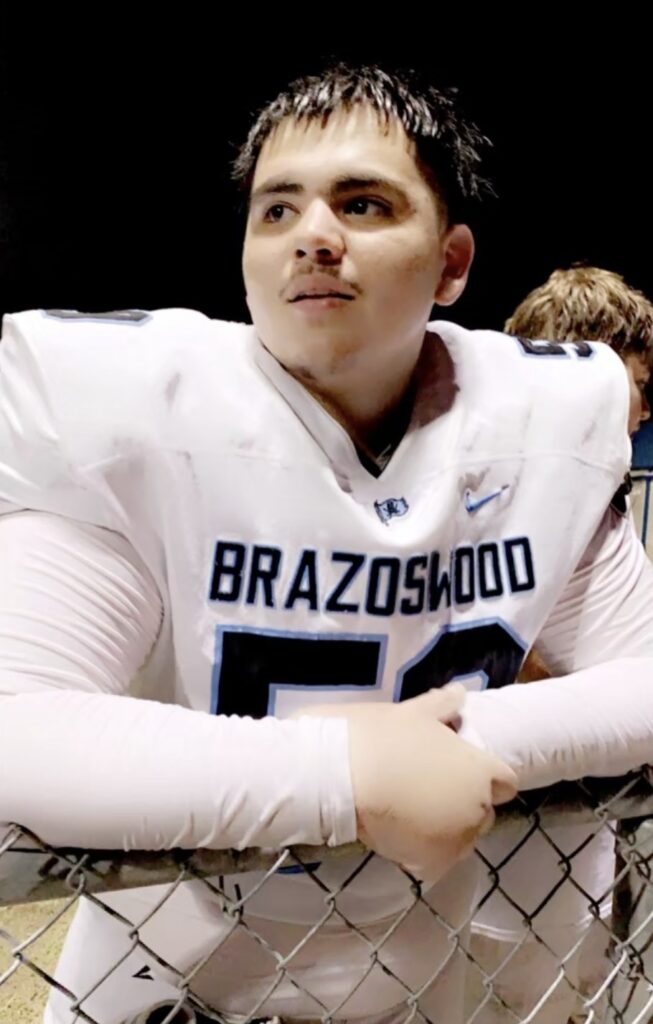
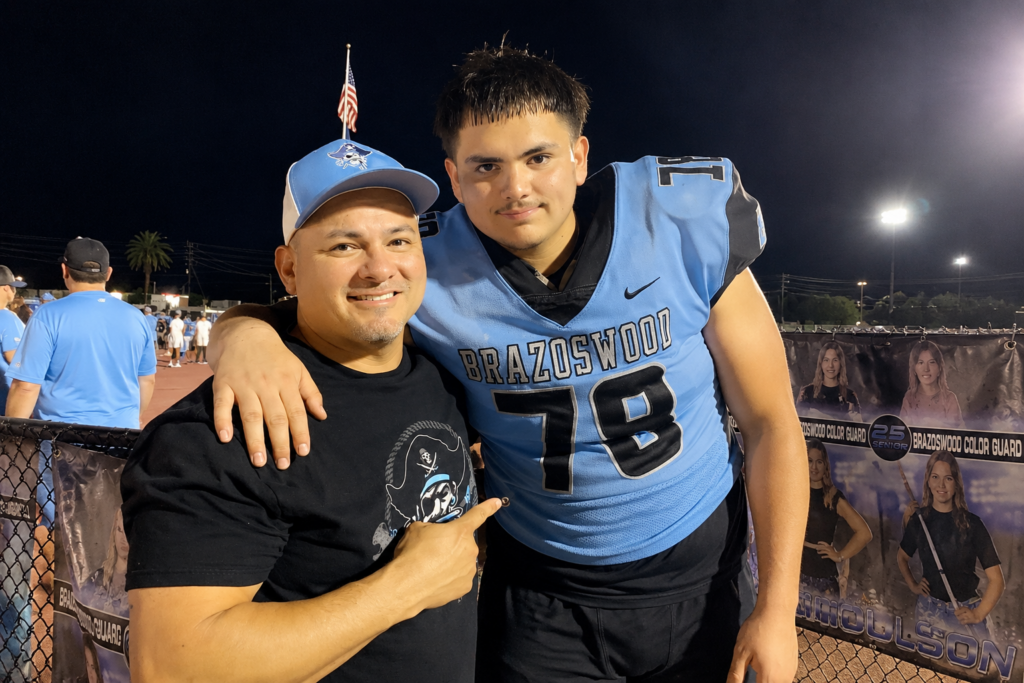
John Gabriel Mendoza Jr., 18, pictured in a Brazoswood football uniform. Mendoza was fatally shot on June 1, 2026, after a pursuit ended at his family’s Lake Jackson home. Photo courtesy of the Mendoza family.
Attorney Charles Adams, who represents Mendoza’s family, has said surveillance video shows Tippit fired within seconds of getting out of his patrol vehicle.
Adams has also said Mendoza and the other occupants were unarmed. Those details came from the family’s attorney and should not be confused with an official finding by investigators.
The Texas Rangers later obtained a search warrant as they investigated the shooting. Court documents showed investigators were examining several possible offenses, including manslaughter, criminally negligent homicide and aggravated assault by a public servant.
Brazoria County Sheriff Fired Kevin Tippit
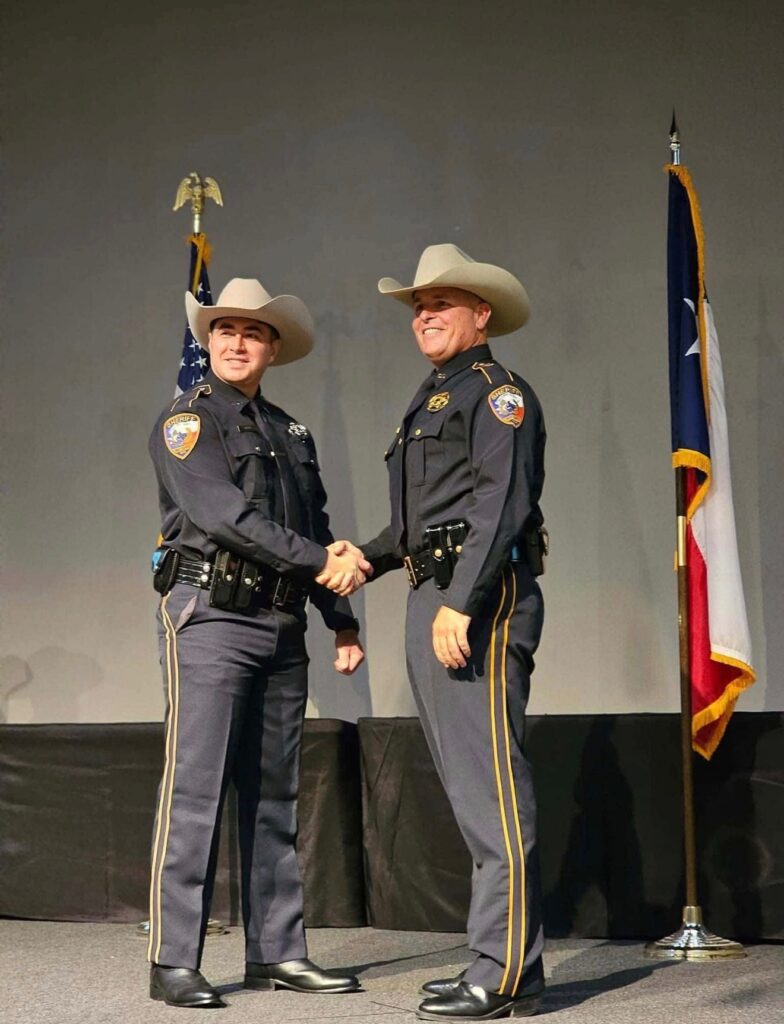
Former Brazoria County Sheriff’s Deputy Kevin Tippit, left, pictured with Brazoria County Sheriff Bo Stallman during a department ceremony. Tippit was later fired following the fatal shooting of 18-year-old John Gabriel Mendoza Jr. in Lake Jackson.
Eight days after the shooting, Brazoria County Sheriff Bo Stallman fired Tippit on June 9, 2026.
Stallman said an internal investigation found Tippit violated department policies involving the handling and discharge of his firearm.
The sheriff stressed that Tippit’s termination was an administrative decision separate from the criminal investigation being conducted by the Texas Rangers and Brazoria County District Attorney’s Office.
Tippit had served as a Brazoria County deputy since July 2024 after previously working as a jailer.
Kevin Tippit Faces Up to Life in Prison
Former Brazoria County Sheriff’s Deputy Kevin Daniel Tippit was arrested by Texas Rangers on August 11, 2026, in connection with the fatal shooting of 18-year-old John Gabriel Mendoza Jr. Photo credit: Brazoria County Sheriff’s Office.
The charge carries potentially severe consequences.
The Brazoria County District Attorney’s Office says aggravated assault by a public servant in this case constitutes a first-degree felony.
If convicted, Tippit could receive a sentence ranging from five to 99 years or life in prison.
A conviction and sentence are not predetermined. The prosecution must prove the criminal charge in court.
John Mendoza Jr. Case Enters New Stage
The criminal charge marks a significant development in a case that has drawn attention across Brazoria County since the June shooting.
Mendoza’s family has repeatedly called for transparency and accountability while the Texas Rangers investigated what happened.
Now, more than two months after Mendoza’s death, the former deputy who fired the fatal shot is facing a first-degree felony charge.
This remains a developing story. Investigator Reporter Tammy Rose will continue following the criminal case and any new court filings or hearings involving Kevin Tippit.
As an Amazon Associate, I earn from qualifying purchases at no additional cost to you. Some travel links may also be affiliate links, which means I may earn a commission at no additional cost to you.
Former Deputy Kent McGowen Responds to Susan White 911 Call, Allegations Before 1992 Shooting
By Investigative Reporter Tammy Rose
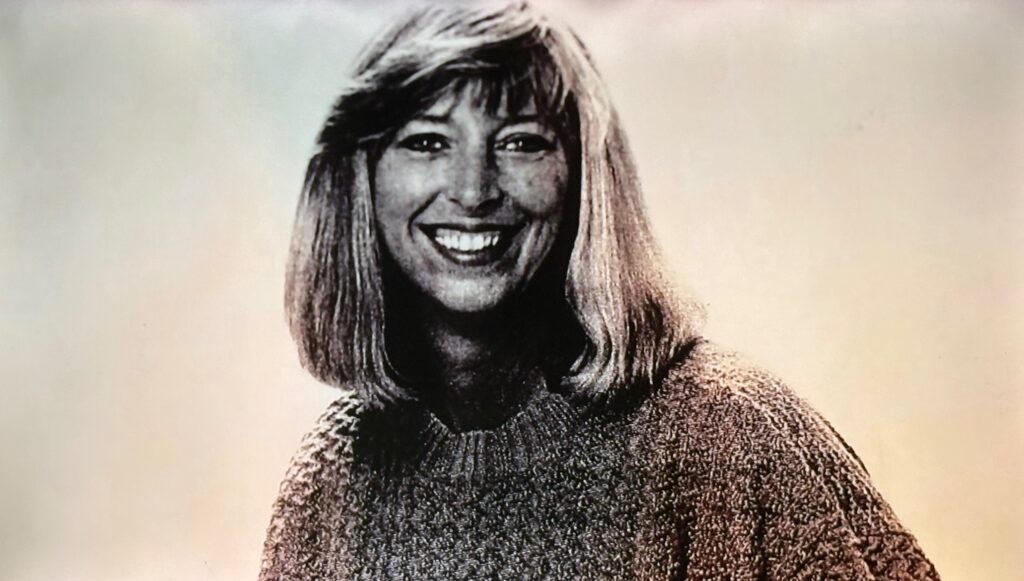
More than three decades after the fatal shooting of Susan White, former Harris County Sheriff’s Office Deputy Kent McGowen is publicly responding to allegations White made before the shooting, including claims she voiced during calls to 911.
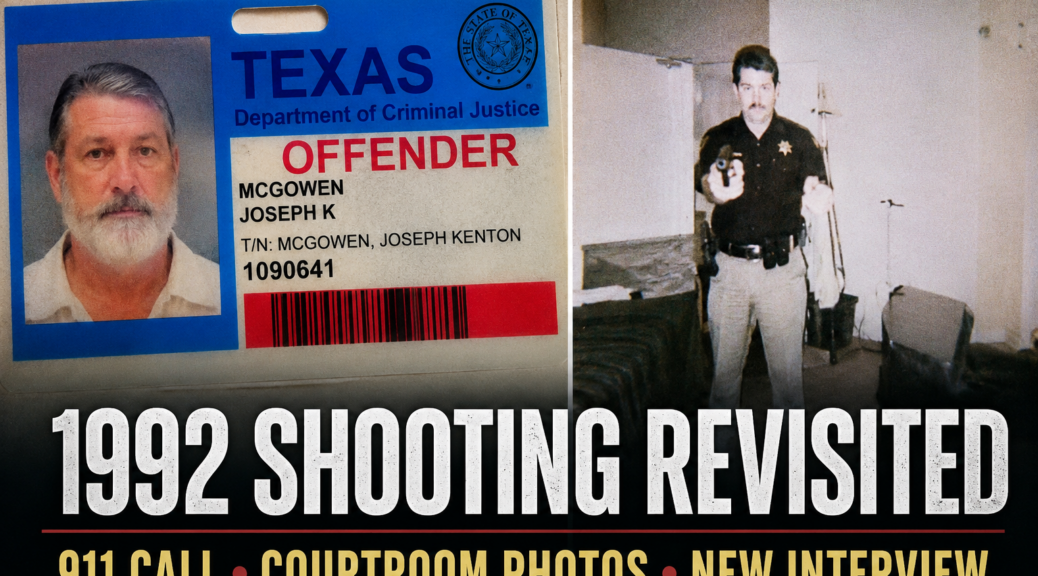
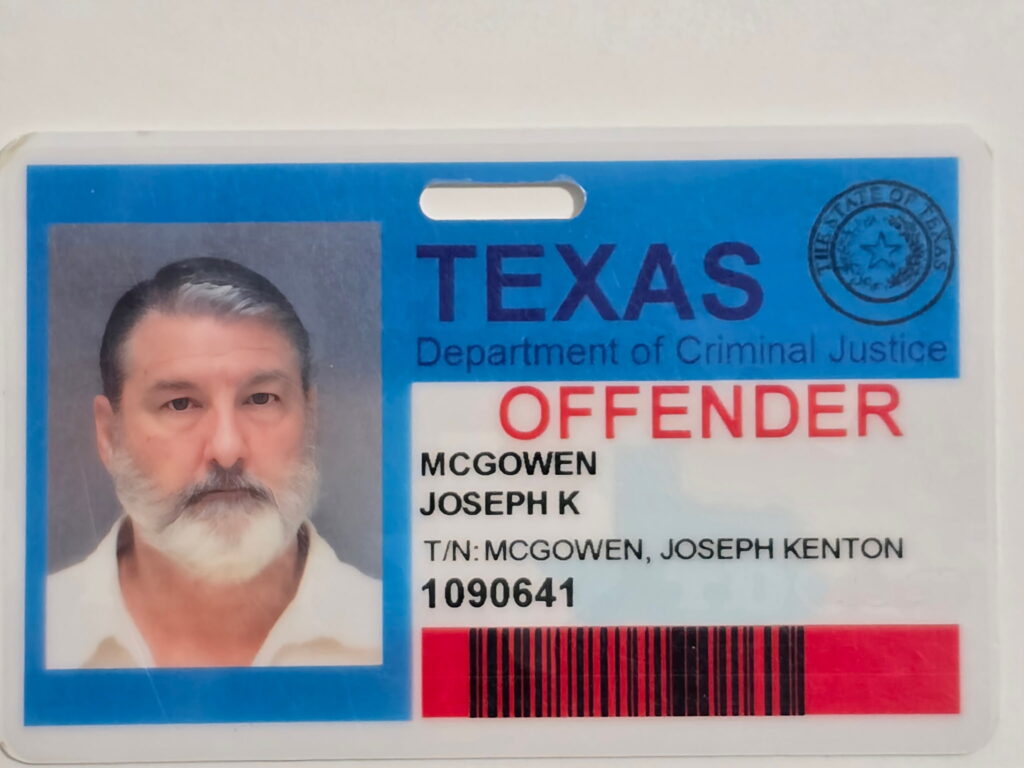
In an exclusive interview with Investigative Reporter Tammy Rose, McGowen discussed the August 25, 1992 shooting, disputed allegations that he sexually harassed White, addressed why she repeatedly mentioned his name and shared courtroom demonstration photographs that he says support his version of events.
The interview pairs portions of White’s 911 call with McGowen’s current account, allowing readers to compare both versions of events.
Viewer Note: This story contains discussion of a fatal officer-involved shooting and includes portions of a 911 call that some readers may find disturbing.
⸻
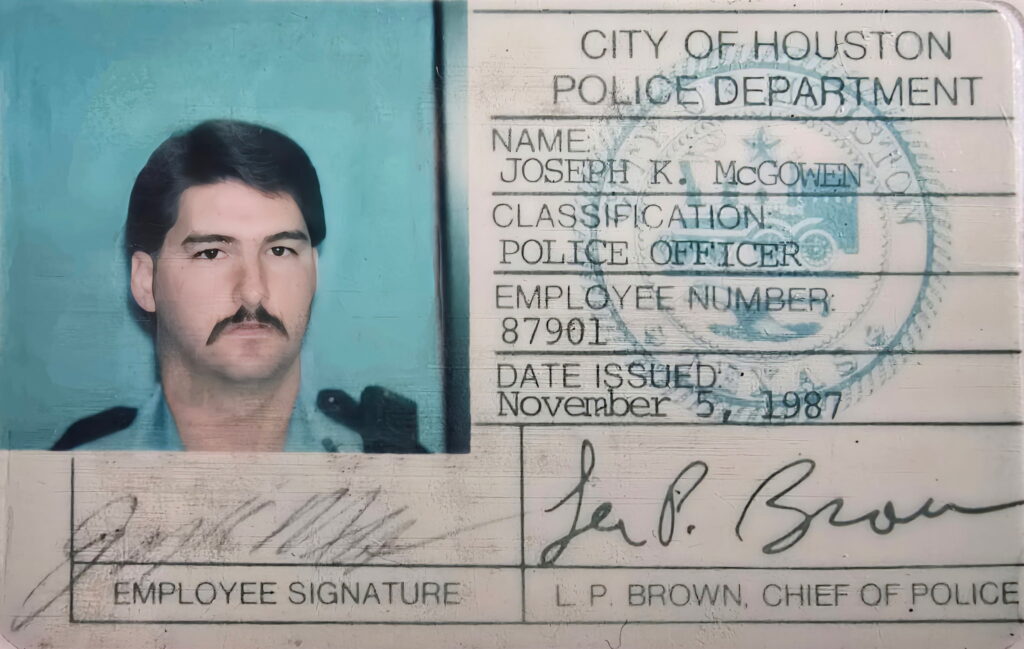
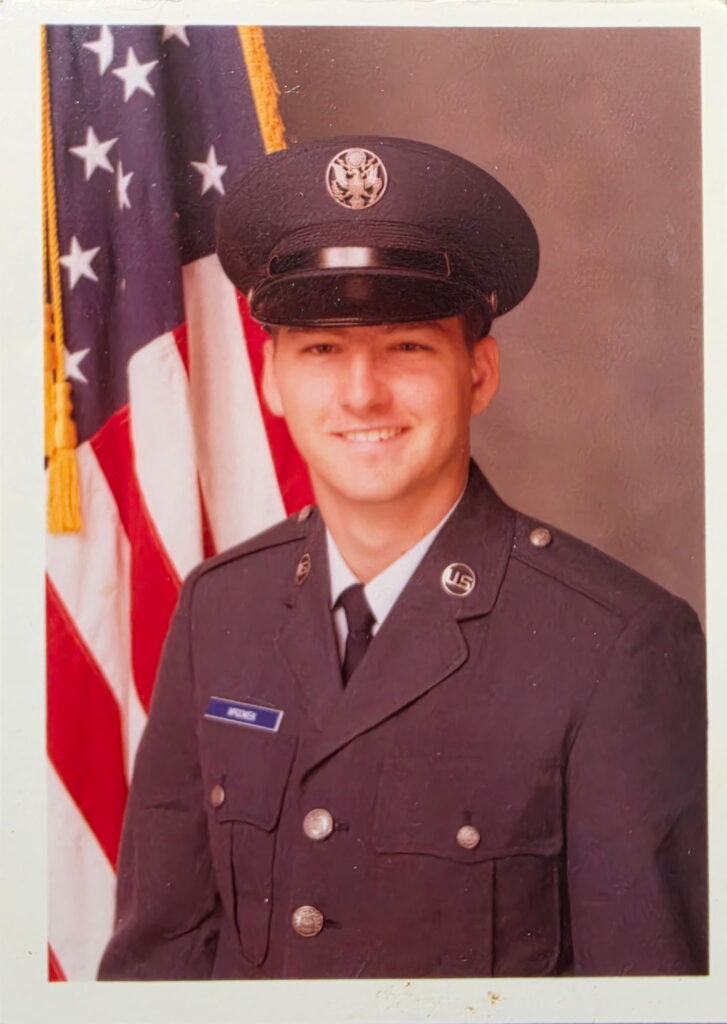
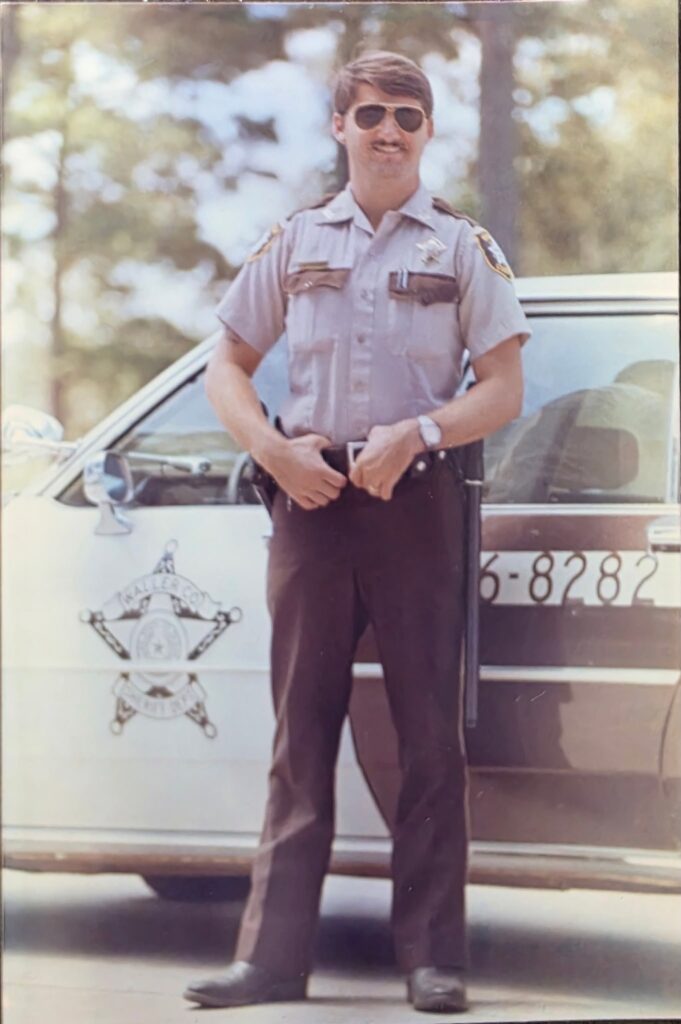
Before entering law enforcement, Kent McGowen served in the U.S. Air Force. He later worked as a Houston police officer and Harris County deputy before the Aug. 25, 1992, fatal shooting of Susan White that led to two criminal trials and his eventual conviction.
Background Before the Case
Before beginning his law enforcement career, Kent McGowen served in the United States Air Force.
After leaving the military, he joined the Houston Police Department before later serving with the Harris County Sheriff’s Office. During his career, he received commendations and officer recognition awards.
After serving in the U.S. Air Force, Kent McGowen joined the Houston Police Department before later serving with the Harris County Sheriff’s Office.
Before beginning his law enforcement career, Kent McGowen served in the United States Air Force.
After leaving the military, he joined the Houston Police Department before later serving with the Harris County Sheriff’s Office. During his career, he received commendations and officer recognition awards.
McGowen’s career changed forever on August 25, 1992, when deputies serving a felony warrant fatally shot Susan White at her home.
A jury convicted McGowen of murder in his first trial. An appellate court later overturned that conviction. A second jury convicted him in 2002. He ultimately served approximately 19 years in prison before his release in 2021.
Book About the Case
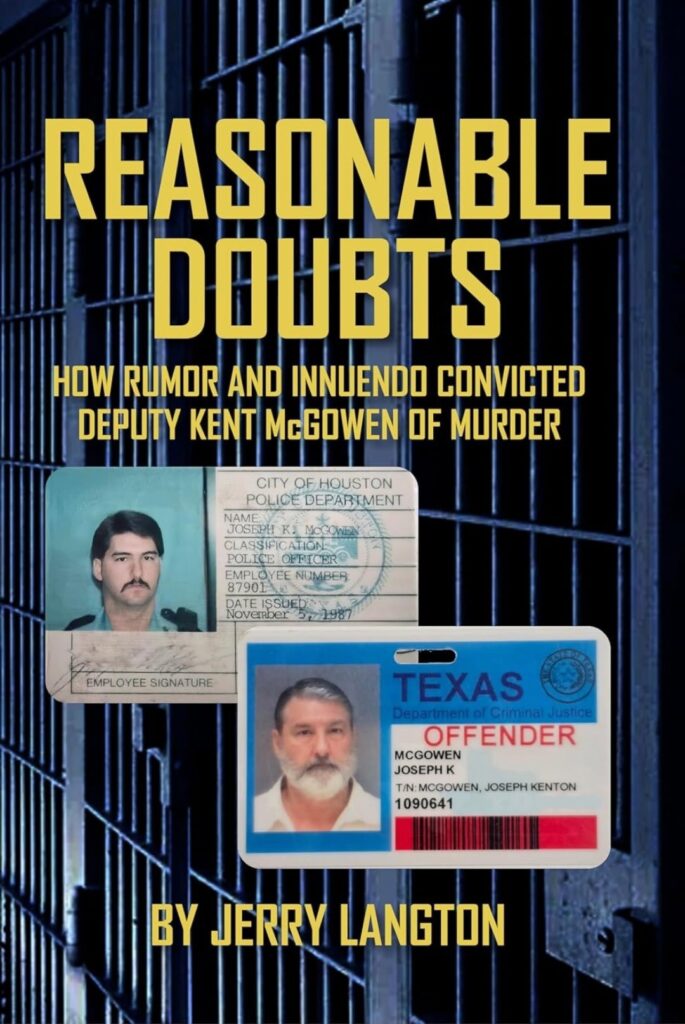
Journalist Jerry Langton later examined the case in Reasonable Doubts: How Rumor and Innuendo Convicted Deputy Kent McGowen of Murder. The book explores the investigation, the two trials and McGowen’s conviction.
In addition to the trial record, Kent McGowen has provided investigative records and expert reports that he says support his account of the shooting.
Among the records McGowen provided is a forensic review by consulting forensic scientist Dr. Edward E. Hueske.
Hueske prepared the review during McGowen’s legal proceedings.
McGowen also provided a statement he wrote at the request of Harris County Assistant District Attorney Baldwin Chin, then chief of the Harris County District Attorney’s Office Post Conviction Integrity Review Unit, during the office’s review of his case in 2011–2012.
According to McGowen, the statement summarizes the case and his account of events as they existed during the Harris County District Attorney’s Office Post Conviction Integrity Review in 2011-2012.
After two criminal trials stemming from the Aug. 25, 1992, fatal shooting of Susan White, Kent McGowen was ultimately convicted of murder. He served approximately 19 years in the Texas Department of Criminal Justice before his release in 2021.
⸻
Watch the Full Investigation
The television report below includes exclusive interview excerpts with Kent McGowen, courtroom demonstration photographs and additional background on the Susan White case.
⸻
Listen to Susan White’s 911 Call
The audio below captures one of Susan White’s calls to 911 before deputies entered her home.
During the recording, White repeatedly asks dispatchers for help and expresses fear as deputies remain outside the residence.
The call contains emotional language and may be disturbing to some listeners.
Susan White’s 911 Call Before Deputies Entered The Home
The video and audio above include one of Susan White’s 911 calls before deputies entered the home.
During the recording, White repeatedly asks dispatchers for help while describing people outside her home.
The recording contains emotional language that some listeners may find disturbing.
⸻
McGowen Strongly Disputes White’s Allegations
Kent McGowen while serving with the Waller County Sheriff’s Office at age 19, before joining the Houston Police Department pending completion of his background investigation.
During his interview with Investigative Reporter Tammy Rose, McGowen firmly denied White’s allegations.
According to McGowen, he never sexually harassed White, never stalked her and never had the repeated contacts she described.
“I had never pulled her over. I’d never spoken to her,” McGowen said during the interview.
McGowen believes White confused him with another deputy who previously worked in the area.
He told Tammy Rose that investigators later uncovered witness statements he believes support that explanation.
According to McGowen, White mistakenly identified him after seeing him during the arrest of her son and others connected to a burglary investigation.
⸻
Why Did White Know McGowen’s Name?
Susan White. Investigators and former Deputy Kent McGowen have offered differing explanations for why White repeatedly mentioned his name before the August 25, 1992, shooting.
One of the questions surrounding the case is why White repeatedly mentioned McGowen by name before the shooting.
McGowen offered his explanation during the interview.
He said White arrived at the scene after deputies arrested her son and began asking officers who “McGowen” was.
According to McGowen, several deputies pointed in different directions while trying to identify him, causing White to approach multiple officers before eventually speaking with him.
McGowen believes that encounter explains why she later knew his name.
He disputes claims that he had an ongoing personal conflict with White before the shooting.
⸻
McGowen Says White Mistook Him for Another Deputy
McGowen also challenged allegations that he repeatedly stopped or harassed White before the shooting.
Instead, he told Tammy Rose that another deputy had previous contact with White and believes she mistakenly associated him with those earlier encounters.
McGowen said he never received phone calls from White, never contacted her outside official duties and never had a personal relationship with her.
He also pointed to subpoenaed telephone records that he says failed to show communication between them.
Those statements reflect McGowen’s account. Investigative Reporter Tammy Rose continues reviewing court records, witness statements and other documents connected to the case.
⸻
McGowen’s Description of White’s Condition
McGowen also discussed White’s condition while deputies attempted to serve the warrant.
According to McGowen, White appeared to be slurring her speech as deputies tried to communicate with her through the front door.
He told Tammy Rose he believed White was impaired and described her behavior as confused and erratic.
McGowen said those observations influenced how he interpreted her actions that morning.
His statements represent his account of the encounter and should not be interpreted as independent findings of fact.
⸻
The Warrant That Led to the Shooting
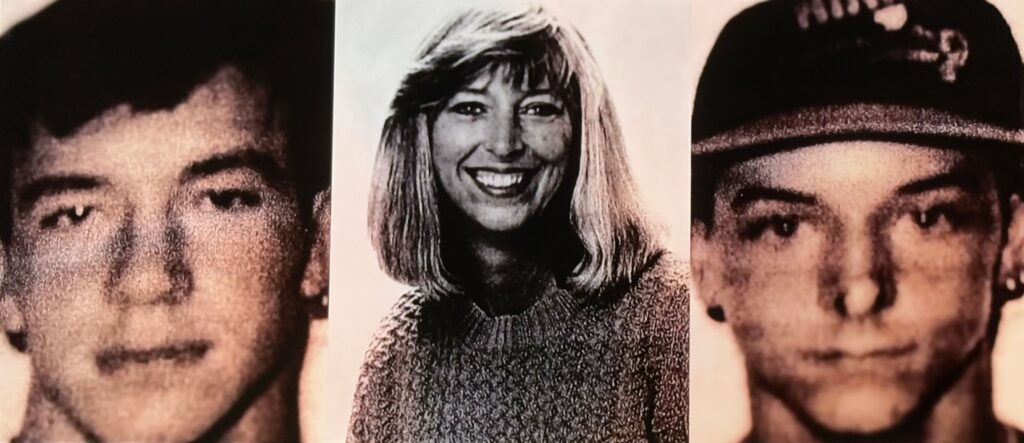
Left to right: Confidential informant Michael Shaffer, Susan White and Jason Aguillard, Susan White’s teenage son.
According to McGowen, deputies went to Susan White’s home to serve a felony retaliation warrant after investigators alleged she threatened a confidential informant connected to a burglary investigation.
McGowen said he first attempted to obtain the warrant during the overnight hours but claimed a judge was unavailable to sign it. He returned the following morning with the approved warrant and several deputies to serve it.
He told Investigative Reporter Tammy Rose that deputies knocked on the front door for several minutes, repeatedly identified themselves as members of the Harris County Sheriff’s Office and asked White to come outside.
According to McGowen, White refused to open the door.
McGowen said deputies eventually forced entry after obtaining permission from a supervisor.
⸻
McGowen Describes What Happened Inside
According to McGowen, deputies entered the home and began clearing rooms while searching for White.
He told Tammy Rose he saw White move through the house toward a bedroom. He followed her and said she picked up a handgun after entering the room.
McGowen said he ordered White three times to drop the weapon.
He claims White raised the handgun toward him and began placing her finger on the trigger.
Believing his life and the lives of the other deputies were in danger, McGowen fired three shots.
He has consistently maintained that he acted in self-defense.
Prosecutors disputed that version of events during both criminal trials.
⸻
Courtroom Demonstration Photos
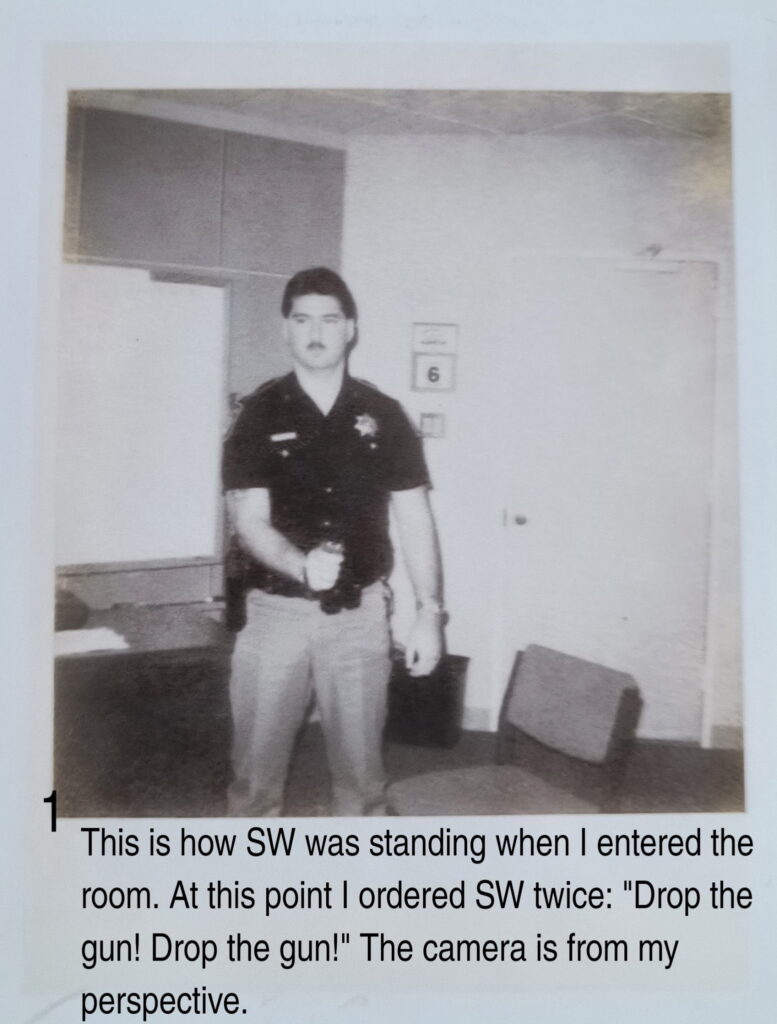
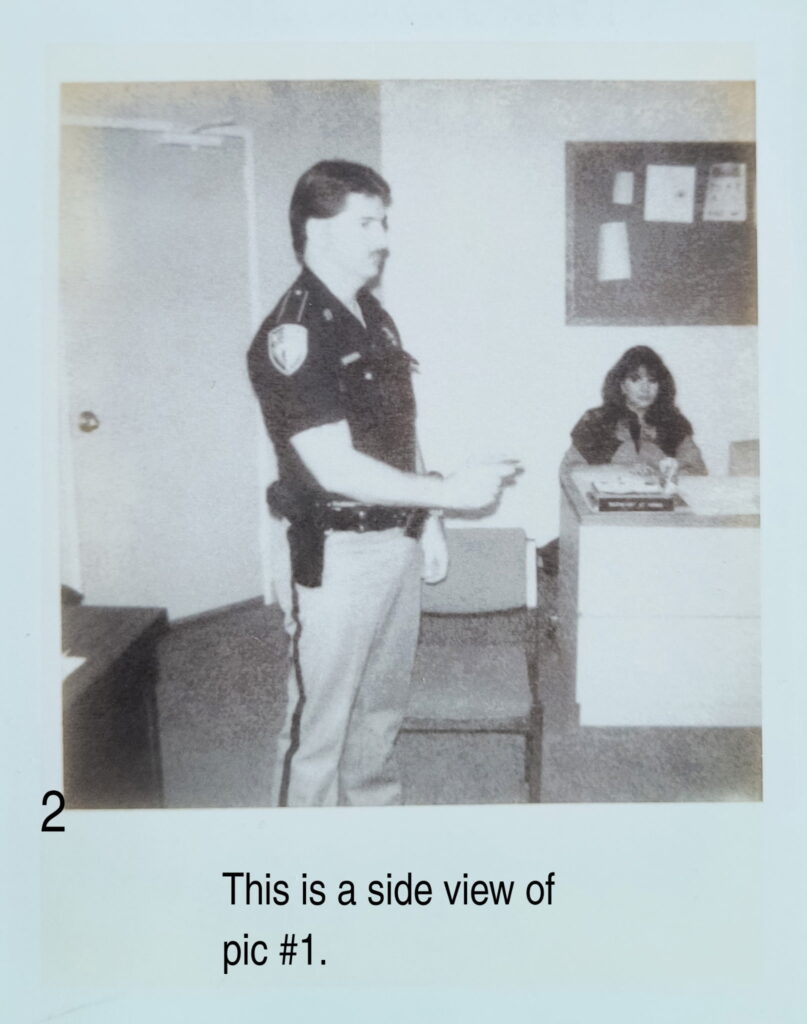
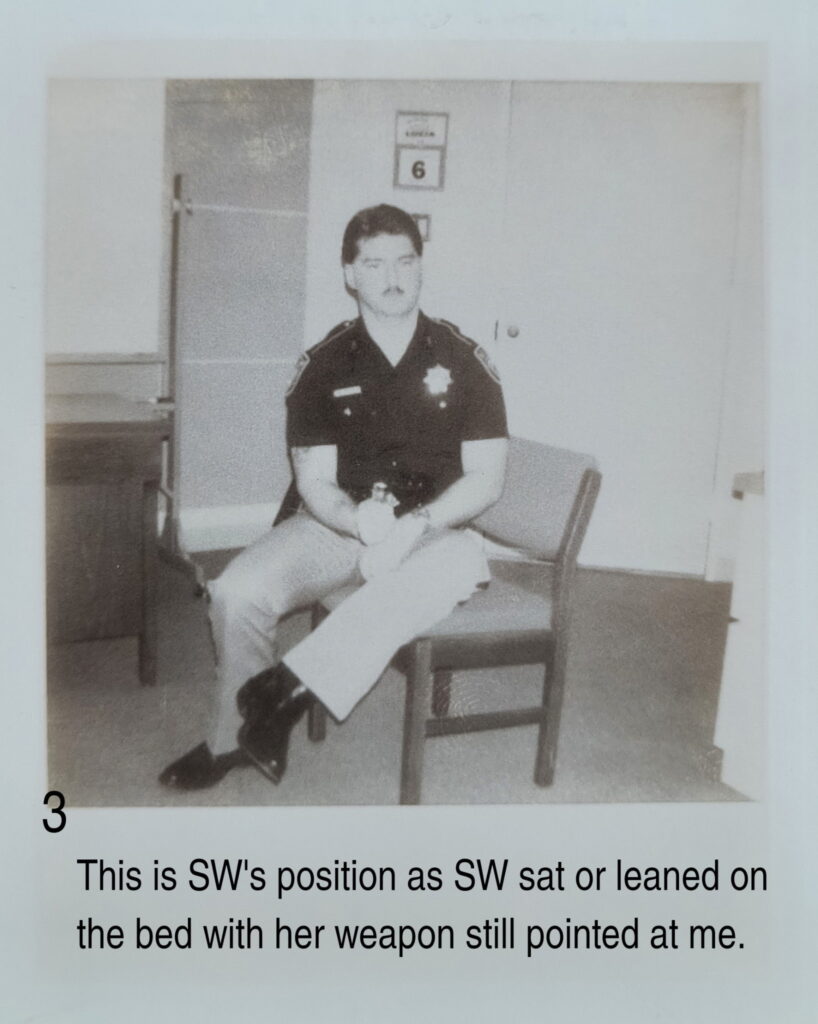
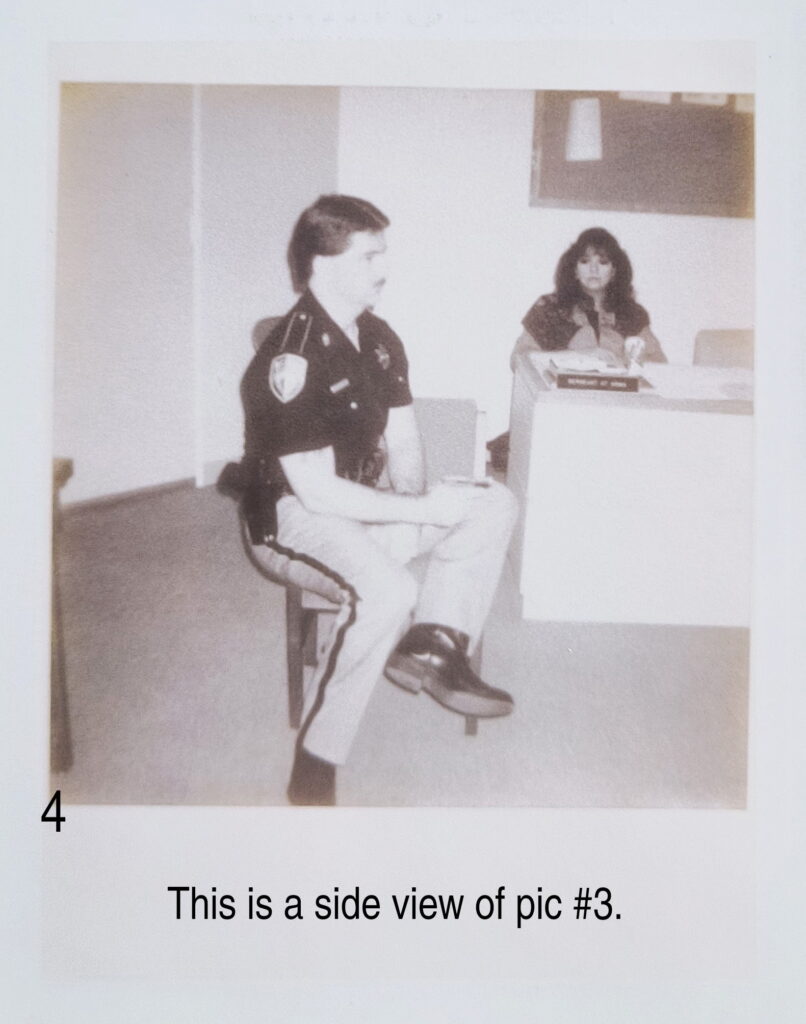
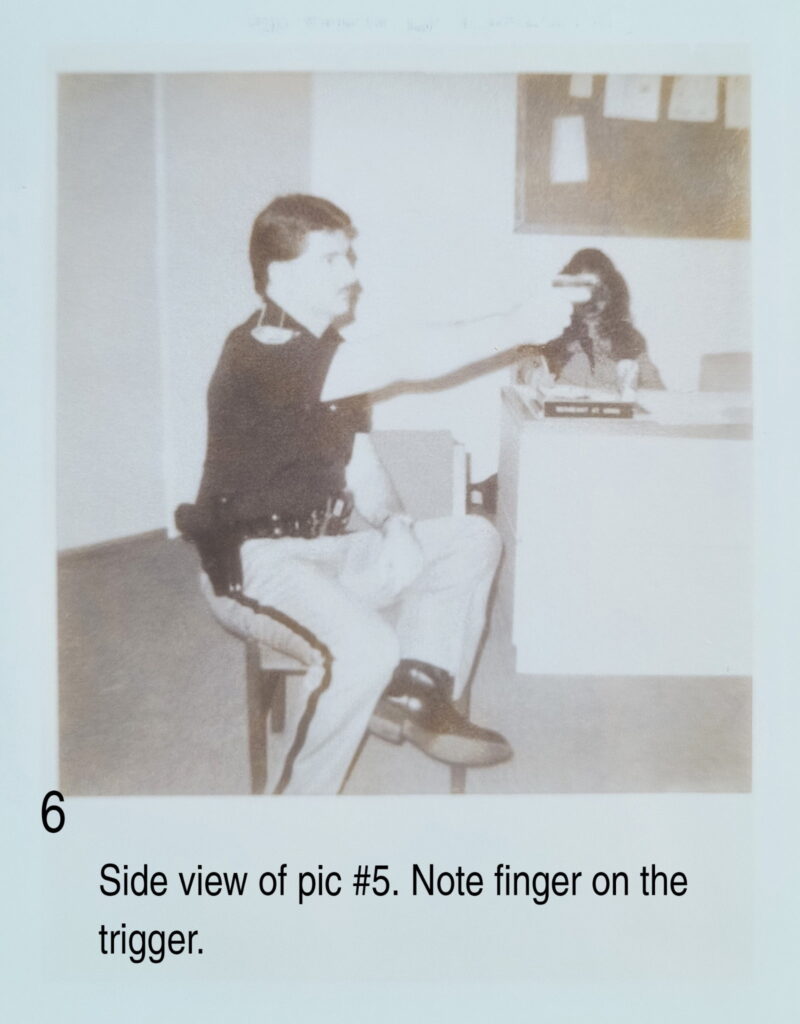
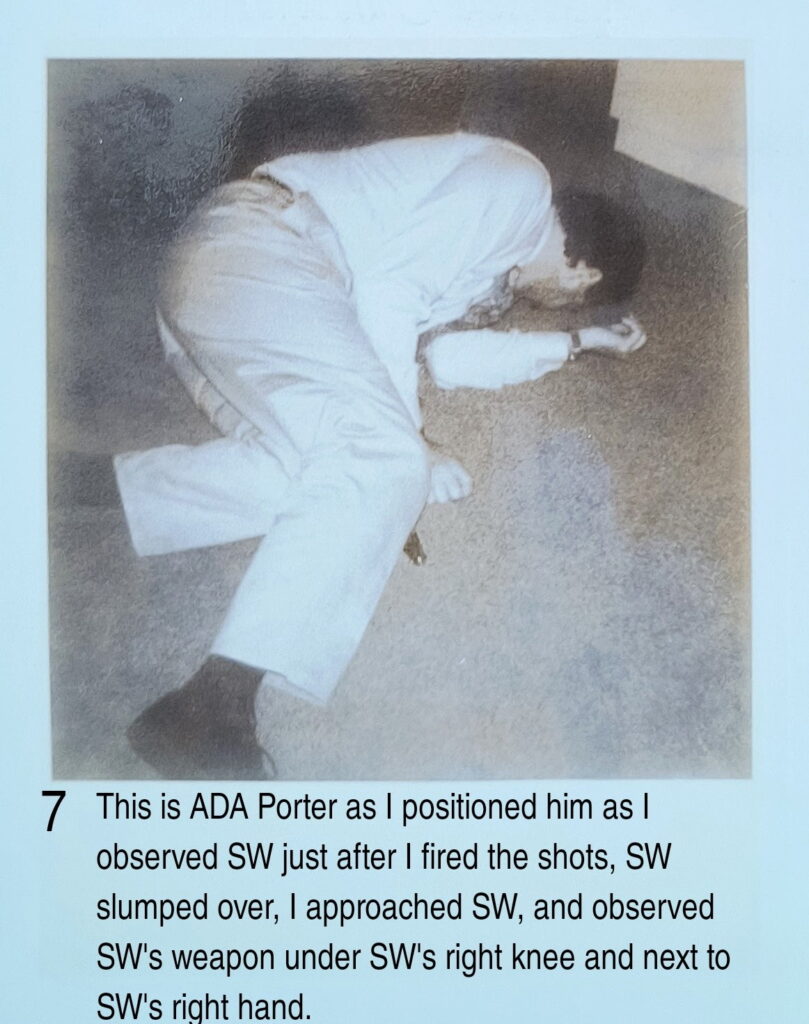
Former deputy Kent McGowen recently provided Investigative Reporter Tammy Rose with these courtroom demonstration photographs, which he says were used during legal proceedings to illustrate his version of the Aug. 25, 1992, fatal shooting of Susan White. The images reflect McGowen’s account and are presented for context alongside court records, the 911 call, and his interview.
McGowen recently provided Investigative Reporter Tammy Rose with courtroom demonstration photographs that he says were used during legal proceedings to explain his version of the shooting.
Several photographs include handwritten descriptions showing where McGowen says he was standing, where White was positioned and where he believes the handgun came to rest after the shooting.
Other images illustrate the angle from which he says he observed White inside the bedroom.
The photographs are not crime scene photographs. Instead, they are courtroom demonstrations created to illustrate McGowen’s account during litigation.
⸻
One Issue Continues to Draw Attention
One issue discussed during Tammy Rose’s interview involved which hand White used to hold the handgun.
McGowen maintains White pointed the weapon with her right hand before he fired.
During the interview, Tammy Rose asked McGowen about reports indicating White was left-handed.
McGowen stood by his account and said the position of the handgun after the shooting matched what he remembered seeing inside the bedroom.
That issue remains one of several points that have been debated for years.
⸻
McGowen Says Jurors Never Heard Everything
During the interview, McGowen repeatedly argued that jurors never heard all of the evidence he believes supports his account.
He pointed to witness statements, subpoenaed records and other documents that he says were unavailable or never fully presented during trial.
McGowen also criticized how the case was investigated and prosecuted.
Those claims have not been independently verified by Investigative Reporter Tammy Rose and remain part of McGowen’s account of the case.
⸻
Two Trials, Two Different Juries
The Susan White case was presented to two different juries.
McGowen’s first murder conviction was later overturned on appeal, resulting in a new trial.
Following that second trial, another jury convicted McGowen of murder in 2002.
He ultimately served approximately 19 years in prison before his release in 2021.
Since leaving prison, McGowen has continued speaking publicly about the shooting and maintains he acted lawfully while serving the warrant.
⸻
Why Revisit the Susan White Case Now?
More than 30 years after the shooting, Kent McGowen continues to challenge the conclusions reached during his criminal case.
Since his release from prison in 2021, he has participated in interviews, worked with author Jerry Langton on a book about his case and continues to review court records and investigative documents.
His recent interview with Investigative Reporter Tammy Rose offers readers an opportunity to hear his account in his own words while comparing those statements with court records, courtroom exhibits and the 911 call placed by Susan White.
As with any decades-old criminal case, many questions remain disputed.
Tammy Rose will continue reviewing court records, witness statements and other documents connected to the investigation as additional records become available.
⸻
Editor’s Note: This article includes court records, historical documents, portions of Susan White’s 911 call, and an interview with Joseph Kent McGowen. McGowen disputes allegations made against him before the shooting. The interview is presented so readers can review his response in full.
This interview is part of an ongoing investigative series examining Kent McGowen’s criminal case and new claims he has made since his release from prison.
Readers can also follow Tammy Rose’s continuing investigation into McGowen’s allegations involving convicted serial killer Roy Alan Stuart.
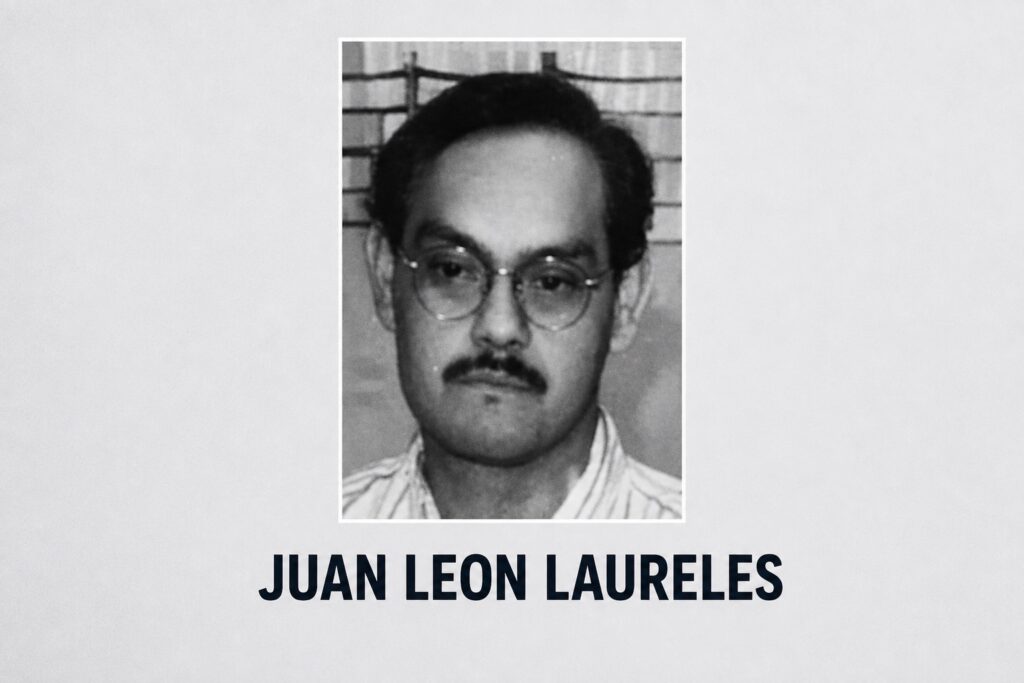
Juan Laureles Cold Case: Texas Rangers Seek New Tips 30 Years Later
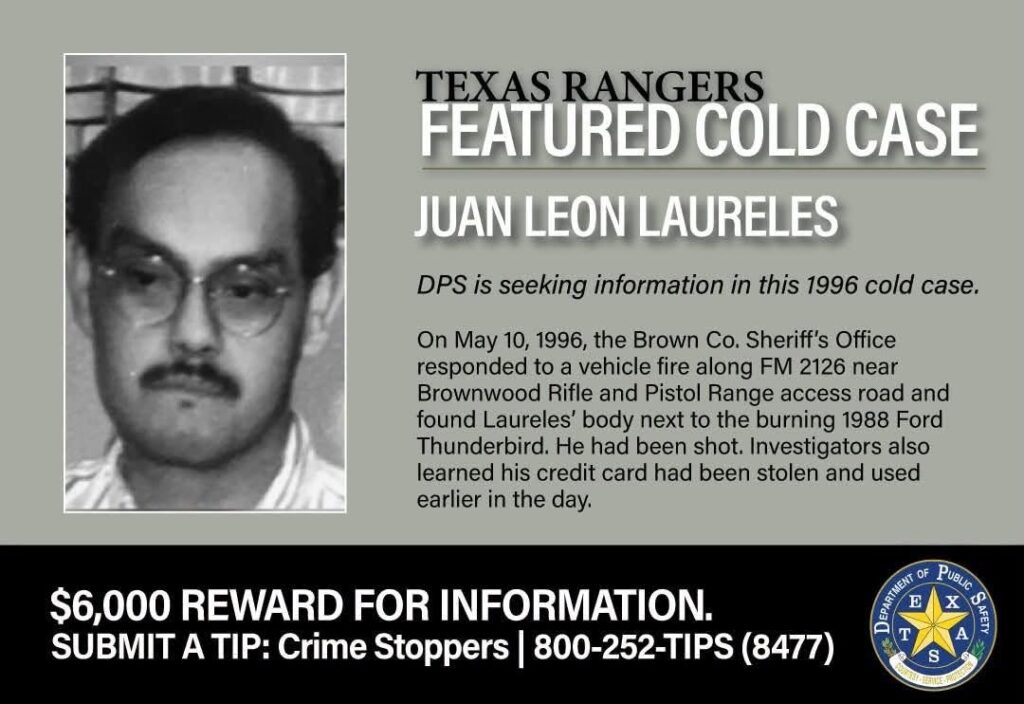
Nearly 30 years after Juan Leon Laureles was found shot to death beside his burning car, Texas investigators are making a renewed push for answers.
The Texas Department of Public Safety announced that authorities are seeking new information in the Juan Laureles cold case. Laureles, 30, died in Brown County in May 1996.
Now, investigators hope someone who knows what happened will finally come forward.
Juan Laureles Found Beside Burning Car
On May 10, 1996, Brown County Sheriff’s deputies responded to a vehicle fire at about 12:30 a.m.
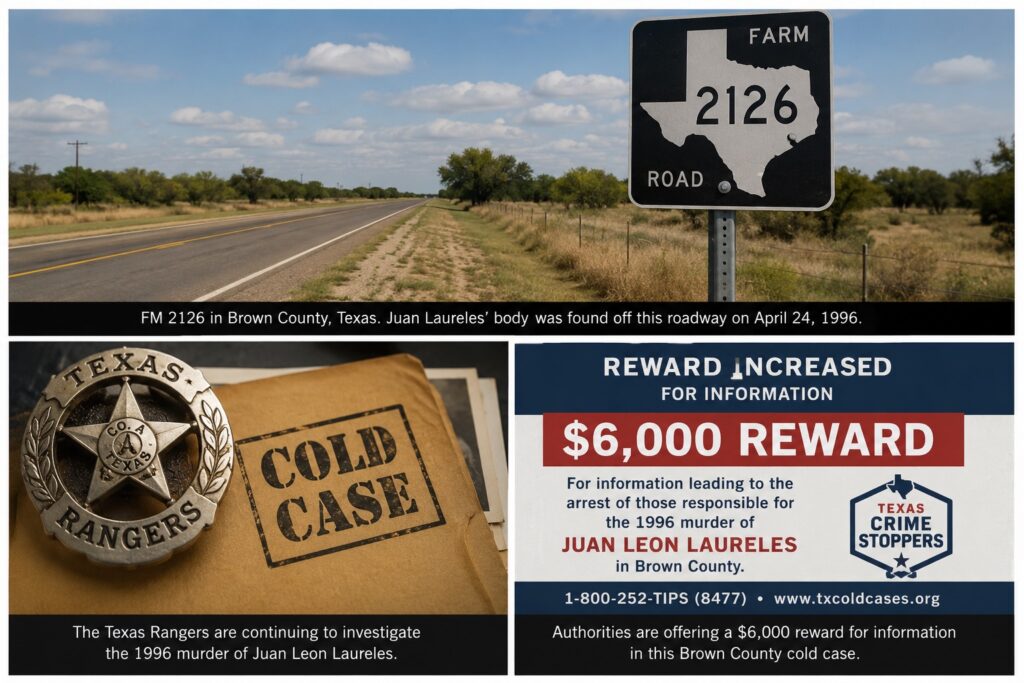
The fire occurred along FM 2126 near the railroad crossing and the access road to the Brownwood Rifle and Pistol Range.
When deputies arrived, they found Laureles dead next to his burning 1988 Ford Thunderbird.
Investigators determined that someone had shot Laureles in the back of the head. Someone also set his vehicle on fire.
Stolen Credit Card Used After Murder
Investigators discovered another important clue.
Someone stole Laureles’ credit card and used it at a Bealls Department Store in the area later that same day.
Authorities still want information about those transactions.
In addition, investigators want to hear from anyone who remembers seeing Laureles’ Ford Thunderbird or other vehicles near the murder scene that night.
Texas Rangers Continue Investigating Juan Laureles Cold Case
Investigators have followed numerous leads during the past three decades. However, they have not made an arrest.
The Brown County Sheriff’s Office and Texas Rangers continue to actively investigate the murder.
Authorities believe people in the community may still have information that could help solve the case.
Even a detail that seemed insignificant in 1996 could potentially give investigators a new lead today.
Reward Increased to $6,000
Texas Crime Stoppers has increased the reward to up to $6,000 for information that leads to an arrest in the case.
However, the increased reward remains available only until DPS announces its next featured Texas Rangers cold case.
Anyone seeking the cash reward must submit the information through Texas Crime Stoppers.
Tipsters can call 1-800-252-TIPS (tel:1-800-252-TIPS) (8477) or submit information through the official Texas Crime Stoppers tip system.
Nearly 30 Years Without Answers
Three decades have passed since someone killed Juan Laureles.
Yet murder has no statute of limitations in Texas, and investigators have not closed the case.
The Texas Rangers continue reviewing unsolved homicides in hopes that new information, witnesses or investigative methods can provide the break detectives need.
For Laureles’ case, that break could come from someone who remembers what happened on May 10, 1996.
Anyone with information should contact Texas Crime Stoppers.
Source: Texas Department of Public Safety
The official DPS release is here: Texas DPS — Juan Laureles Cold Case. DPS confirms the $6,000 enhanced reward applies if an eligible tip comes in before the next featured Texas Rangers cold case is announced.
Planning a Texas trip?
If your travels take you through Brown County or elsewhere in Texas, you can compare hotel options and rates through Hotels.com.
Interested in Texas cold cases?
Readers who follow unsolved cases can browse Texas true crime books on Amazon.
Why I Continue Investigating the Texas Killing Fields: Every Victim Deserves to Be Remembered
By Investigative Reporter Tammy Rose
People often ask why I continue investigating murders that happened more than 50 years ago.
They wonder why I file public records requests. They ask why I travel hundreds of miles to interview witnesses. They also question why I keep digging into cases that many people have forgotten.
When I began researching the Texas Killing Fields, one issue quickly bothered me.
Old news reports often focused on how the victims died. Police records also placed heavy attention on their circumstances. Those accounts did not always show who the women were or how they lived.
Authorities described some victims as runaways. Others struggled with addiction or lived through difficult times. Reports also linked some women to prostitution.
Those labels often overshadowed their identities.
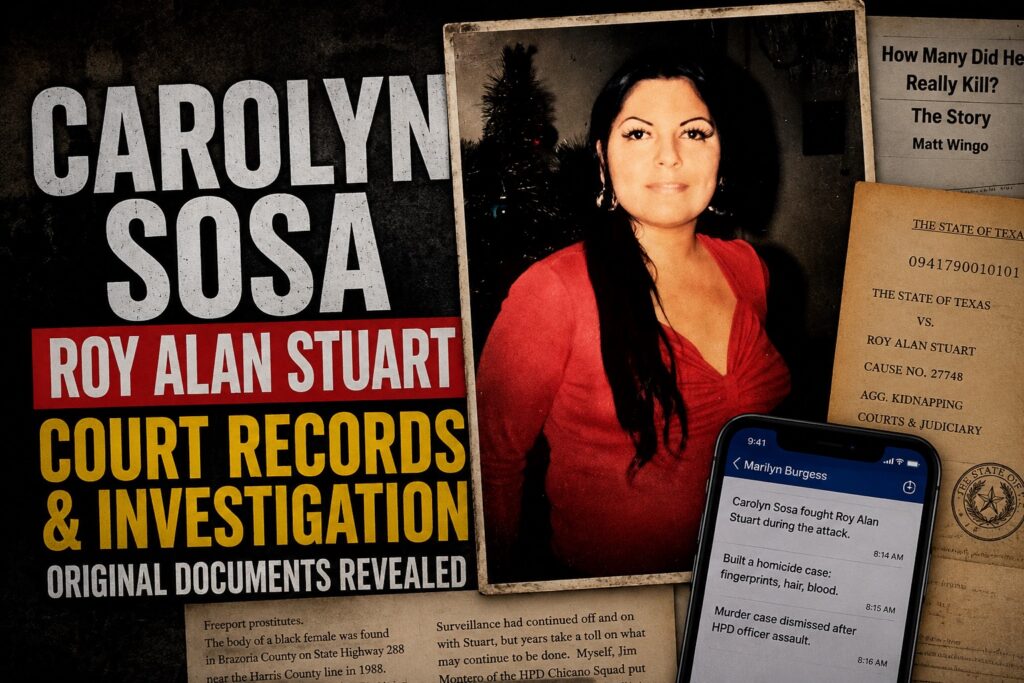
Investigators first viewed Laura Miller as a possible runaway. Reports also associated Carolyn Sosa and Teri McDaniel with prostitution.
Those descriptions may have been accurate, incomplete or unfair. Either way, they often became the focus of the story.
The victims deserved better.
No one should disappear from history because of a label.
My investigation has taken me across Texas and beyond.
I have tracked down key witnesses. I have interviewed retired investigators. I have reviewed thousands of pages of public records.
I have also examined evidence that many people have never seen.
Each interview raises another question. Every record leads to another document. One conversation can reveal a missing piece of history.
Some discoveries involve unidentified remains. Others involve witnesses who were overlooked years ago. Records may also expose decisions that still raise questions today.
I do not investigate these cases to sensationalize tragedy.
I investigate because every victim mattered.
A person’s past should never decide how much effort investigators make. It should not affect whether authorities search for them or work to solve their murder.
A straight-A student had value. A runaway had value. A woman struggling with addiction had value. A person living on the streets had value.
Their circumstances did not make their lives less important.
Justice should never depend on someone’s background.
My investigations sometimes require travel across Texas and beyond. When I need a place to stay near an interview, courthouse or records office, I compare available hotels through Hotels.com.
I also rely on practical tools while reviewing old case files. A portable document scannerhelps me preserve records, photographs and handwritten notes.
This post contains affiliate links. I may earn a small commission from qualifying bookings or purchases at no additional cost to you. As an Amazon Associate, I earn from qualifying purchases.