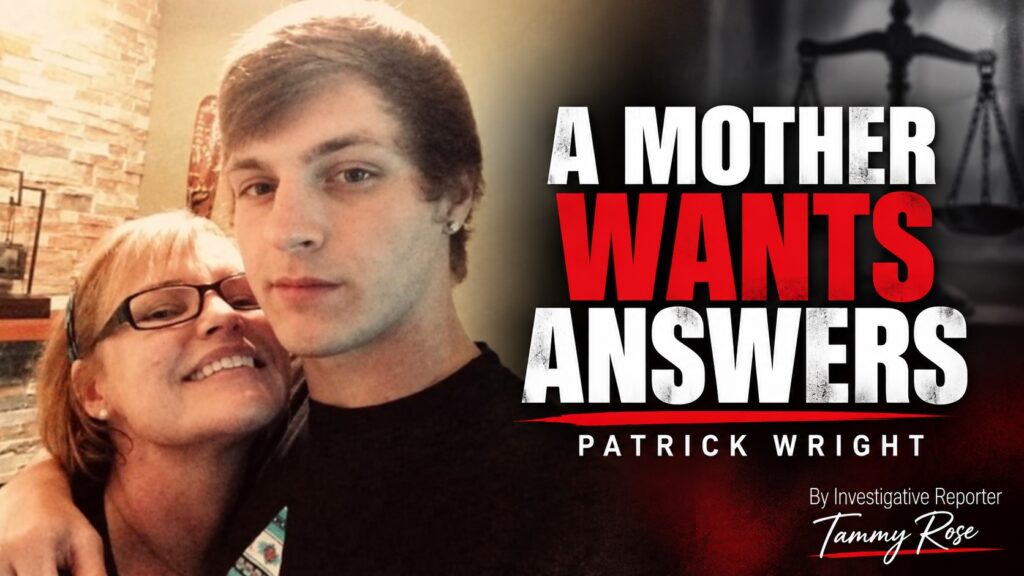
More than a year after the Patrick Wright killing in Galveston, his mother, Kim Lain, says she still has serious questions about the investigation.
Kim Lain was there when her son died. She says she saw the man involved in the confrontation. She spoke directly to him. Moments later, she watched her son collapse after he was shot.
The investigation took several unexpected turns. Police first arrested the wrong man on a murder charge. Investigators later acknowledged problems with gunshot residue testing.
Authorities eventually identified another man as the shooter. They said he admitted firing the shots but claimed self-defense.
Watch the full investigation
Investigative Reporter Tammy Rose sat down with Kim Lain to discuss her son’s death, the investigation and the questions she says remain unanswered. Watch the full report below.
A Galveston County grand jury later took no action in the case.
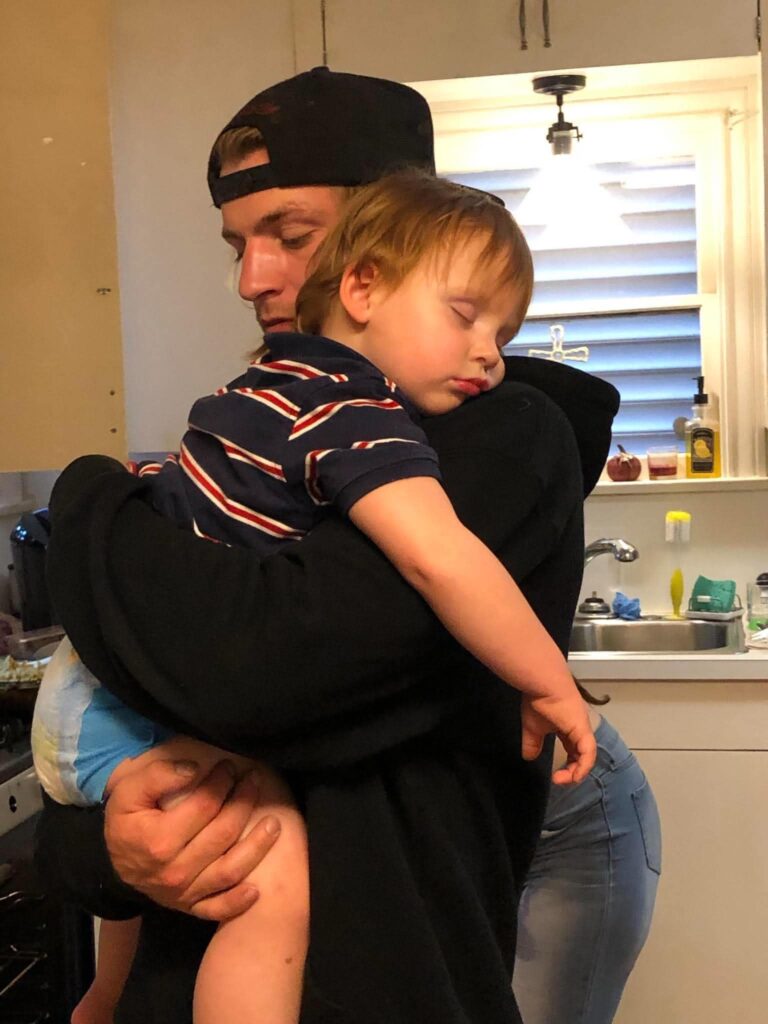
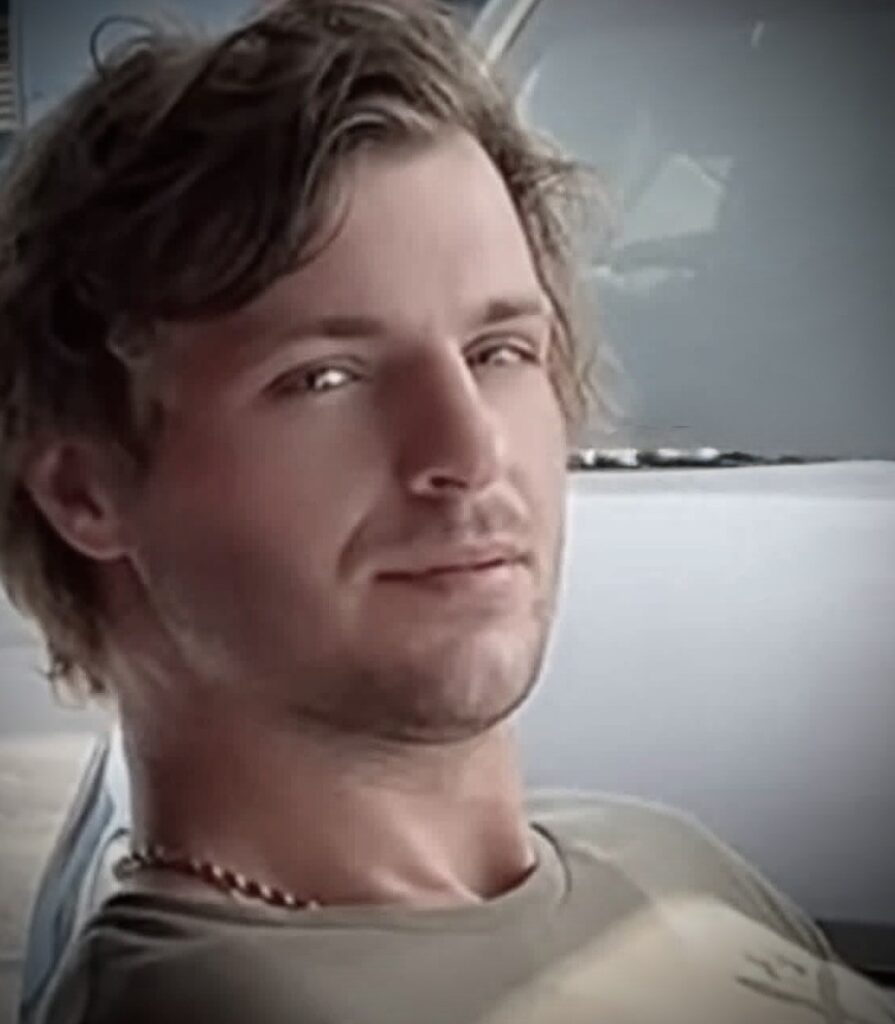
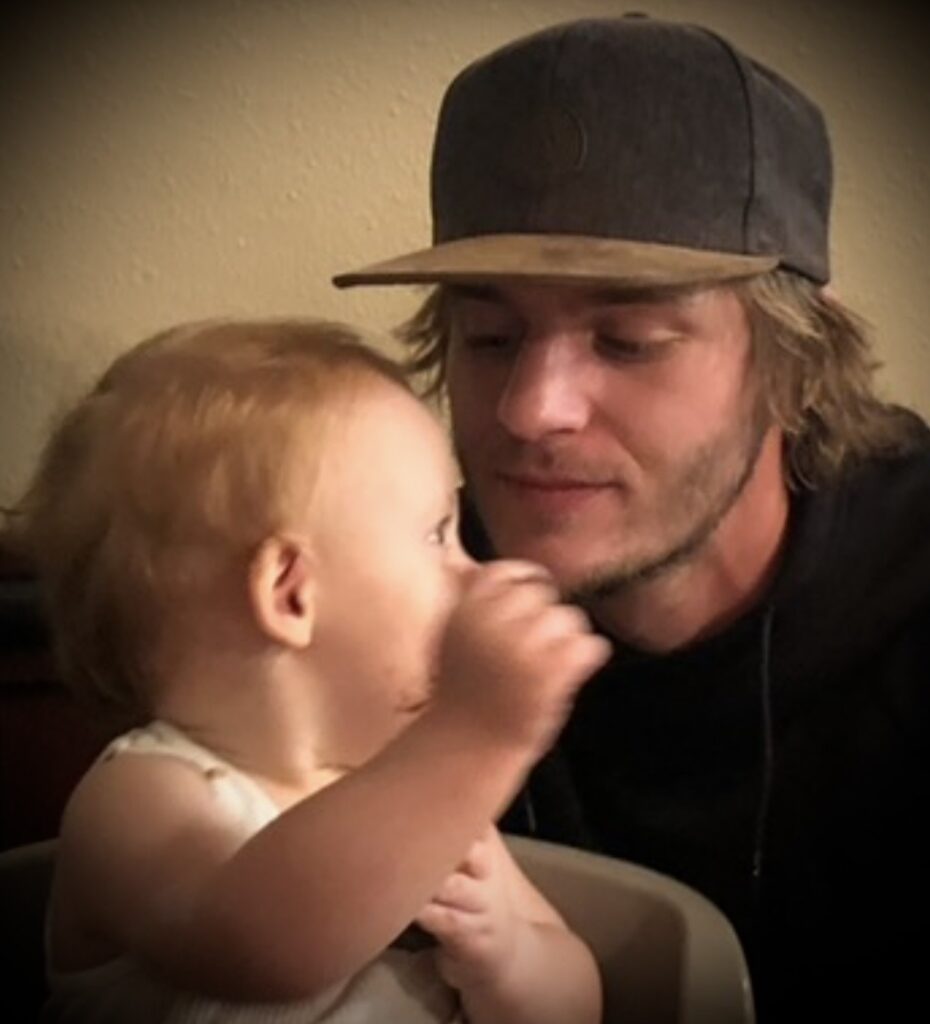
Patrick William Wright with one of his children. His mother, Kim Lain, remembers him as a devoted father who put family first.
Now Lain is questioning how investigators handled her son’s death and why no one faces charges.
Patrick Wright killed in Galveston
Patrick William Wright was 29 when he died on June 20, 2025.
Lain remembers her son for much more than the circumstances surrounding his death.
“He was a very pure soul, that is for sure,” Lain said. “Family was everything to him.”
She described Patrick as someone who held doors open for strangers and helped people who needed it.
“He’s the guy that would give the homeless a few bucks and something to eat, no questions asked,” she said. “I admired that about him.”
A confrontation on Avenue R
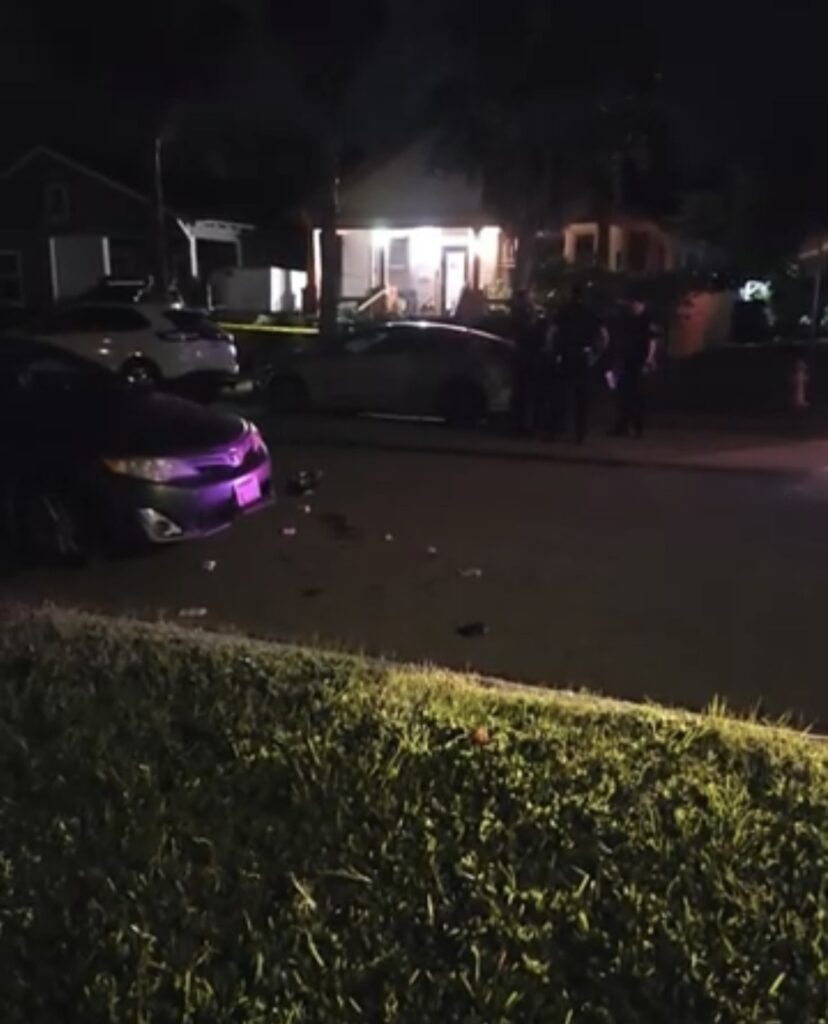
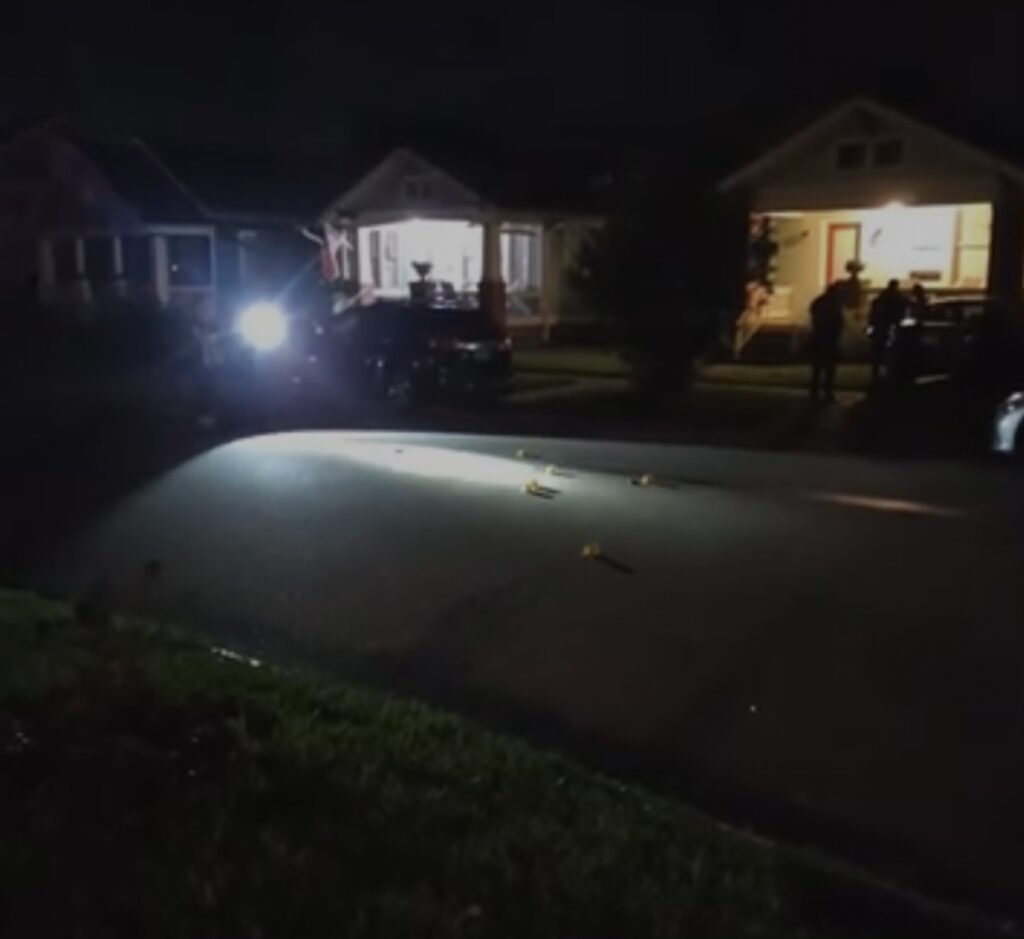
Police at the scene following the fatal shooting of 29-year-old Patrick William Wright in Galveston.The scene on Avenue R in Galveston following the fatal shooting of 29-year-old Patrick William Wright.
Lain says she and Patrick were traveling along Avenue R in Galveston when another vehicle made a wide U-turn and came close to them.
She says Patrick wanted the vehicle’s license plate number. He backed up until the two vehicles were next to each other.
“I heard my son say something to the effect of, ‘Hey, you know, what’s your problem? You almost hit me,’” Lain said.
Patrick eventually got out.
Lain says she repeatedly asked her son not to engage with the other driver. She also asked the other driver to leave.
Seconds later, she heard gunfire.
“It sounded like four shots to me,” Lain said. “It was more than two.”
Patrick then appeared at her window.
“He clenched his chest, and he said, ‘I’ve been shot,’” she recalled.
Lain called 911 at 10:14 p.m.
“He collapsed on the hood, and I lost him there,” she said.
Patrick had been shot twice in the chest.
Lain says less than three minutes passed between the U-turn and the shooting.
Police initially arrested the wrong man
The investigation soon took an unexpected turn.
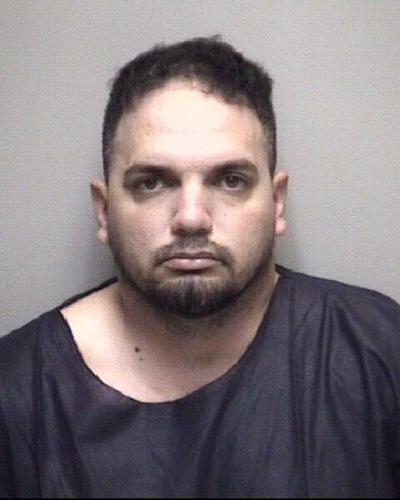
Galveston police initially arrested Uber driver Sanddy Diaz Pino on a murder charge. Police later determined he was not the shooter.
Galveston police initially arrested Uber driver Sanddy Diaz Pino and charged him with murder.
Days later, police determined he was not the shooter.
Investigators said video evidence raised questions about his involvement. Police also acknowledged problems with preliminary gunshot residue testing that produced false-positive results.
Authorities dismissed the murder charge against Diaz Pino.
Investigators later identified another ride-share driver.
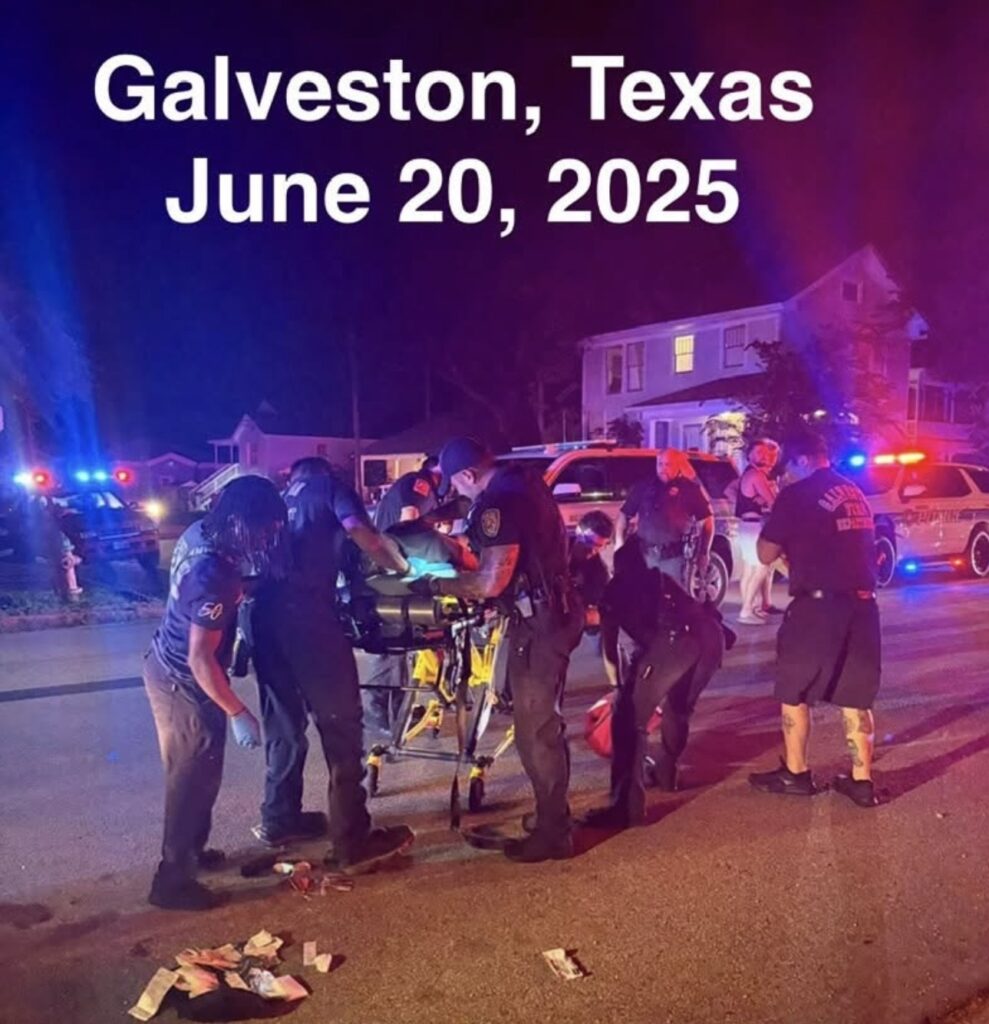
Emergency responders tend to 29-year-old Patrick William Wright after he was shot in Galveston on June 20, 2025.
Authorities said that man admitted shooting Patrick but claimed he acted in self-defense.
Lain disputes part of the shooting account
Early reports cited a witness and a probable cause affidavit. They said Patrick lunged toward the driver’s open window before the shooting.
Lain says she did not see that happen.
“It hurts immensely,” she said. “It also hurts how things have been characterized … because that is not what I witnessed at that scene.”
Lain also disputes the identity of the driver.
She says she looked directly at the man behind the wheel and spoke to him during the confrontation.
Lain says she later made a sworn identification of the man she saw that night. She says the man she identified was not the same person authorities identified during their investigation.
She later took her eyewitness identification to authorities.
Lain says authorities told her it did not qualify as new evidence.
Grand jury takes no action
Patrick William Wright was 29 years old when he was shot and killed in Galveston in June 2025.
The case went before a Galveston County grand jury. The grand jury returned no indictment.
Grand jury proceedings remain secret under Texas law. That means the public cannot independently determine all the evidence prosecutors presented or why jurors reached their decision.
Lain has also discussed her own involvement in the grand jury process. Before publishing, I would confirm with Kim that she personally testified and then add that fact here. Your package does not establish that point clearly enough for me to put it in as fact yet.
Lain questions evidence in the case
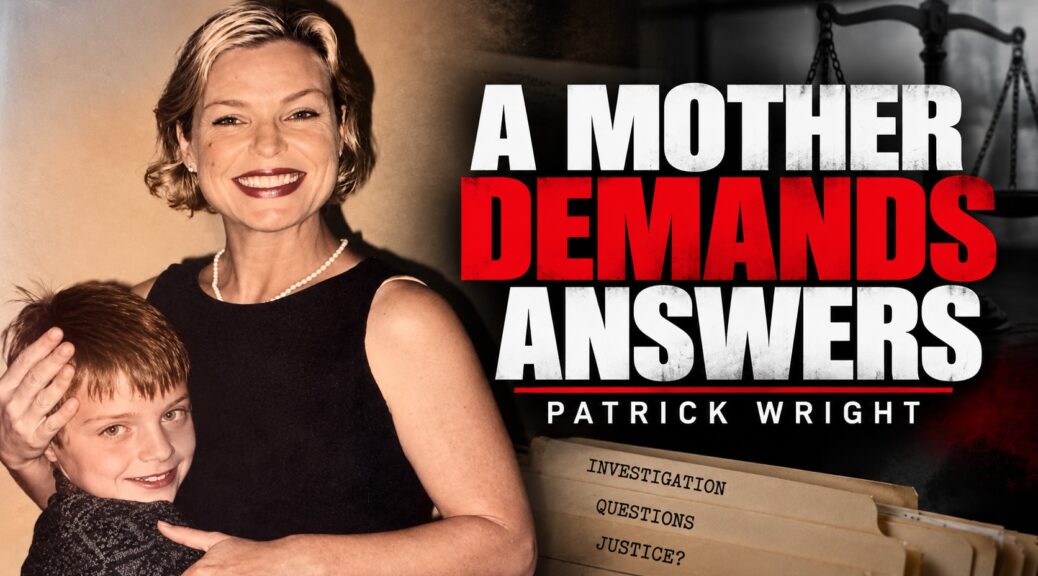
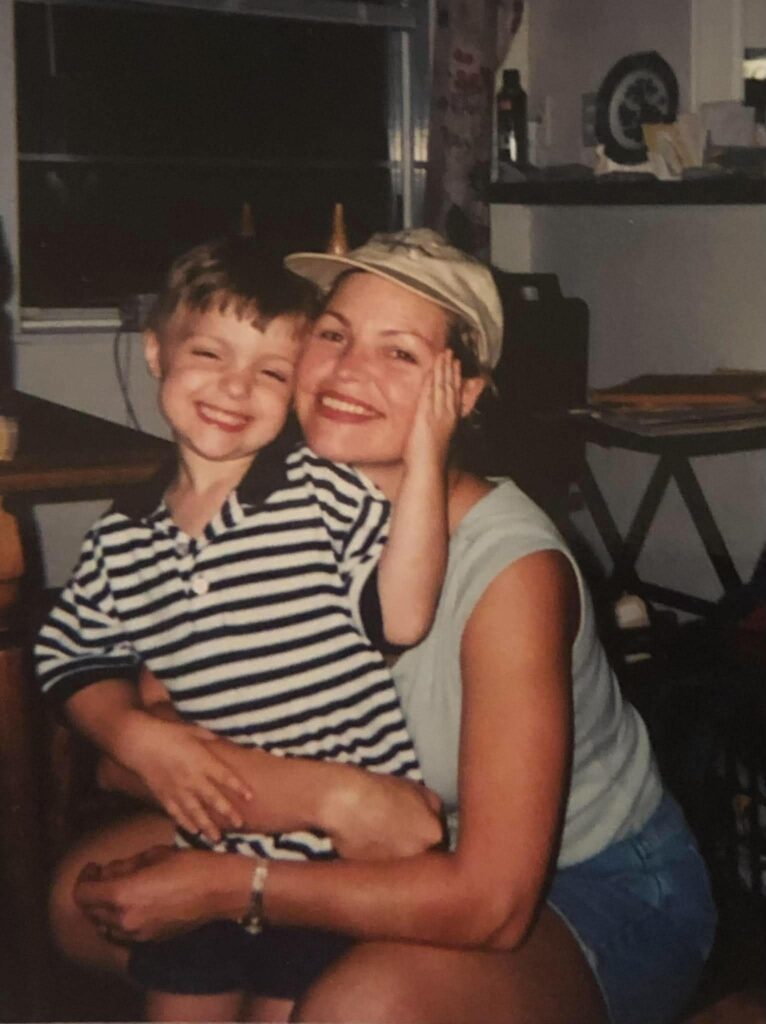
Kim Lain with her son, Patrick William Wright, years before his death in Galveston.
Lain says the prosecutor who presented the case later discussed the evidence with her.
According to Lain, the prosecutor said the case went before the grand jury without a firearm, ballistics evidence, eyewitness identification or physical evidence tying the person under investigation to the scene.
Lain says the prosecutor told her authorities did have a confession and information from Uber placing that person there.
Those statements reflect Lain’s account of what the prosecutor told her. Grand jury secrecy prevents the public from independently confirming everything jurors saw or heard.
Lain says authorities told her she would need new evidence before they could consider the case again. She says they gave a firearm as one example.
She also questions why authorities want her to produce new evidence while opposing the release of Patrick’s complete autopsy file.
Lain believes that file could contain forensic evidence relevant to the case.
A mother continues searching for answers
Patrick William Wright was a father of three. His mother, Kim Lain, says family meant everything to him.
Lain says she was also told that another grand jury would reach the same outcome even if she produced new evidence.
She questions how anyone could know what another grand jury would decide.
“I feel violated. I feel betrayed,” Lain said. “I feel pain for my son. I feel pain for myself. Every day is hell.”
More than a year after Patrick’s death, Lain wants authorities to take another look at the case.
She wants investigators to consider her eyewitness identification and her account of her son’s final minutes.
For Lain, Patrick is more than a name in an investigative file.
He was a 29-year-old father whom she remembers for his kindness and devotion to his family.
“Family was everything to him,” she said.
A grand jury’s decision not to indict does not determine guilt or innocence. Grand jury proceedings are secret, and the evidence presented to jurors generally remains outside public view.
My new book, When Two Worlds Collide During WWII, follows two families on opposite sides of World War II and the remarkable events that eventually brought their lives together in Wisconsin.
The story is based on my own family history, with real people, family photographs and stories passed down through generations.
Disclosure: As an Amazon Associate, I earn from qualifying purchases.
Former Deputy Kent McGowen Responds to Susan White 911 Call, Allegations Before 1992 Shooting
By Investigative Reporter Tammy Rose
More than three decades after the fatal shooting of Susan White, former Harris County Sheriff’s Office Deputy Kent McGowen is publicly responding to allegations White made before the shooting, including claims she voiced during calls to 911.
In an exclusive interview with Investigative Reporter Tammy Rose, McGowen discussed the August 25, 1992 shooting, disputed allegations that he sexually harassed White, addressed why she repeatedly mentioned his name and shared courtroom demonstration photographs that he says support his version of events.
The interview pairs portions of White’s 911 call with McGowen’s current account, allowing readers to compare both versions of events.
Viewer Note: This story contains discussion of a fatal officer-involved shooting and includes portions of a 911 call that some readers may find disturbing.
⸻
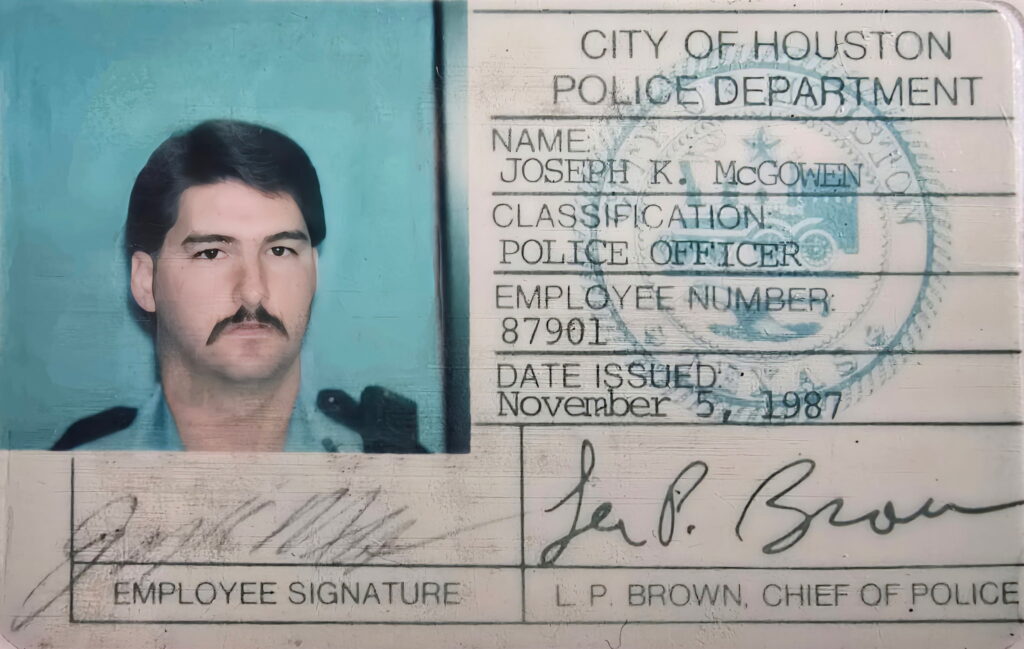
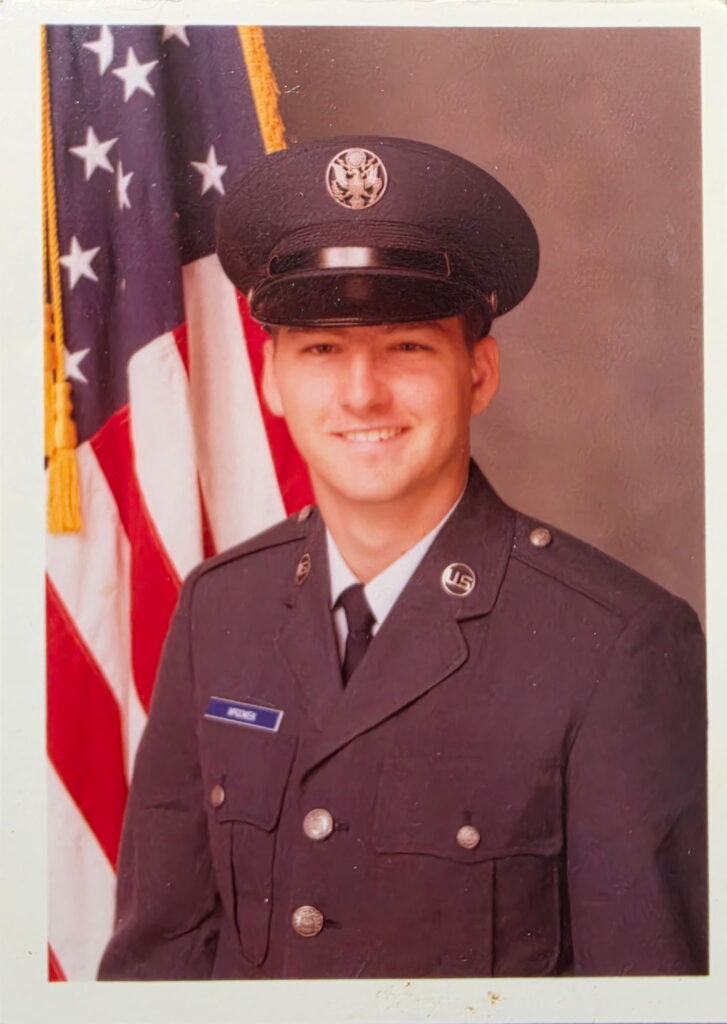
Before entering law enforcement, Kent McGowen served in the U.S. Air Force. He later worked as a Houston police officer and Harris County deputy before the Aug. 25, 1992, fatal shooting of Susan White that led to two criminal trials and his eventual conviction.
Background Before the Case
Before beginning his law enforcement career, Kent McGowen served in the United States Air Force.
After leaving the military, he joined the Houston Police Department before later serving with the Harris County Sheriff’s Office. During his career, he received commendations and officer recognition awards.
After serving in the U.S. Air Force, Kent McGowen joined the Houston Police Department before later serving with the Harris County Sheriff’s Office.
Before beginning his law enforcement career, Kent McGowen served in the United States Air Force.
After leaving the military, he joined the Houston Police Department before later serving with the Harris County Sheriff’s Office. During his career, he received commendations and officer recognition awards.
McGowen’s career changed forever on August 25, 1992, when deputies serving a felony warrant fatally shot Susan White at her home.
A jury convicted McGowen of murder in his first trial. An appellate court later overturned that conviction. A second jury convicted him in 2002. He ultimately served approximately 19 years in prison before his release in 2021.
Book About the Case
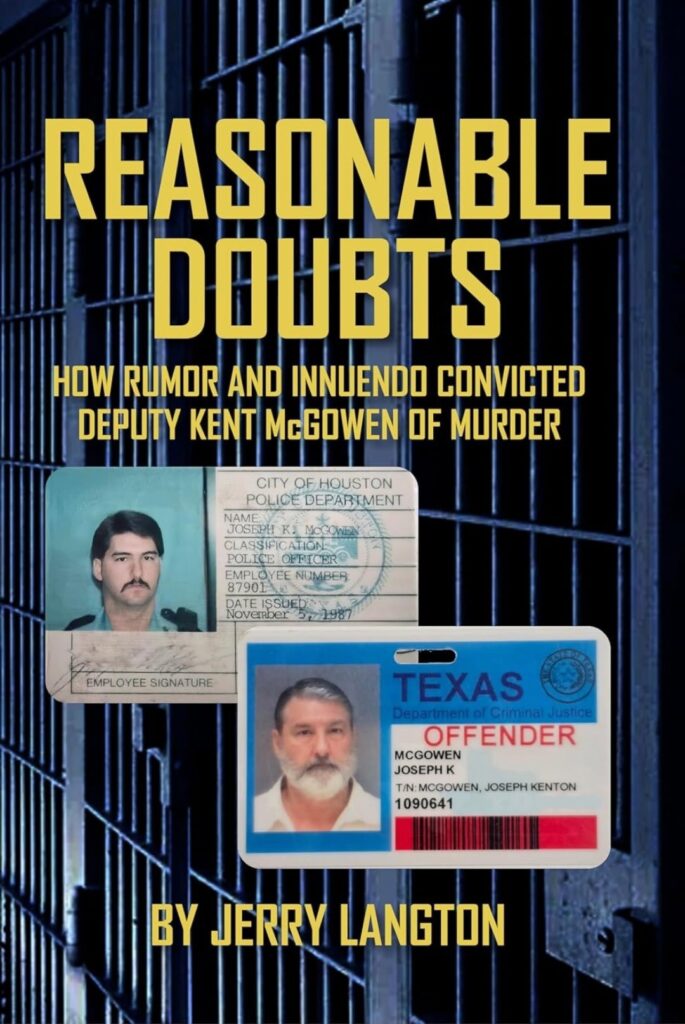
Journalist Jerry Langton later examined the case in Reasonable Doubts: How Rumor and Innuendo Convicted Deputy Kent McGowen of Murder. The book explores the investigation, the two trials and McGowen’s conviction.
In addition to the trial record, Kent McGowen has provided investigative records and expert reports that he says support his account of the shooting.
Among the records McGowen provided is a forensic review by consulting forensic scientist Dr. Edward E. Hueske.
Hueske prepared the review during McGowen’s legal proceedings.
McGowen also provided a statement he wrote at the request of Harris County Assistant District Attorney Baldwin Chin, then chief of the Harris County District Attorney’s Office Post Conviction Integrity Review Unit, during the office’s review of his case in 2011–2012.
According to McGowen, the statement summarizes the case and his account of events as they existed during the Harris County District Attorney’s Office Post Conviction Integrity Review in 2011-2012.
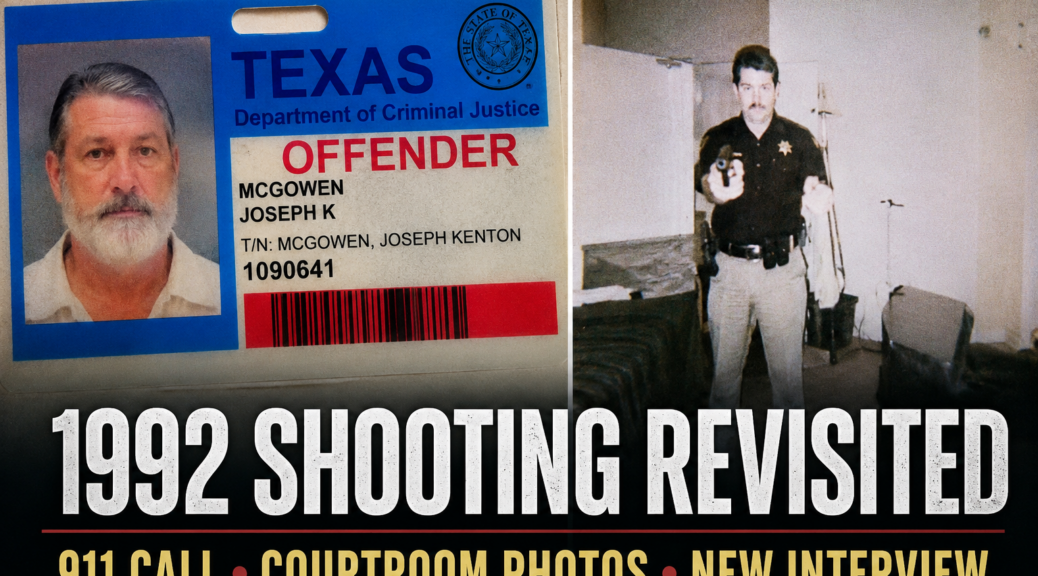
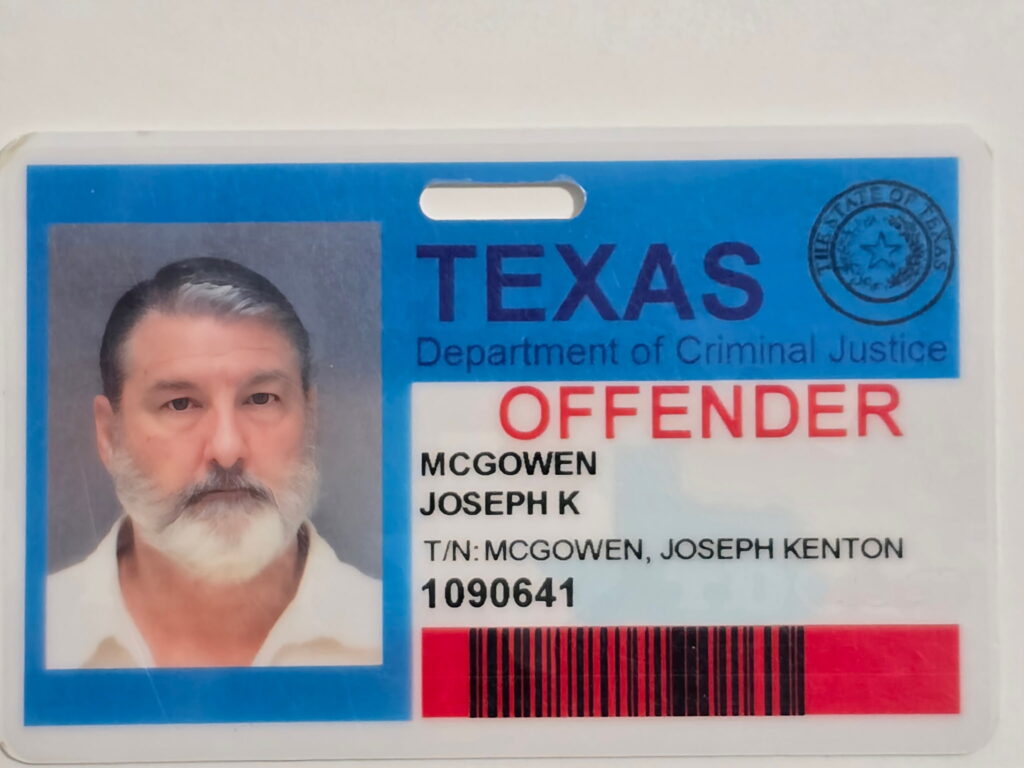
After two criminal trials stemming from the Aug. 25, 1992, fatal shooting of Susan White, Kent McGowen was ultimately convicted of murder. He served approximately 19 years in the Texas Department of Criminal Justice before his release in 2021.
⸻
Watch the Full Investigation
The television report below includes exclusive interview excerpts with Kent McGowen, courtroom demonstration photographs and additional background on the Susan White case.
⸻
Listen to Susan White’s 911 Call
The audio below captures one of Susan White’s calls to 911 before deputies entered her home.
During the recording, White repeatedly asks dispatchers for help and expresses fear as deputies remain outside the residence.
The call contains emotional language and may be disturbing to some listeners.
Susan White’s 911 Call Before Deputies Entered The Home
The video and audio above include one of Susan White’s 911 calls before deputies entered the home.
During the recording, White repeatedly asks dispatchers for help while describing people outside her home.
The recording contains emotional language that some listeners may find disturbing.
⸻
McGowen Strongly Disputes White’s Allegations
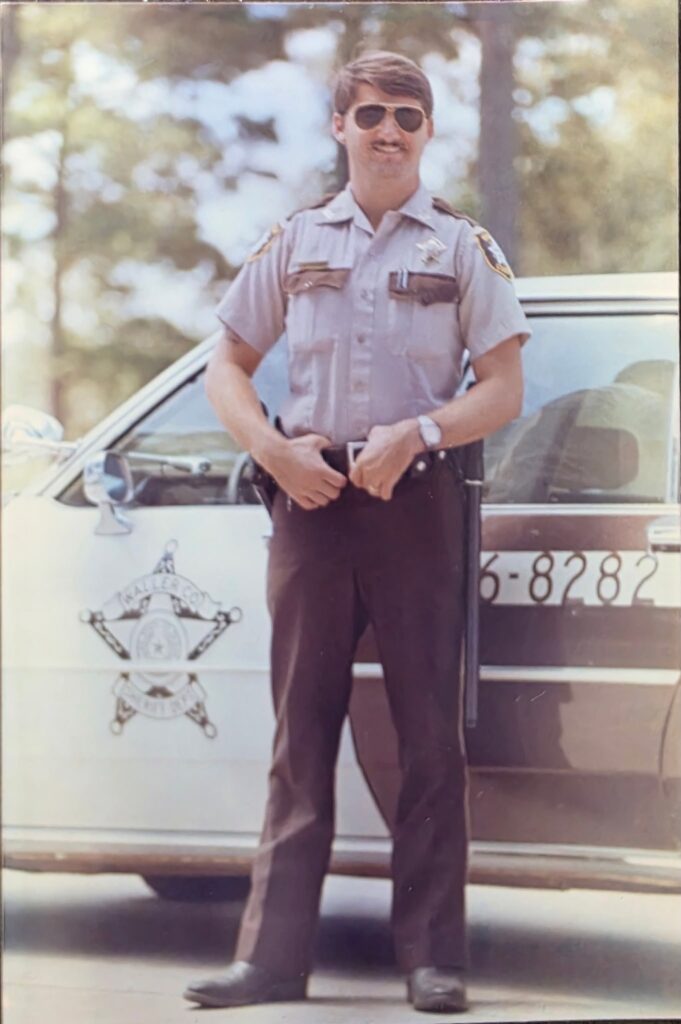
Kent McGowen while serving with the Waller County Sheriff’s Office at age 19, before joining the Houston Police Department pending completion of his background investigation.
During his interview with Investigative Reporter Tammy Rose, McGowen firmly denied White’s allegations.
According to McGowen, he never sexually harassed White, never stalked her and never had the repeated contacts she described.
“I had never pulled her over. I’d never spoken to her,” McGowen said during the interview.
McGowen believes White confused him with another deputy who previously worked in the area.
He told Tammy Rose that investigators later uncovered witness statements he believes support that explanation.
According to McGowen, White mistakenly identified him after seeing him during the arrest of her son and others connected to a burglary investigation.
⸻
Why Did White Know McGowen’s Name?
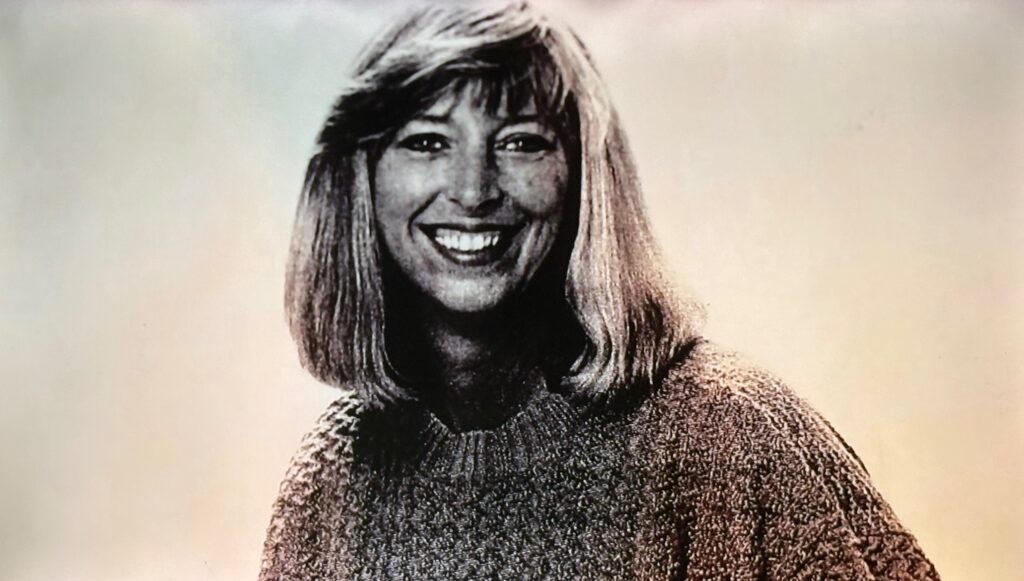
Susan White. Investigators and former Deputy Kent McGowen have offered differing explanations for why White repeatedly mentioned his name before the August 25, 1992, shooting.
One of the questions surrounding the case is why White repeatedly mentioned McGowen by name before the shooting.
McGowen offered his explanation during the interview.
He said White arrived at the scene after deputies arrested her son and began asking officers who “McGowen” was.
According to McGowen, several deputies pointed in different directions while trying to identify him, causing White to approach multiple officers before eventually speaking with him.
McGowen believes that encounter explains why she later knew his name.
He disputes claims that he had an ongoing personal conflict with White before the shooting.
⸻
McGowen Says White Mistook Him for Another Deputy
McGowen also challenged allegations that he repeatedly stopped or harassed White before the shooting.
Instead, he told Tammy Rose that another deputy had previous contact with White and believes she mistakenly associated him with those earlier encounters.
McGowen said he never received phone calls from White, never contacted her outside official duties and never had a personal relationship with her.
He also pointed to subpoenaed telephone records that he says failed to show communication between them.
Those statements reflect McGowen’s account. Investigative Reporter Tammy Rose continues reviewing court records, witness statements and other documents connected to the case.
⸻
McGowen’s Description of White’s Condition
McGowen also discussed White’s condition while deputies attempted to serve the warrant.
According to McGowen, White appeared to be slurring her speech as deputies tried to communicate with her through the front door.
He told Tammy Rose he believed White was impaired and described her behavior as confused and erratic.
McGowen said those observations influenced how he interpreted her actions that morning.
His statements represent his account of the encounter and should not be interpreted as independent findings of fact.
⸻
The Warrant That Led to the Shooting
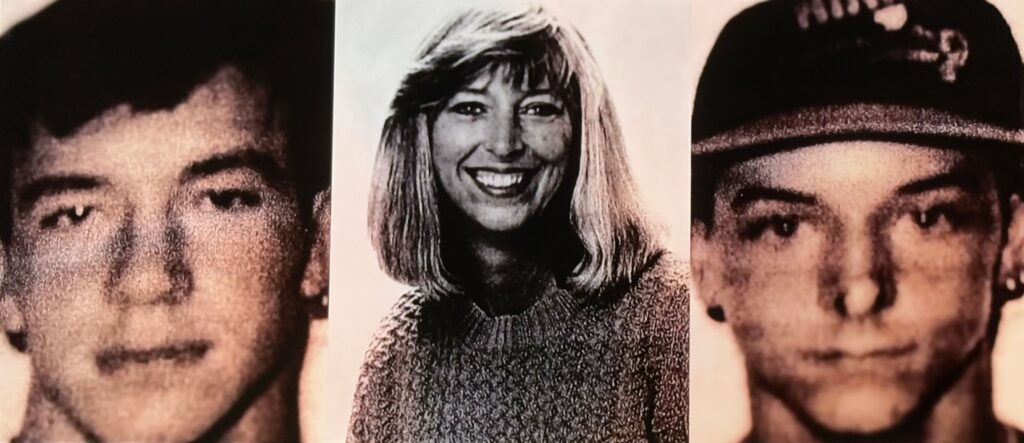
Left to right: Confidential informant Michael Shaffer, Susan White and Jason Aguillard, Susan White’s teenage son.
According to McGowen, deputies went to Susan White’s home to serve a felony retaliation warrant after investigators alleged she threatened a confidential informant connected to a burglary investigation.
McGowen said he first attempted to obtain the warrant during the overnight hours but claimed a judge was unavailable to sign it. He returned the following morning with the approved warrant and several deputies to serve it.
He told Investigative Reporter Tammy Rose that deputies knocked on the front door for several minutes, repeatedly identified themselves as members of the Harris County Sheriff’s Office and asked White to come outside.
According to McGowen, White refused to open the door.
McGowen said deputies eventually forced entry after obtaining permission from a supervisor.
⸻
McGowen Describes What Happened Inside
According to McGowen, deputies entered the home and began clearing rooms while searching for White.
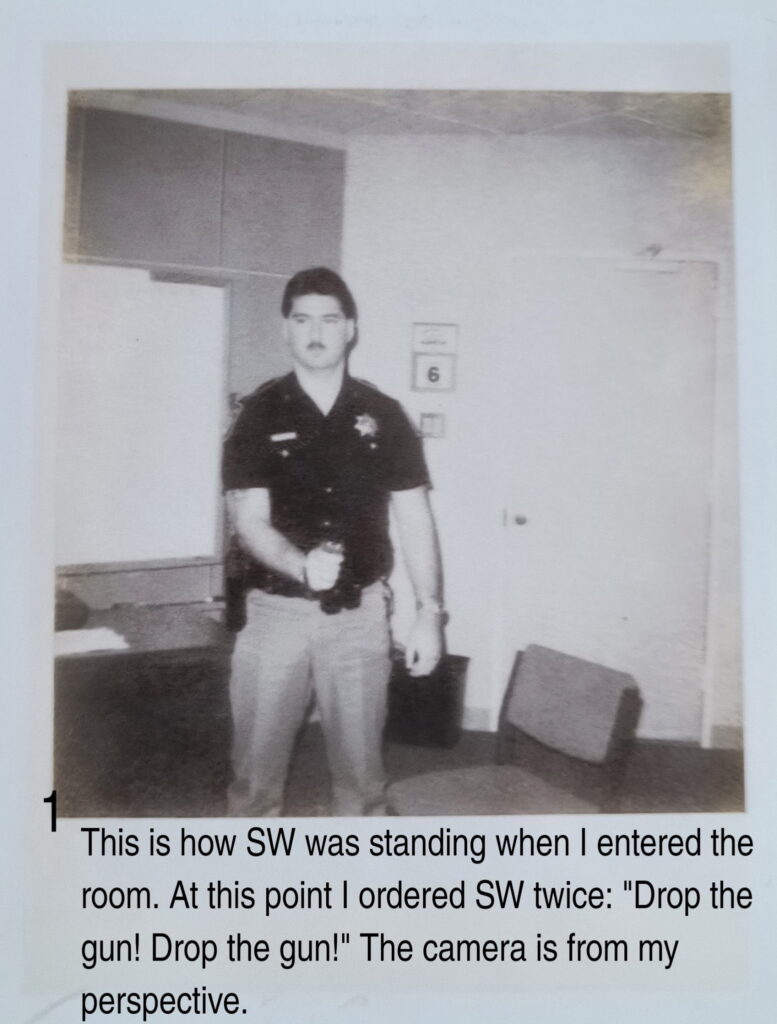
He told Tammy Rose he saw White move through the house toward a bedroom. He followed her and said she picked up a handgun after entering the room.
McGowen said he ordered White three times to drop the weapon.
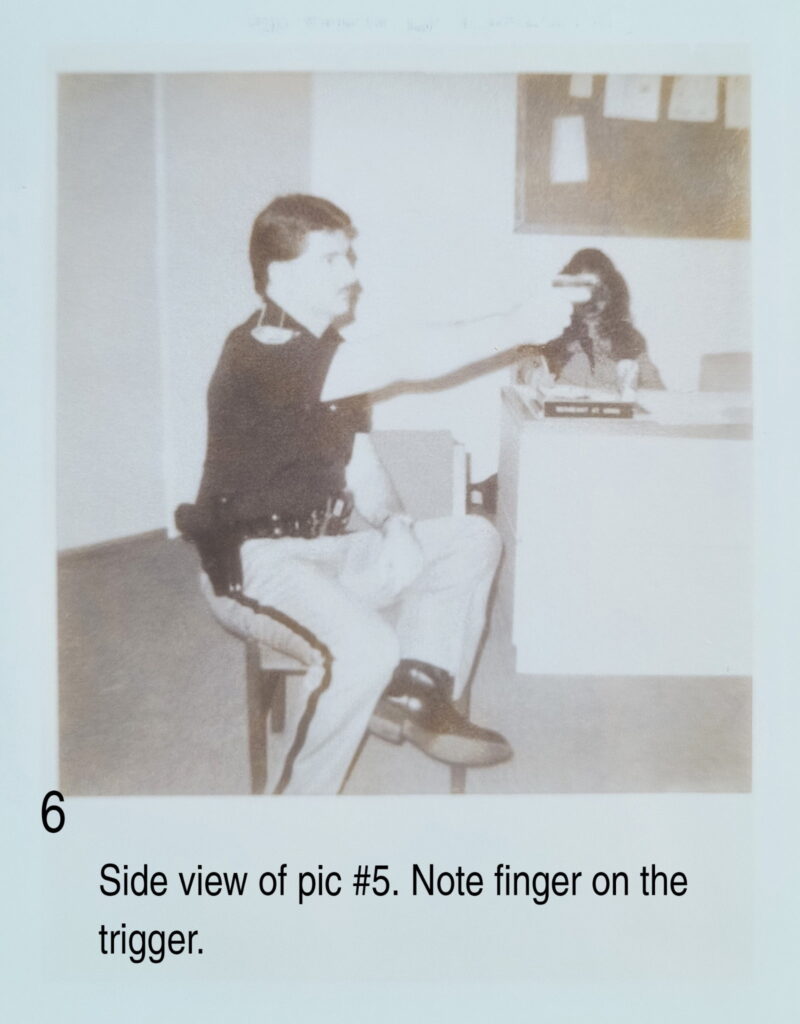
He claims White raised the handgun toward him and began placing her finger on the trigger.
Believing his life and the lives of the other deputies were in danger, McGowen fired three shots.
He has consistently maintained that he acted in self-defense.
Prosecutors disputed that version of events during both criminal trials.
⸻
Courtroom Demonstration Photos
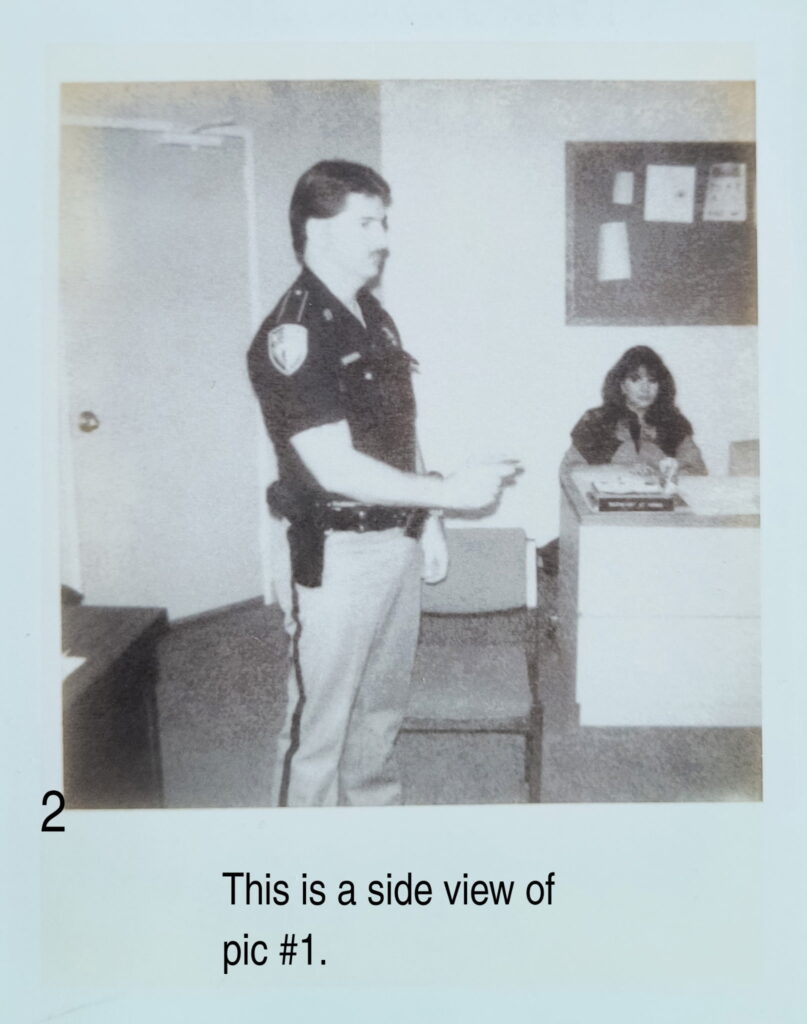
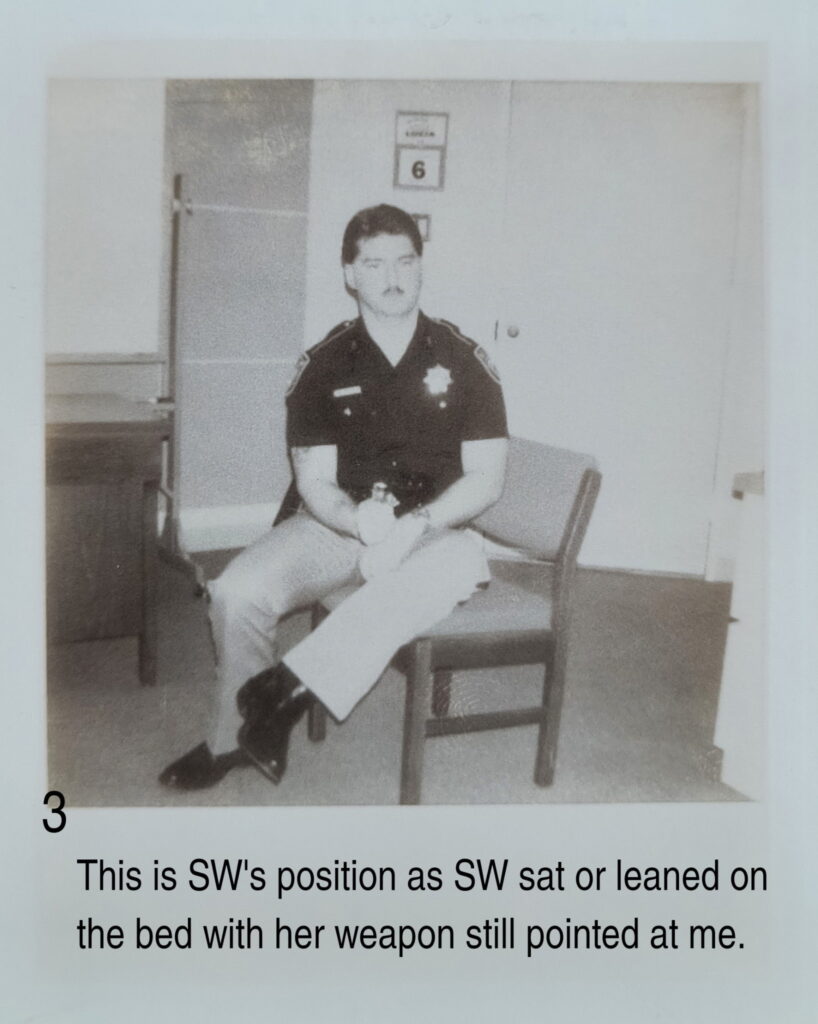
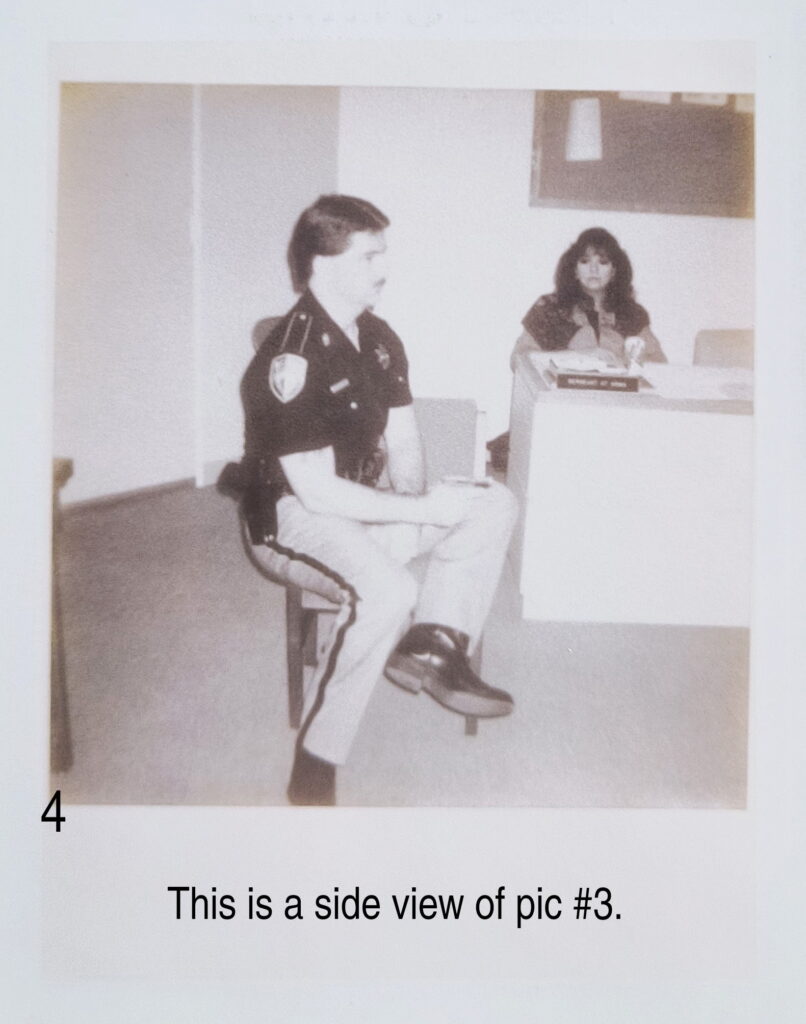
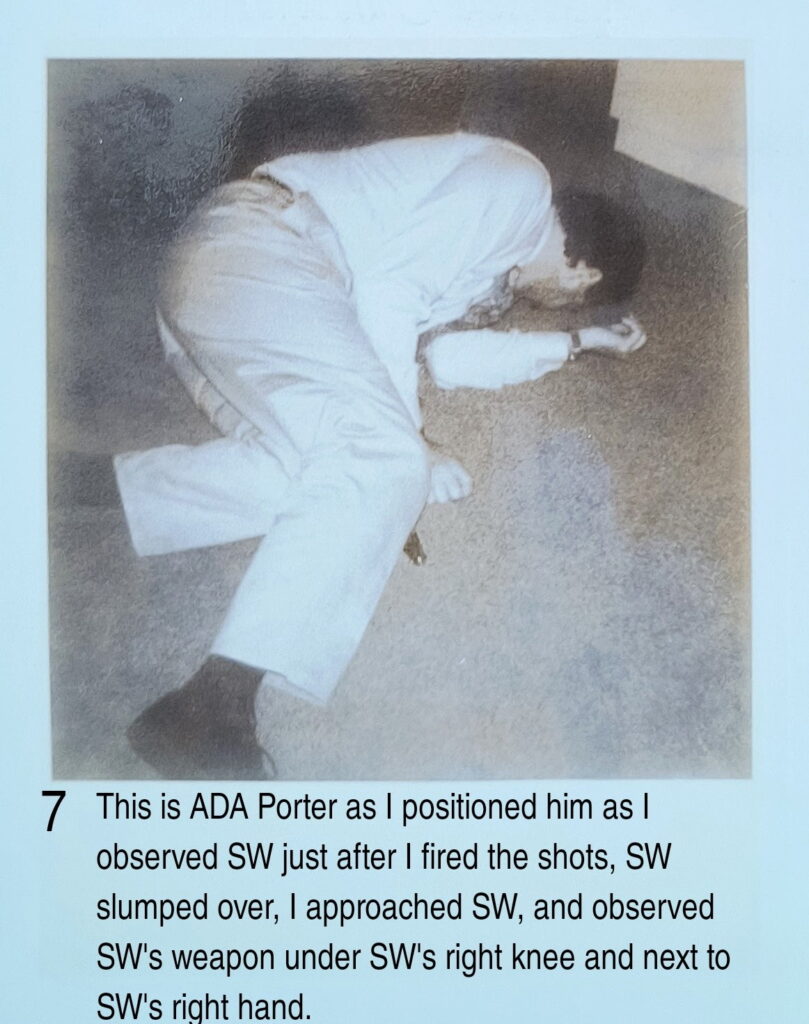
Former deputy Kent McGowen recently provided Investigative Reporter Tammy Rose with these courtroom demonstration photographs, which he says were used during legal proceedings to illustrate his version of the Aug. 25, 1992, fatal shooting of Susan White. The images reflect McGowen’s account and are presented for context alongside court records, the 911 call, and his interview.
McGowen recently provided Investigative Reporter Tammy Rose with courtroom demonstration photographs that he says were used during legal proceedings to explain his version of the shooting.
Several photographs include handwritten descriptions showing where McGowen says he was standing, where White was positioned and where he believes the handgun came to rest after the shooting.
Other images illustrate the angle from which he says he observed White inside the bedroom.
The photographs are not crime scene photographs. Instead, they are courtroom demonstrations created to illustrate McGowen’s account during litigation.
⸻
One Issue Continues to Draw Attention
One issue discussed during Tammy Rose’s interview involved which hand White used to hold the handgun.
McGowen maintains White pointed the weapon with her right hand before he fired.
During the interview, Tammy Rose asked McGowen about reports indicating White was left-handed.
McGowen stood by his account and said the position of the handgun after the shooting matched what he remembered seeing inside the bedroom.
That issue remains one of several points that have been debated for years.
⸻
McGowen Says Jurors Never Heard Everything
During the interview, McGowen repeatedly argued that jurors never heard all of the evidence he believes supports his account.
He pointed to witness statements, subpoenaed records and other documents that he says were unavailable or never fully presented during trial.
McGowen also criticized how the case was investigated and prosecuted.
Those claims have not been independently verified by Investigative Reporter Tammy Rose and remain part of McGowen’s account of the case.
⸻
Two Trials, Two Different Juries
The Susan White case was presented to two different juries.
McGowen’s first murder conviction was later overturned on appeal, resulting in a new trial.
Following that second trial, another jury convicted McGowen of murder in 2002.
He ultimately served approximately 19 years in prison before his release in 2021.
Since leaving prison, McGowen has continued speaking publicly about the shooting and maintains he acted lawfully while serving the warrant.
⸻
Why Revisit the Susan White Case Now?
More than 30 years after the shooting, Kent McGowen continues to challenge the conclusions reached during his criminal case.
Since his release from prison in 2021, he has participated in interviews, worked with author Jerry Langton on a book about his case and continues to review court records and investigative documents.
His recent interview with Investigative Reporter Tammy Rose offers readers an opportunity to hear his account in his own words while comparing those statements with court records, courtroom exhibits and the 911 call placed by Susan White.
As with any decades-old criminal case, many questions remain disputed.
Tammy Rose will continue reviewing court records, witness statements and other documents connected to the investigation as additional records become available.
⸻
Editor’s Note: This article includes court records, historical documents, portions of Susan White’s 911 call, and an interview with Joseph Kent McGowen. McGowen disputes allegations made against him before the shooting. The interview is presented so readers can review his response in full.
This interview is part of an ongoing investigative series examining Kent McGowen’s criminal case and new claims he has made since his release from prison.
Readers can also follow Tammy Rose’s continuing investigation into McGowen’s allegations involving convicted serial killer Roy Alan Stuart.
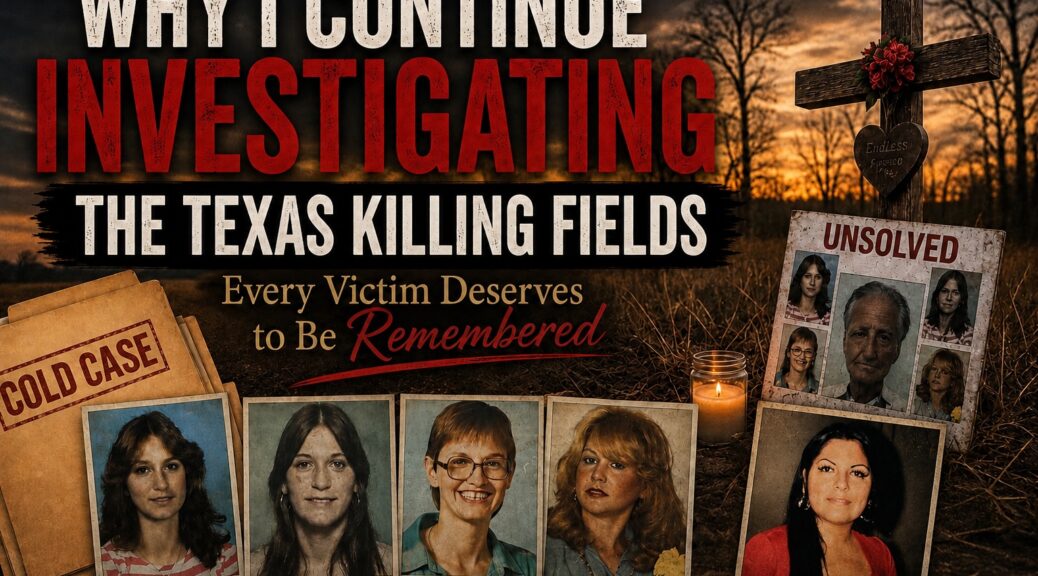
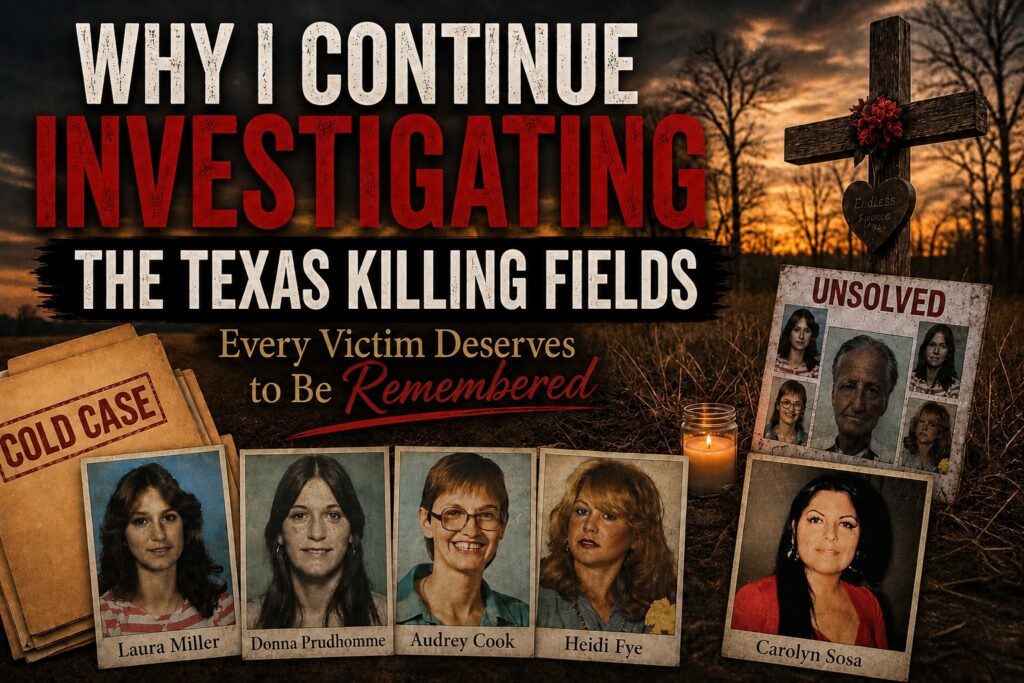
Why I Continue Investigating the Texas Killing Fields: Every Victim Deserves to Be Remembered
By Investigative Reporter Tammy Rose
People often ask why I continue investigating murders that happened more than 50 years ago.
They wonder why I file public records requests. They ask why I travel hundreds of miles to interview witnesses. They also question why I keep digging into cases that many people have forgotten.
When I began researching the Texas Killing Fields, one issue quickly bothered me.
Old news reports often focused on how the victims died. Police records also placed heavy attention on their circumstances. Those accounts did not always show who the women were or how they lived.
Authorities described some victims as runaways. Others struggled with addiction or lived through difficult times. Reports also linked some women to prostitution.
Those labels often overshadowed their identities.
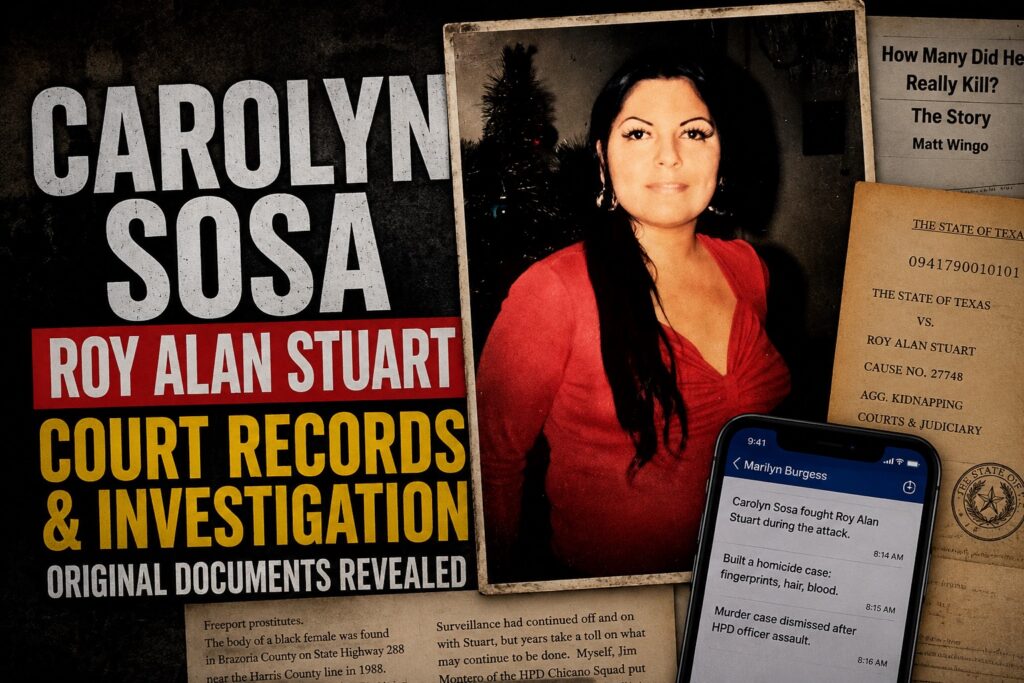
Investigators first viewed Laura Miller as a possible runaway. Reports also associated Carolyn Sosa and Teri McDaniel with prostitution.
Those descriptions may have been accurate, incomplete or unfair. Either way, they often became the focus of the story.
The victims deserved better.
No one should disappear from history because of a label.
My investigation has taken me across Texas and beyond.
I have tracked down key witnesses. I have interviewed retired investigators. I have reviewed thousands of pages of public records.
I have also examined evidence that many people have never seen.
Each interview raises another question. Every record leads to another document. One conversation can reveal a missing piece of history.
Some discoveries involve unidentified remains. Others involve witnesses who were overlooked years ago. Records may also expose decisions that still raise questions today.
I do not investigate these cases to sensationalize tragedy.
I investigate because every victim mattered.
A person’s past should never decide how much effort investigators make. It should not affect whether authorities search for them or work to solve their murder.
A straight-A student had value. A runaway had value. A woman struggling with addiction had value. A person living on the streets had value.
Their circumstances did not make their lives less important.
Justice should never depend on someone’s background.
My investigations sometimes require travel across Texas and beyond. When I need a place to stay near an interview, courthouse or records office, I compare available hotels through Hotels.com.
I also rely on practical tools while reviewing old case files. A portable document scannerhelps me preserve records, photographs and handwritten notes.
This post contains affiliate links. I may earn a small commission from qualifying bookings or purchases at no additional cost to you. As an Amazon Associate, I earn from qualifying purchases.
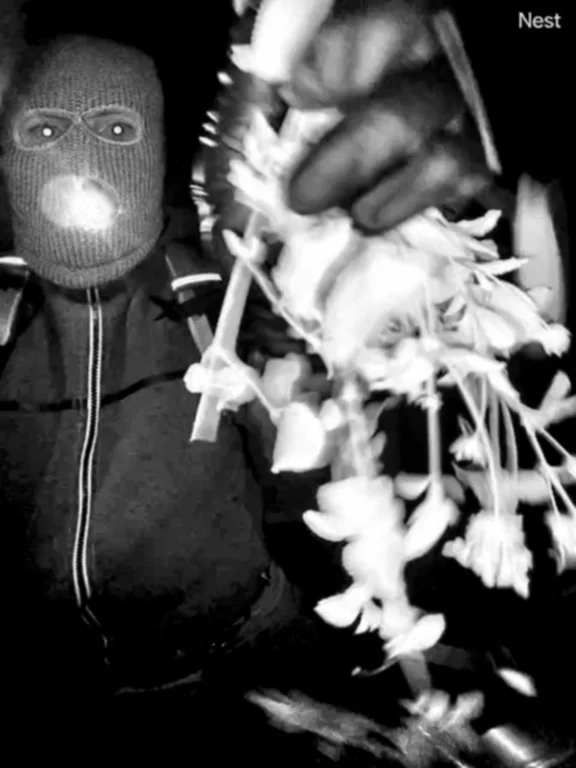
Porch surveillance image released as part of the investigation into the Nancy Guthrie case.
Public Records Reveal Ransom Messages Sent After Nancy Guthrie Disappeared
By Investigative Reporter Tammy Rose
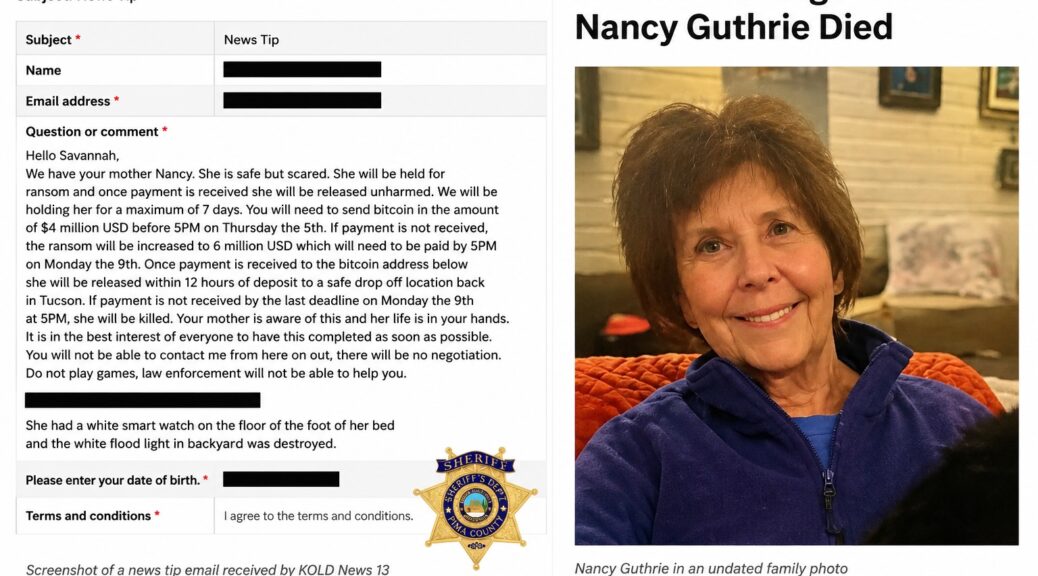
Nancy Guthrie disappeared from her home in the Catalina Foothills near Tucson, Arizona, during the early morning hours of February 1, 2026. Six months later, publicly released investigative records continue to provide insight into one of the most unusual aspects of the case.
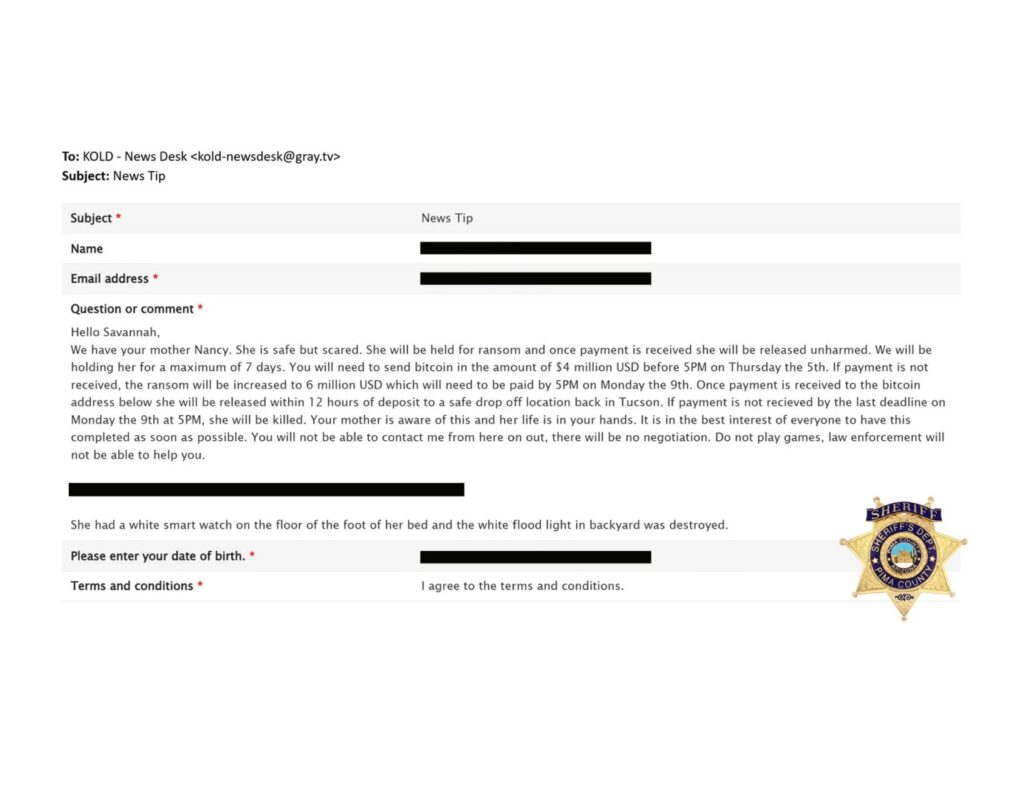
Among the documents released are messages that appeared to demand a ransom and later claimed Nancy Guthrie had died. The messages became part of the investigation and remain included in the publicly released records.
Ransom Message Demanded Bitcoin
Redacted ransom note documents included in the investigative records for the Nancy Guthrie case.
According to publicly released records, one message claimed Nancy Guthrie had been kidnapped and demanded a multi-million-dollar Bitcoin payment in exchange for her safe return.
The message included a deadline, threatened harm if payment was not made, and referenced details about Nancy Guthrie’s home. Investigators documented the message as part of the case.
At the time, there was no public confirmation that the claims made in the message were true.
Second Message Claimed Nancy Guthrie Died
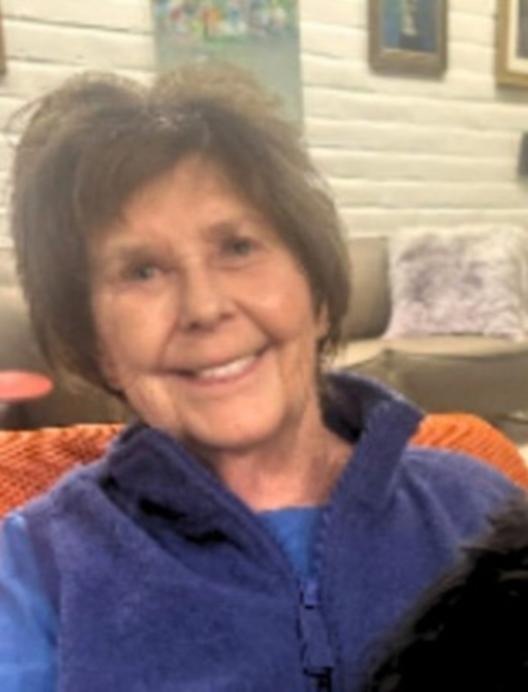
Nancy Guthrie in an undated family photo provided as part of case coverage.
A second message later claimed Nancy Guthrie had died shortly after being taken.
The message stated that her death was not intentional and expressed sympathy to her family. It also claimed she had been buried in a natural area.
Authorities included the message in the investigative file that was later released as a public record.
Investigators Examined the Messages
Law enforcement reviewed the messages as part of the investigation into Nancy Guthrie’s disappearance.
Publicly released records show the communications were preserved as evidence, but investigators have not publicly confirmed who authored the messages or whether any of the claims contained in them were accurate.
As with many criminal investigations, detectives examined numerous leads while working to determine what happened.
Why These Records Matter
The release of investigative records provides the public with a better understanding of the evidence reviewed during the case.
While the messages generated significant attention, they represent only one part of the overall investigation. Any conclusions about who sent them or why should be based on official investigative findings rather than speculation.
As additional records become public, they may continue to provide new details about the investigation.
If you have information related to the case, contact the investigating law enforcement agency.
⸻
Home Security Camera (Indoor/Outdoor) – If you’re interested in true crime or home security, a smart security camera is one of the best ways to monitor your property and record suspicious activity.
Planning to visit Texas for court proceedings, historical research, or to explore the areas connected to this case? Find hotels that fit your budget through my Hotels.com affiliate link.
Amazon Disclosure
As an Amazon Associate, I earn from qualifying purchases. If you shop through my affiliate links, I may receive a small commission at no additional cost to you. Thank you for supporting my independent journalism.
If you book a hotel through my Hotels.com affiliate links, I may earn a small commission at no additional cost to you. Thank you for helping support my reporting and website.
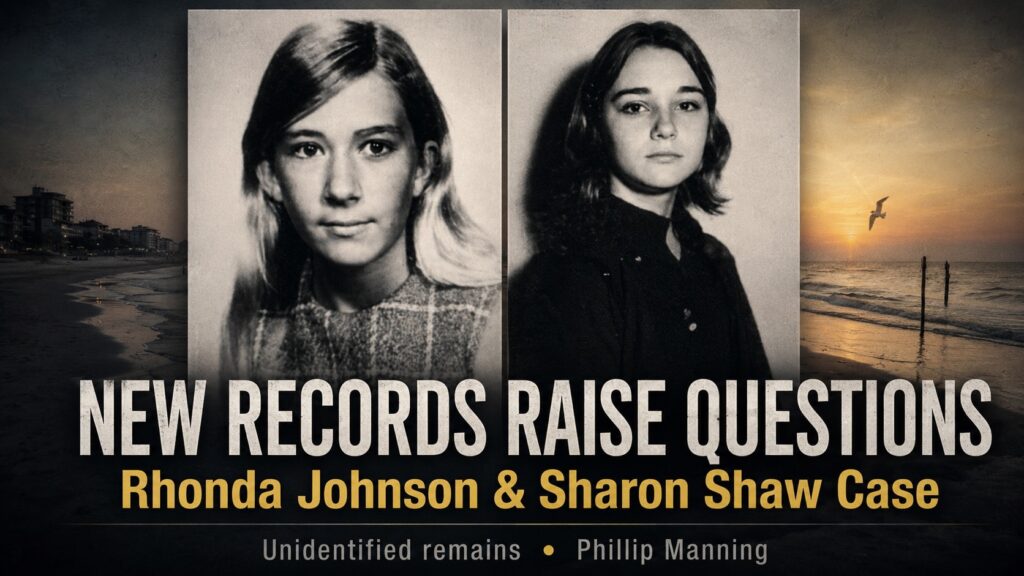
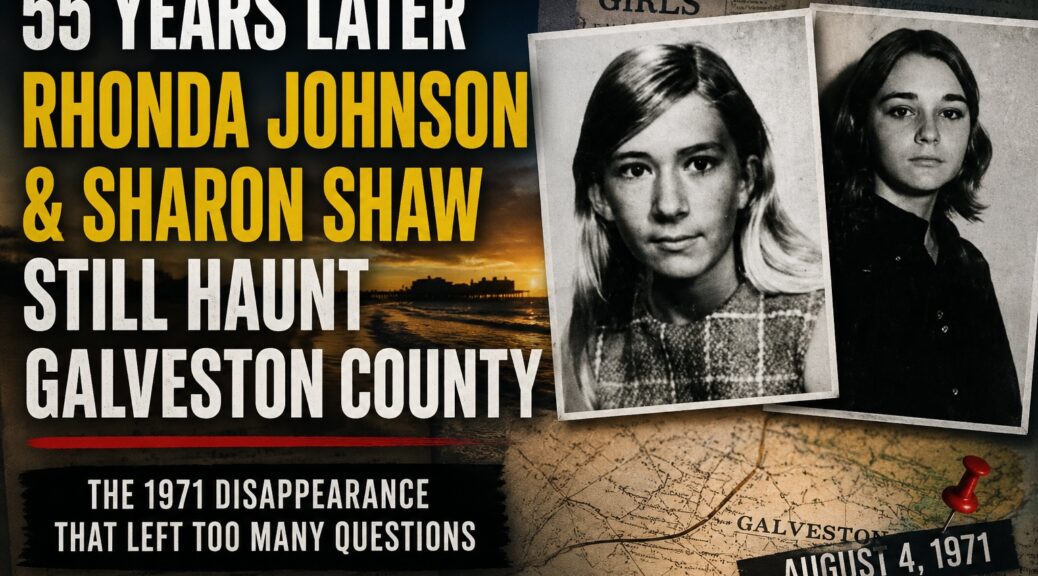
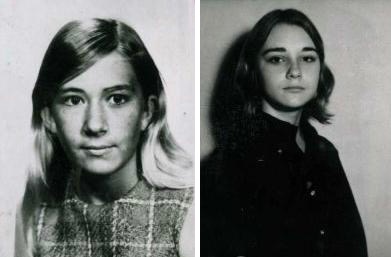
Rhonda Renee Johnson, left, and Sharon Lynn Shaw disappeared after traveling from Webster to Galveston on August 4, 1971.
By Investigative Reporter Tammy Rose
Two teenage friends left Webster for a summer day in Galveston on August 4, 1971. They never returned home.
Nearly 55 years later, the deaths of Rhonda Renee Johnson and Sharon Lynn Shaw remain surrounded by painful questions, a controversial confession and competing claims about who was responsible.
Rhonda was 14 years old. Sharon was 13 and just days away from her 14th birthday.
Their case became one of the earliest and most troubling mysteries associated with a series of young women and girls who disappeared across the Houston-Galveston region during the 1970s.
A Summer Trip to Galveston
Rhonda Johnson and Sharon Shaw traveled from Webster to Galveston on August 4, 1971, before they disappeared.
According to federal court records, Sharon and Rhonda were last seen on August 4, 1971, after leaving Webster for a day trip to Galveston, about 25 miles away.
The two friends reportedly spent time near the beach and Galveston Seawall. However, they did not make it home that evening.
Their disappearance launched a search that continued for months.
Their Remains Were Found Months Later
On January 3, 1972, human remains were discovered in the Clear Lake area.
Additional remains were found several weeks later. Authorities identified the victims as Sharon Shaw and Rhonda Johnson.
The medical examiner could not determine the cause of their deaths because there was no identifiable damage to the bones or skulls, according to the federal appellate record.
The discovery confirmed the families’ worst fears. However, determining who killed the girls would become far more complicated.
Michael Lloyd Self Was Convicted
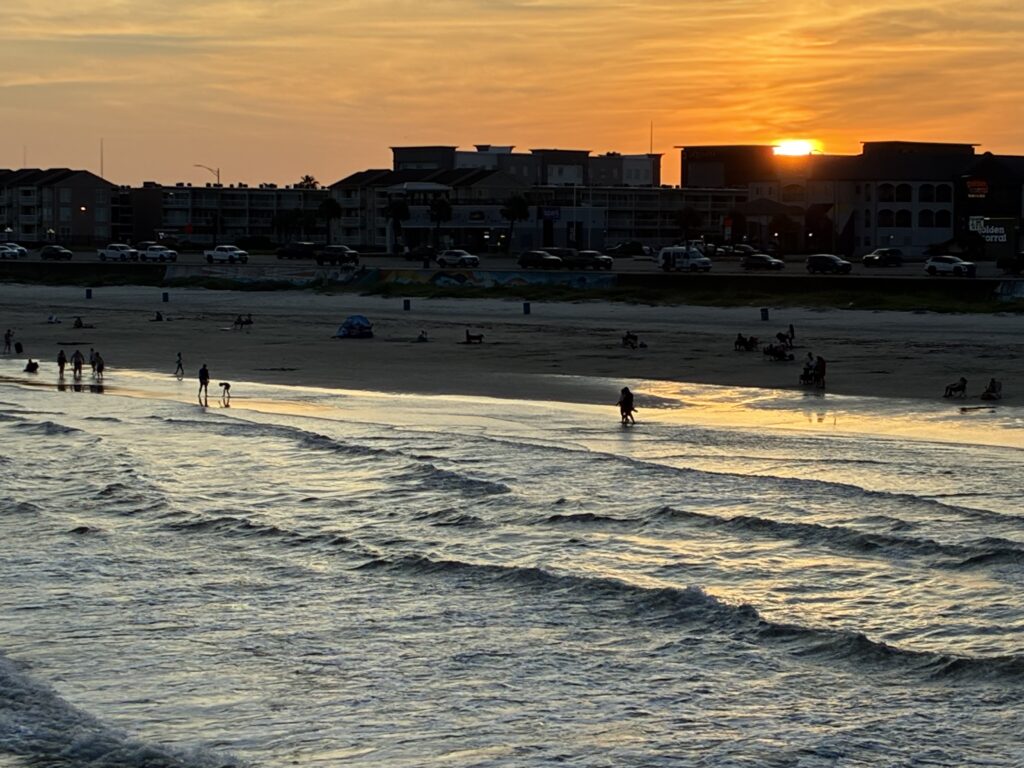
Michael Lloyd Self was convicted in Sharon Shaw’s death after the teenagers disappeared following a trip to Galveston in August 1971. This Galveston beach image is illustrative.
Investigators eventually focused on Michael Lloyd Self, a Galveston-area gas station attendant.
Self signed a confession after being questioned by police. He later withdrew it and claimed officers had threatened and physically abused him until he confessed.
Self was prosecuted for Sharon Shaw’s murder and received a life sentence. His conviction was upheld by the Texas Court of Criminal Appeals.
Questions about the confession followed the case for decades.
In 1991, a federal district court granted Self’s request for habeas relief after finding that his confession had been obtained in violation of his constitutional rights. However, the Fifth Circuit Court of Appeals later reversed that decision and allowed the conviction to stand.
Self maintained his innocence and died in prison in 2000.
A Second Man Claimed Responsibility
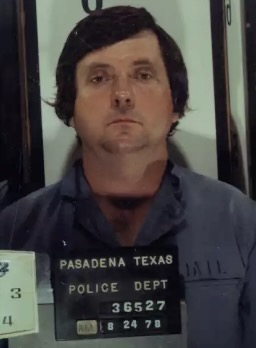
Edward Harold Bell in a 1978 Pasadena Police Department mugshot. Bell later claimed responsibility for several killings in Southeast Texas, but he was never charged in the deaths of Rhonda Johnson or Sharon Shaw. Image credited to the Pasadena Police Department; source copy via Wikipedia/Houston Chronicle.
Years later, convicted murderer Edward Harold Bell claimed he had killed several girls across Southeast Texas during the 1970s.
Bell referred to the victims as the “Eleven that went to Heaven.” His claims reportedly included two girls from Webster who disappeared after visiting Galveston in 1971.
Those details were believed to refer to Sharon and Rhonda.
Investigators familiar with Bell’s statements said portions of his accounts appeared to match information from several cases. However, Bell was never charged with killing Sharon or Rhonda.
Bell was serving a prison sentence for the 1978 murder of Larry Dickens when he died in 2019.
Families Were Left Without Definitive Answers
The conviction of Michael Self remained legally intact. Still, some investigators and members of the victims’ families came to believe Bell may have been responsible.
That leaves a difficult conflict at the center of the case.
One man was convicted based largely on a confession he said was forced. Another man later claimed responsibility but was never prosecuted in connection with the girls’ deaths.
No DNA evidence or weapon publicly connected Bell to the murders. His death ended any possibility that he-would face a trial or further questioning in court.
Remembering Rhonda and Sharon
Rhonda Renee Johnson, left, and Sharon Lynn Shaw disappeared after leaving Webster for a trip to Galveston on August 4, 1971. Public-domain image via Wikimedia Commons.
The competing accusations can easily overshadow the two young victims.
Rhonda and Sharon were teenage friends enjoying the final weeks of summer. Their families expected them to return home after a day at the beach.
Instead, August 4 became an anniversary marked by loss and unanswered questions.
As the 55th anniversary approaches, the most important part of this story remains the lives that were taken.
Rhonda Renee Johnson and Sharon Lynn Shaw should be remembered by their names—not simply as entries on a list of Texas cold cases.
Their families deserved clear answers then. They still deserve them today.
Related Texas Killing Fields Coverage
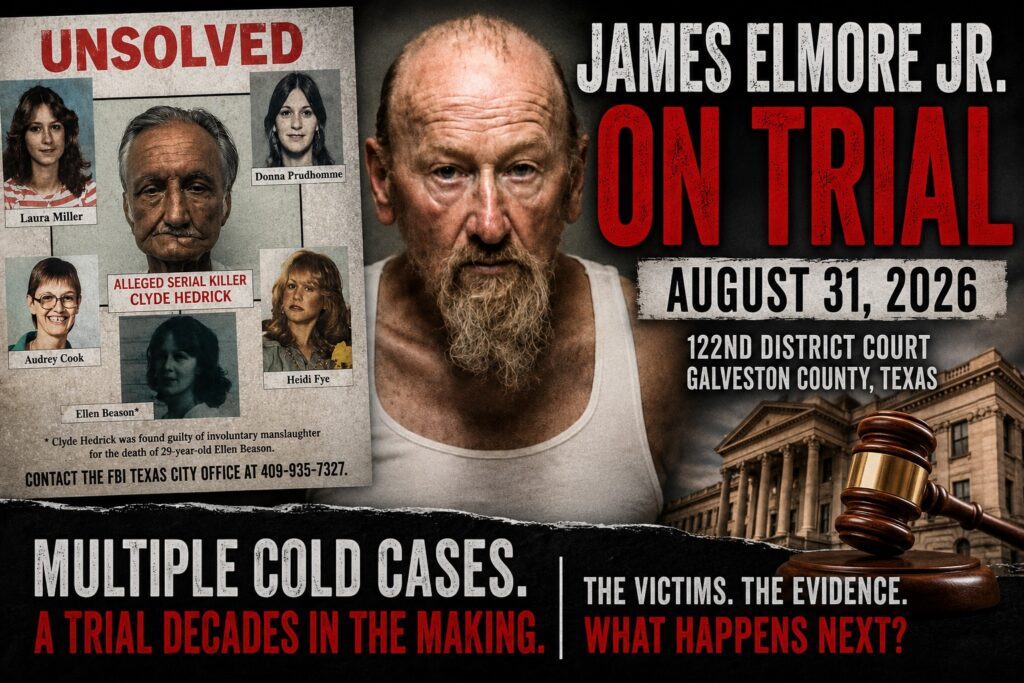
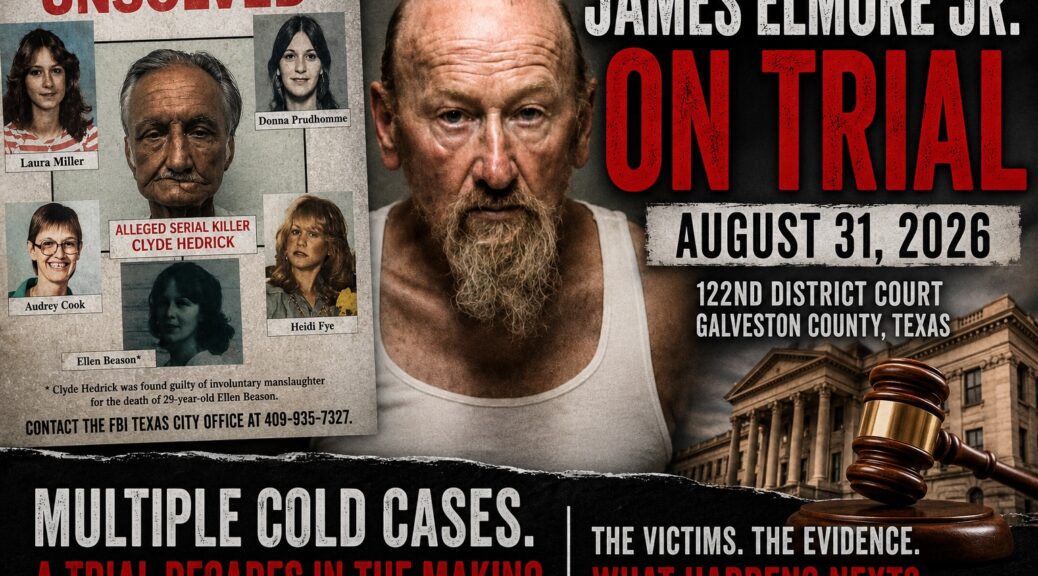
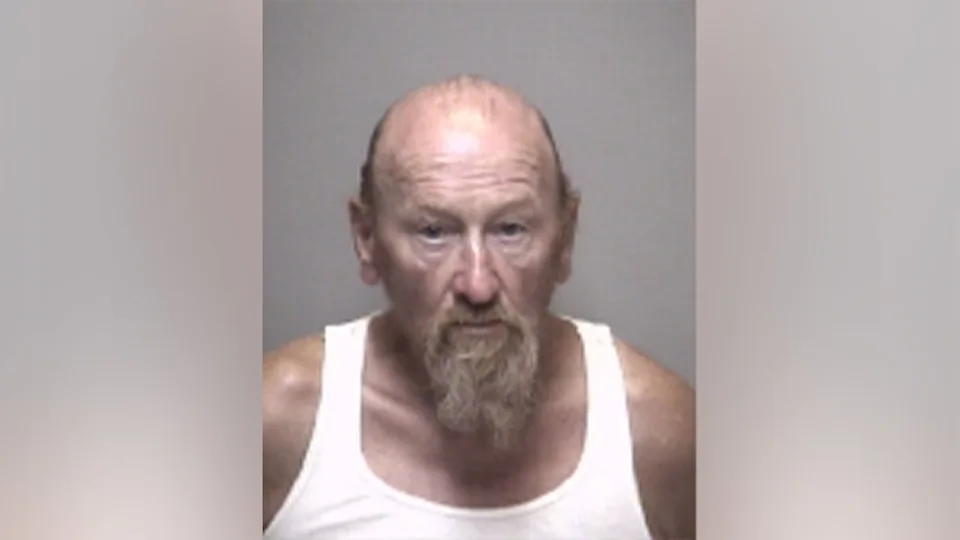
James Elmore Jr. booking photo. His trial is currently scheduled to begin Aug. 31, 2026, in Galveston County.
The questions surrounding Sharon and Rhonda are part of a much larger history of disappearances and deaths along the Interstate 45 corridor between Houston and Galveston.
The upcoming trial of James Elmore Jr. is also expected to renew attention on the Calder Road area known as the Texas Killing Fields.
Elmore is charged in connection with the death of Laura Miller and allegations involving the movement of human remains. His jury trial is currently scheduled to begin August 31 in Galveston County’s 122nd District Court.
This story is based on available court records and previously published reporting. Some allegations were never proven in court. Edward Harold Bell was never charged with the deaths of Rhonda Johnson or Sharon Shaw.
Many people visit Galveston to explore its history, beaches and landmarks. Travelers looking for a place to stay can compare Galveston hotels, prices and availability through Hotels.com before planning their trip.
I may earn a commission if you book through Hotels.com, at no additional cost to you.
Recommended True-Crime Reading
Readers interested in researching historic cases may find a Texas road atlas helpful for understanding the distance between Webster, Galveston, Clear Lake and other locations connected to the investigation.
A portable document organizer can also help keep court records, timelines, printed articles and handwritten notes arranged while researching a complicated cold case.
James Elmore Jr. booking photo. His trial is currently scheduled to begin Aug. 31, 2026, in Galveston County.
James Elmore Jr. Trial Moves Forward
Nearly four decades after several young women were found murdered and their bodies abandoned near Calder Road in Galveston County, the case against James Elmore Jr. continues moving toward trial.
For many victims’ families, the upcoming court proceedings represent another chance to finally see justice.
After checking the Galveston County court docket, I confirmed the case is still moving forward.
According to the current schedule:
Discovery Conference: August 10, 2026
Pretrial Conference: August 21, 2026
Jury Trial: August 31, 2026
The trial is scheduled in the 122nd District Court before Judge Jeth Jones.
If the schedule remains unchanged, I plan to attend the trial and provide updates from the courtroom.
Laura Miller’s Family Has Waited Decades for Answers
Tim Miller, founder of Texas EquuSearch, has assisted in hundreds of missing persons cases across Texas and the United States.
Laura Miller was last seen on September 10, 1984, after stopping at a convenience store in League City to use a pay phone. Her mother had dropped her off because the family’s phone had not yet been connected after they moved into the area.
Laura never returned home.
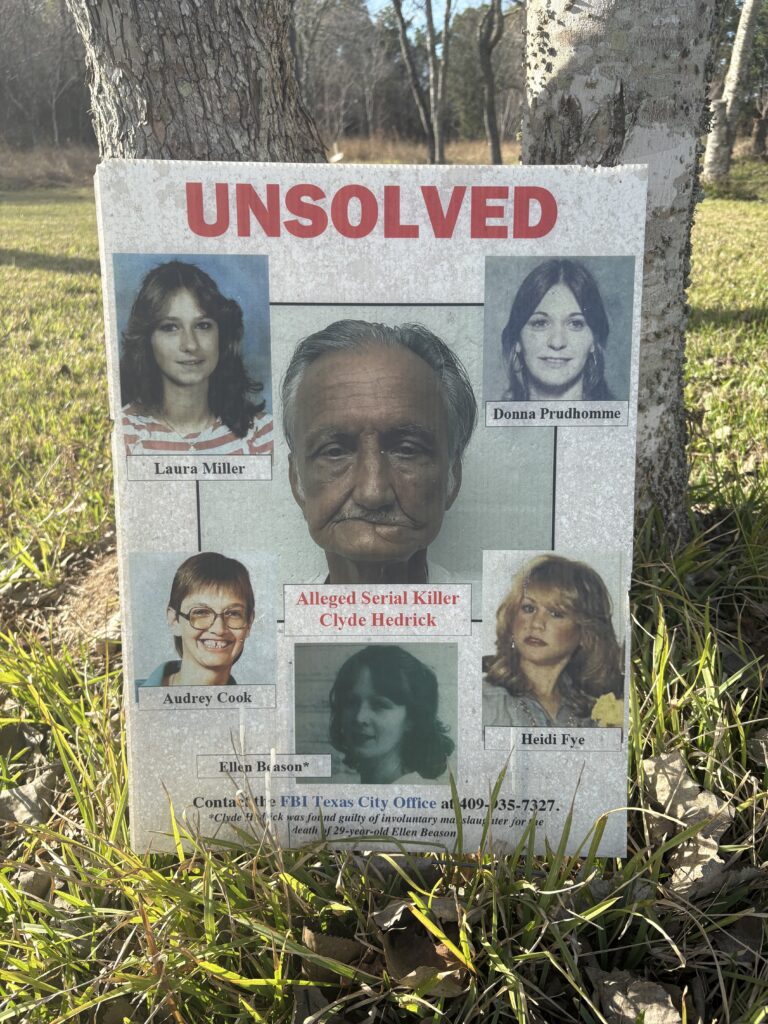
Memorial sign highlighting four victims whose cases have been linked to the same recovery site during the investigation into Clyde Hedrick and several unsolved homicides.
Nearly 17 months later, on February 2, 1986, her remains were discovered in a wooded area near Calder Road. During that same search, investigators also found the remains of Audrey Cook.
For both families, the upcoming trial comes after decades of unanswered questions.
In an earlier interview, Texas EquuSearch founder Tim Miller discussed Laura Miller’s disappearance, the years of searching, and why the case has remained so important to investigators and her family.
Watch: Tim Miller Discusses Laura Miller’s Disappearance
Charges Against James Elmore Jr.
James Elmore Jr. booking photo. He is scheduled to stand trial beginning Aug. 31, 2026, in Galveston County.
James Elmore Jr. remains jailed while awaiting trial.
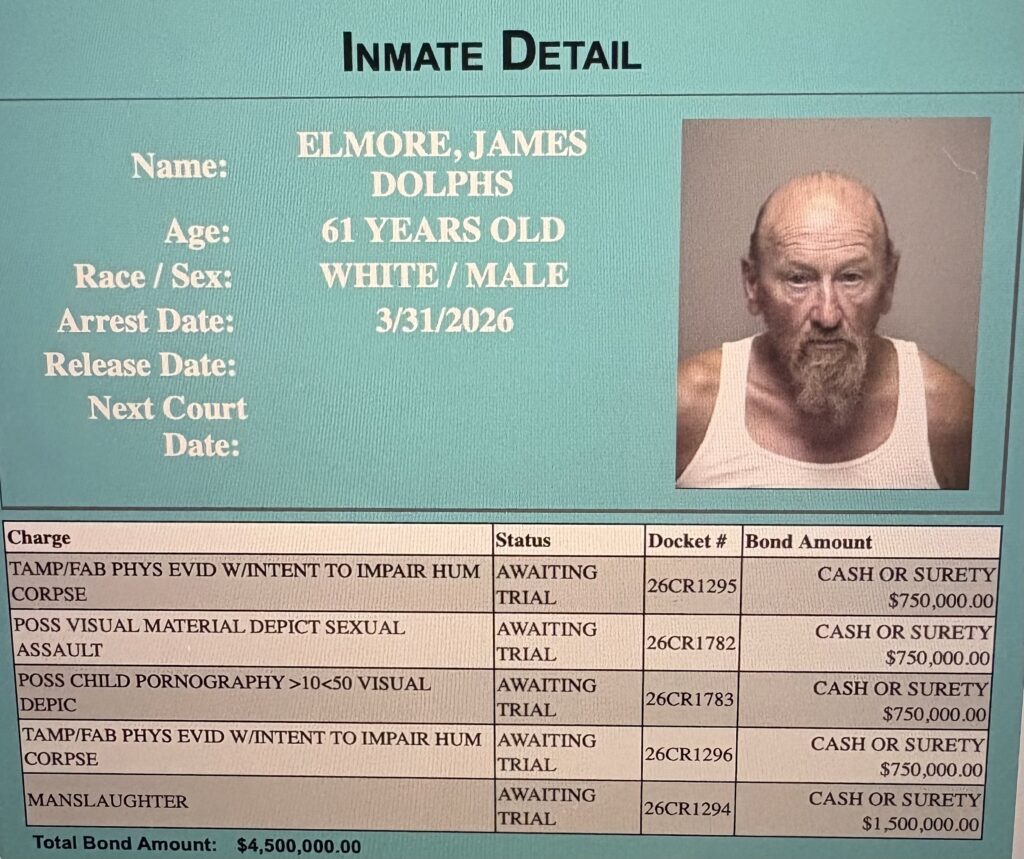
According to jail records, he faces the following charges:
Manslaughter
Two counts of tampering with physical evidence involving a human corpse
Possession of visual material depicting sexual assault
Possession of child sexual abuse material
His total bond is listed at $4.5 million.
As with all criminal cases, these charges are allegations, and James Elmore Jr. is presumed innocent unless proven guilty in court.
Clyde Hedrick Died Before Additional Charges Could Be Filed
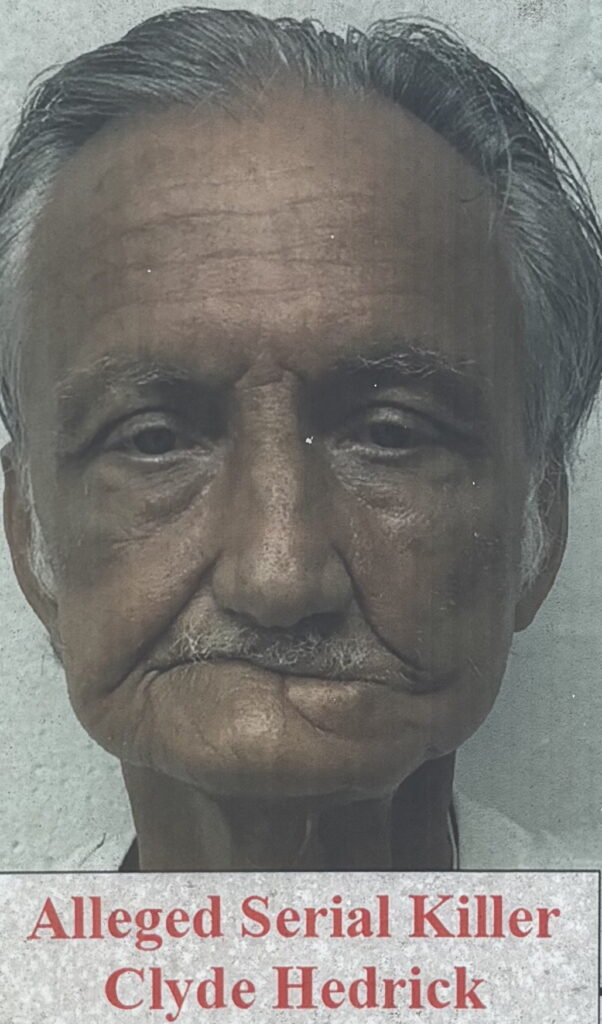
Clyde Hedrick was convicted in the murder of Ellen Beason. Investigators were preparing to charge him in additional cases before his death in March 2026.
The upcoming trial follows the death of Clyde Hedrick, who for years had been publicly linked to several Texas Killing Fields investigations.
Authorities were reportedly preparing additional charges against Hedrick. However, on March 21, 2026, Hedrick removed his breathing tube and died before those charges could be filed.
Hedrick was convicted only in the death of Ellen Beason. He served prison time for that case and was on parole when he died.
Trial Could Bring Long-Awaited Answers
Whether new evidence or testimony emerges during the trial remains to be seen.
However, for the families of Laura Miller, Audrey Cook, Donna Prudhomme, Heidi Fye, and others connected to the Calder Road investigations, the upcoming proceedings represent another opportunity to seek answers after nearly 40 years.
I’ll continue monitoring the Galveston County court docket and, if the trial remains on schedule, will be in the courtroom beginning August 31 to provide updates.
Whether you’re traveling to attend court proceedings or visiting Galveston Island, you can compare hotels throughout Galveston County before your trip.
As I continue covering cold cases and court proceedings, a reliable body camera is an important part of documenting interactions in the field. This is similar to the type of equipment many journalists and investigators use.
Amazon Affiliate Disclosure
Disclosure: As an Amazon Associate, I earn from qualifying purchases. If you purchase through my links, I may receive a small commission at no additional cost to you.
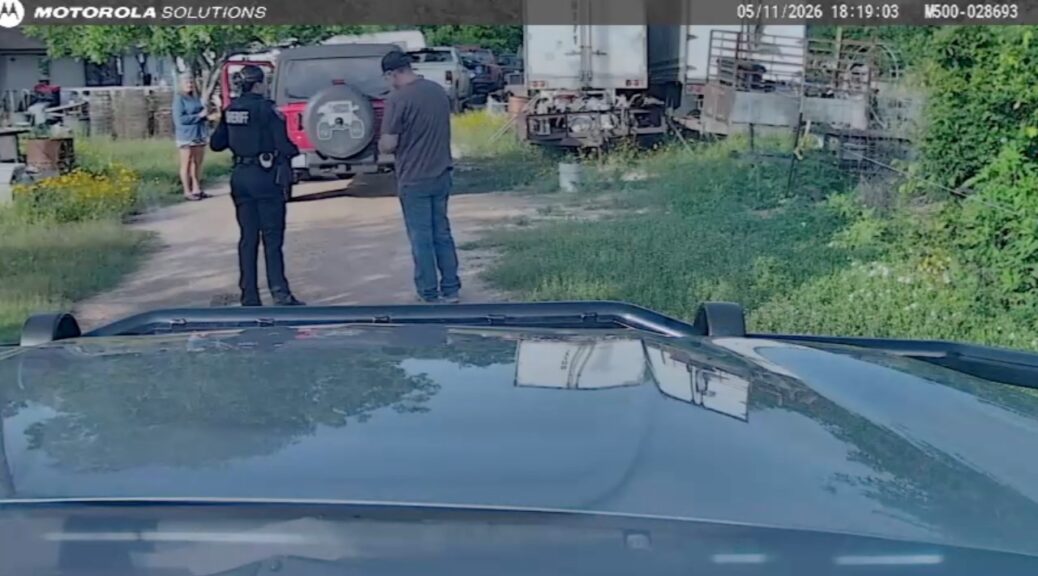
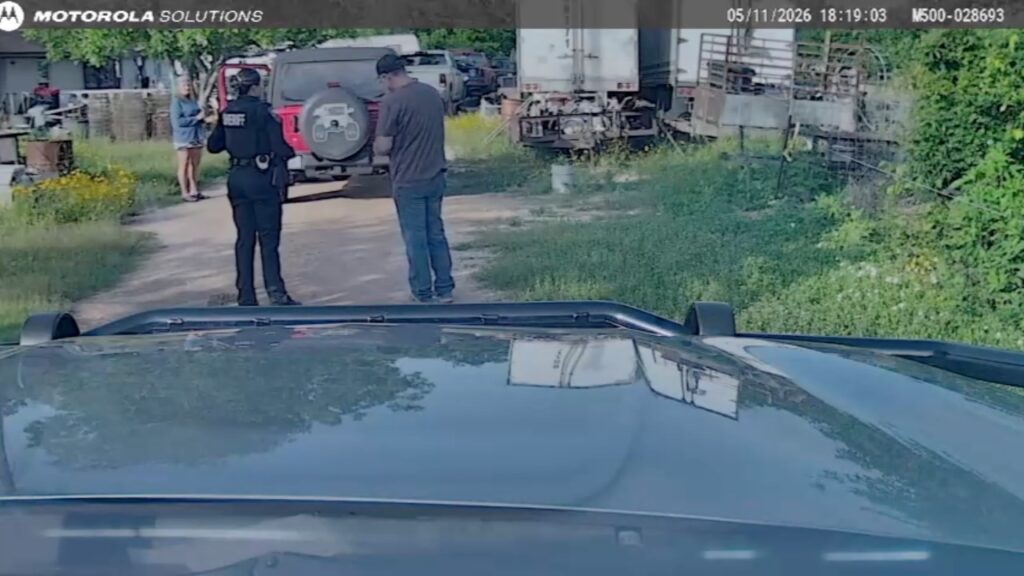
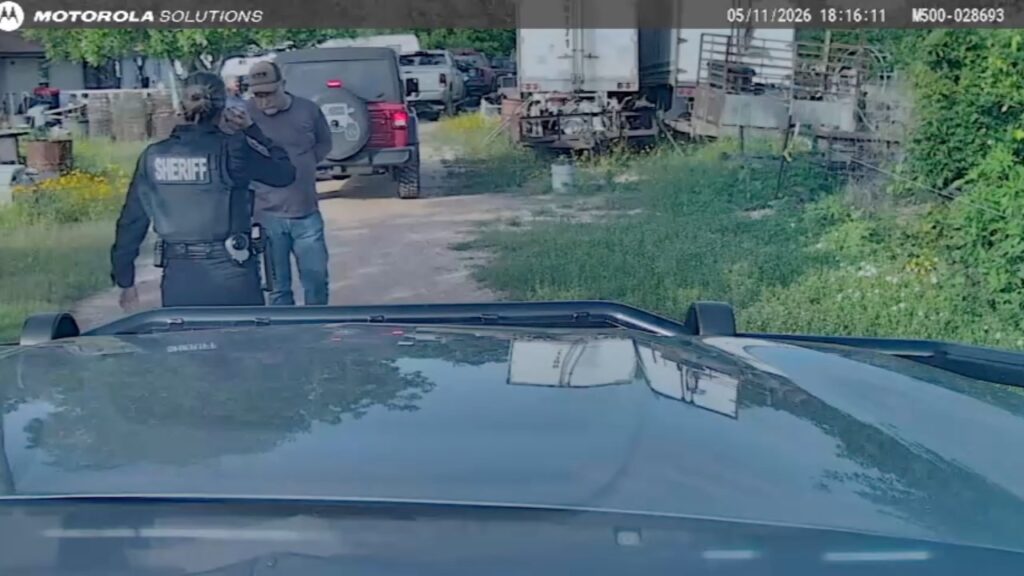
Screenshot from the dash camera video released by Brazoria County in response to a Texas Public Information Act request. The recording contains no audio. The requested body camera video remains pending while the Texas Attorney General reviews whether it may be withheld.
Texas Public Information Act Request Leads to Dash Camera Release While Body Camera Remains Under Review
The Brazoria County Criminal District Attorney’s Office released the dash camera recording in response to my Texas Public Information Act request. The responding deputy’s body camera recording remains under review by the Texas Attorney General.
Page one of the Brazoria County Criminal District Attorney’s Office response confirming my public information request, payment, and the release of the dash camera recording while the requested body camera recording remains under review by the Texas Attorney General.
By Investigative Reporter Tammy Rose
Transparency matters. That is why I filed a Texas Public Information Act request after an encounter with a woman connected to the Rebecca Beard investigation.
The request resulted in sheriff’s reports, dispatch records, redacted documents, and dash camera video. However, one important record remains unavailable. The Brazoria County District Attorney’s Office has asked the Texas Attorney General to decide whether the responding deputy’s body camera can be withheld.
This article explains what happened, what the released records show, and why I continue to seek the body camera recording.
Why I Went to the Property
As an investigative reporter, I believe everyone deserves an opportunity to comment before publication.
I went to Cherie “Rio” Starr’s residence to request an interview about statements she has made regarding the Rebecca Beard investigation.
She declined to comment.
According to the incident report, Starr told deputies she was a protected witness and wanted to know how I obtained her personal information.
The report also states she believed someone had sent me to her property.
I Returned to My Jeep
After Starr declined to comment, I walked back to my Jeep because I intended to leave.
According to the sheriff’s report, I told deputies that Starr and Kenneth Cadenhead prevented me from leaving the property.
The dashcam video released by Brazoria County contains no audio. Therefore, it cannot capture the conversations that occurred during the encounter.
However, the video does show Starr standing near my driver’s side while Cadenhead remained behind my Jeep during part of the incident.
According to my recollection, both were asking me to identify my confidential source.
I declined.
Why I Would Not Reveal My Source
The incident report notes that I refused to identify my source.
That decision was intentional.
Protecting confidential sources is a long-standing practice in investigative journalism. Sources often provide information only because they trust reporters to keep their identities confidential.
My purpose that day was to request an interview. It was not to disclose who provided information for my reporting.
A Detail Not Included in the Report
One part of the encounter is not reflected in the written incident report.
According to my recollection, while standing near my driver’s side door, Starr told me she would agree to an interview “when this is all over.”
She also indicated that the Rebecca Beard investigation remained an active case that had never been closed.
Because the released dashcam has no audio, viewers cannot hear that conversation.
For that reason, I continue to seek release of the responding deputy’s body camera recording.
What the Public Records Show
My Texas Public Information Act request produced several records, including:
Sheriff’s incident reports Dispatch and CAD records Dashcam video Redacted documents
The only major record that has not been released is the deputy’s body camera.
The District Attorney’s Office has asked the Texas Attorney General to determine whether that recording may be withheld under the Texas Public Information Act.
Receiving a request for an Attorney General ruling does not automatically mean the recording will never be released. The Attorney General will determine whether any exceptions to disclosure apply under Texas law.
How I Obtained the Records
Many people ask how to request police records in Texas.
In my case, I submitted a Texas Public Information Act request to Brazoria County.
After receiving a cost estimate, I paid the required fee at the Brazoria County Treasurer’s Office inside the courthouse.
The courthouse is beautiful, although locating the correct office can be a little confusing for first-time visitors.
After payment was processed, I went to the District Attorney’s Office to pick up the responsive records.
Everyone I dealt with during the process was courteous and helpful.
I also received more records than I expected.
Part Two Is Coming Soon
In Part Two, I will explain the Texas Public Information Act process step by step.
I will also show:
How to submit an open records request Where to pay the required fees How to pick up responsive records Why some records are released immediately while others require a ruling from the Texas Attorney General
Understanding the process can help anyone request public records in Texas.
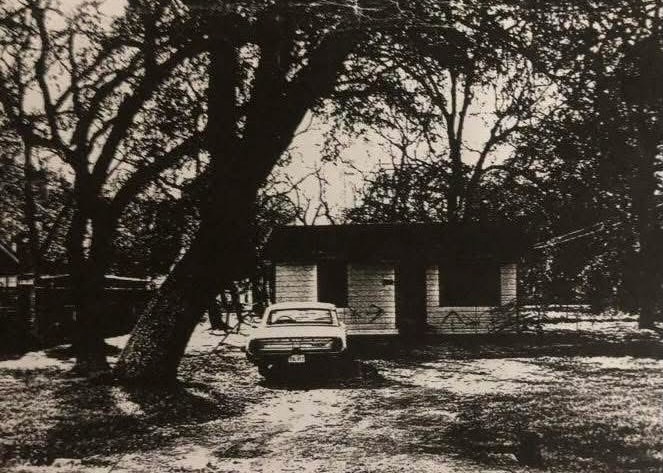
Paul Taylor’s former Clute residence, where investigators later focused much of the Rebecca Beard investigation as witness statements and the case timeline evolved over time.
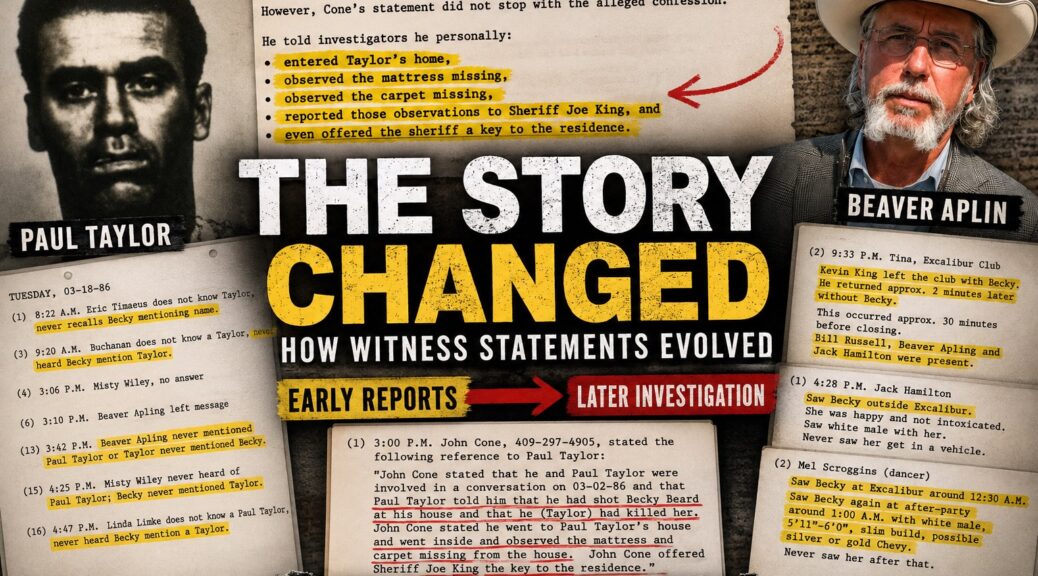
Rebecca Beard Part 3: How Witness Statements Changed During the Investigation
By Investigative Reporter Tammy Rose
As I continued reviewing the original investigative file in the Rebecca Beard case, one pattern became impossible to ignore.
The earliest reports tell a very different story than the theory prosecutors ultimately presented years later.
During the first weeks of the investigation, detectives documented witnesses who said they did not know Paul Taylor or had never heard Becky mention him. At the same time, investigators pursued reports that Becky was seen after leaving the Excalibur Club, including at a Surfside beach party and an after-party.
Months later, investigators had assembled a very different timeline.
The records show how that evolution occurred.
⸻
Early Witnesses Did Not Connect Becky to Paul Taylor
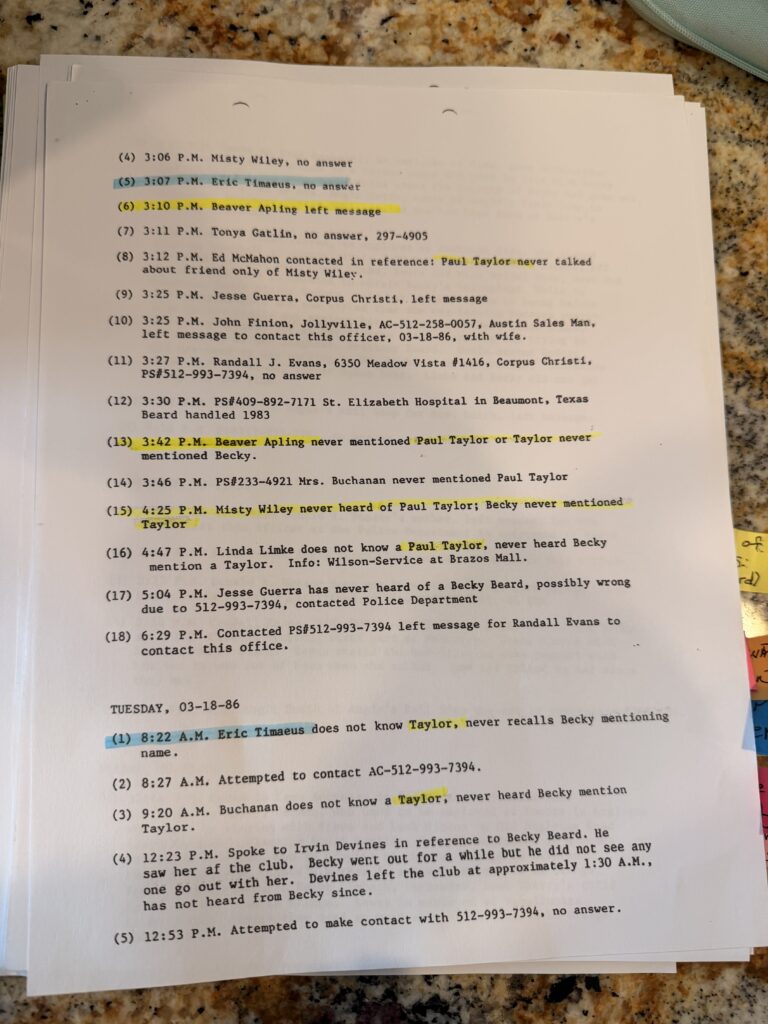
A March 1986 police report documents early witness interviews in the Rebecca Beard investigation. Several witnesses told detectives they did not know Paul Taylor or had never heard Becky mention him, reflecting one of the investigation’s earliest lines of inquiry.
One of the strongest themes in the March 1986 reports is how often investigators documented witnesses saying they had no connection between Becky Beard and Paul Taylor.
Among those interviewed were:
Beaver Aplin, who investigators noted never mentioned Paul Taylor, and Taylor had never mentioned Becky.
Eric Timaeus, Becky’s friend, who said he did not know Paul Taylor and never recalled Becky mentioning his name.
Misty Wiley, who said she had never heard of Paul Taylor and Becky never mentioned him.
Linda Barnes (identified in some records as Linda Limke), who said she had never heard Becky mention Paul Taylor.
Mrs. Buchanan, who also said she did not know Taylor.
At this point in the investigation, detectives had not yet developed the theory that Paul Taylor was the last person with Becky.
⸻
Several Witnesses Reported Becky Alive After Leaving Excalibur
The earliest reports also show investigators pursuing multiple leads suggesting Becky continued socializing after leaving the Excalibur Club in Freeport.
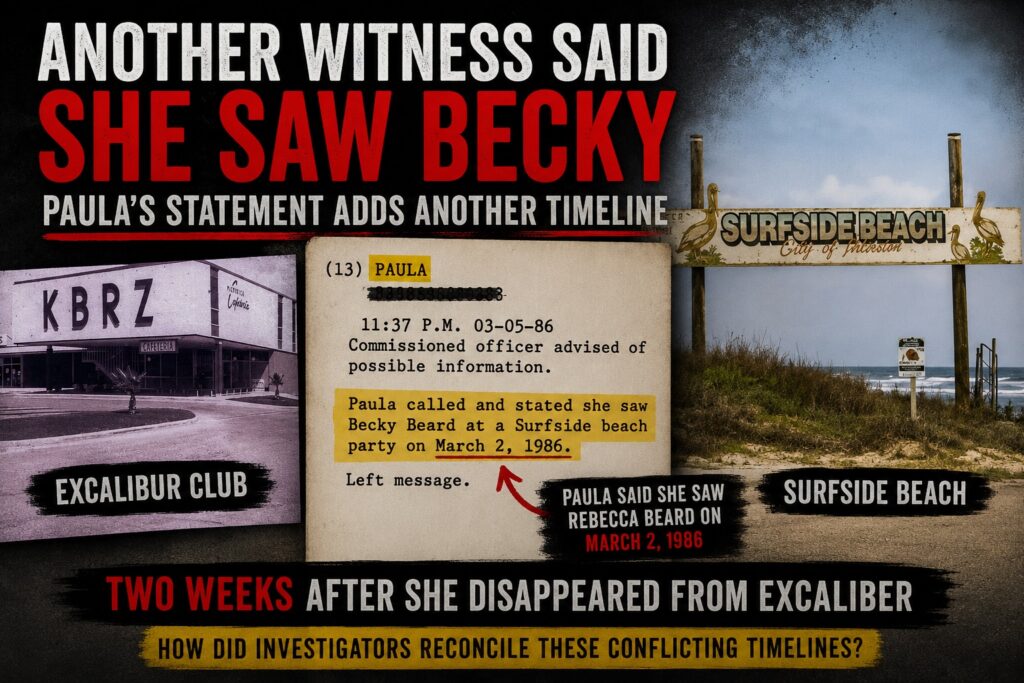
Paula’s Surfside Account
One witness, Paula, told investigators she saw Becky at a Surfside beach party during the morning hours after she disappeared.
That account suggested Becky may have left the club and traveled elsewhere.
Jack Hamilton’s Statement
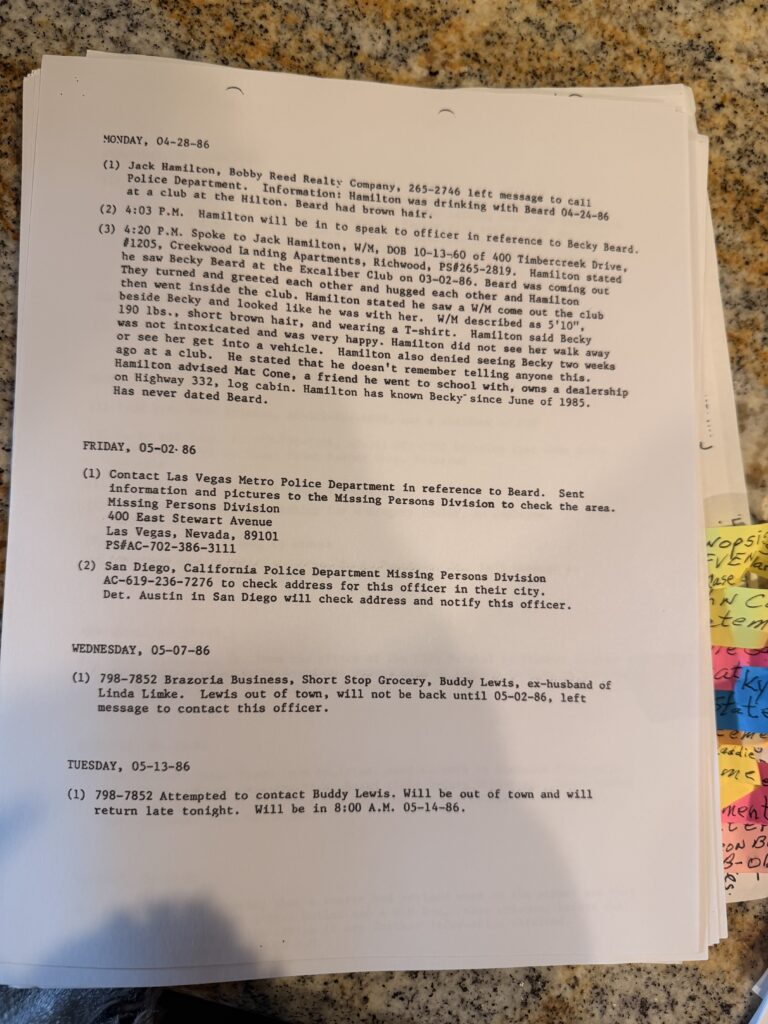
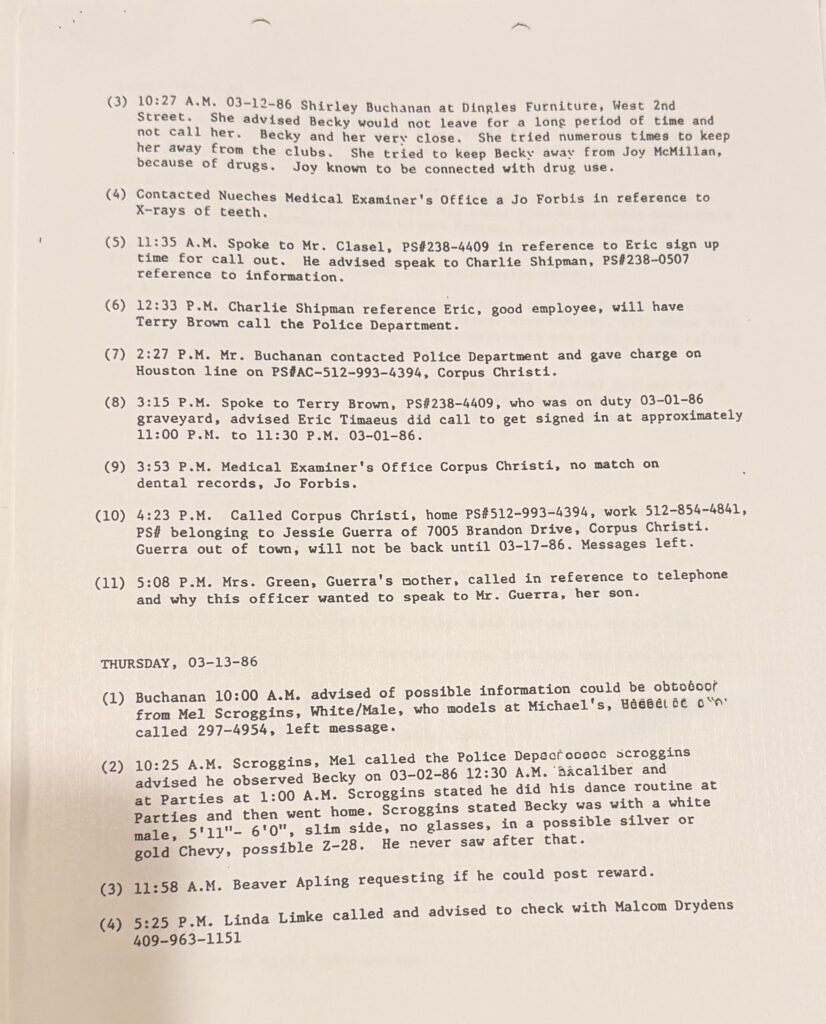
An April 28, 1986 police report documents interviews with Jack Hamilton and dancer Mel Scroggins. Both described seeing Becky Beard after she left the Excalibur Club, adding to the early investigative timeline detectives were working to reconstruct.
On April 28, 1986, Jack Hamilton told investigators he saw Becky outside the Excalibur Club.
Hamilton said:
Becky appeared happy. She was not intoxicated. The two greeted each other and hugged. He saw an unidentified white male walk out beside Becky who appeared to be with her. He never saw Becky get into a vehicle.
Importantly, Hamilton did not identify the man as Paul Taylor.
Hamilton also told investigators he knew Matt Cone, a longtime friend.
Dancer Reported Seeing Becky at an After-Party
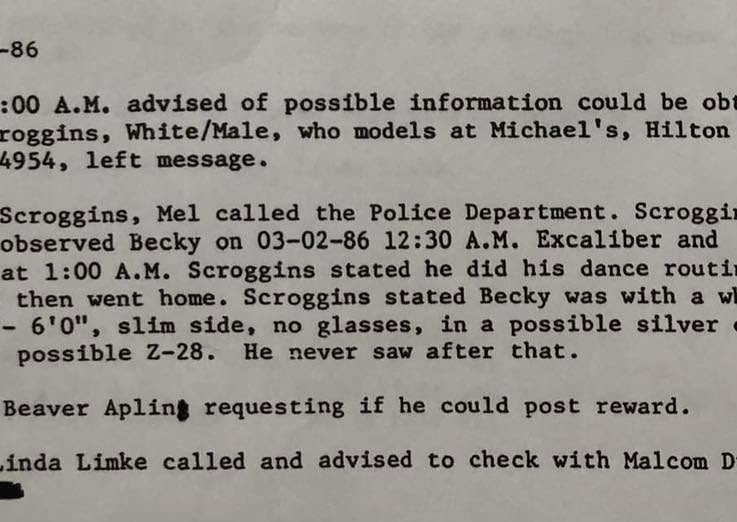
A March 13, 1986 police report documents dancer Mel Scroggins’ statement that he saw Becky Beard at the Excalibur Club and later at an after-party around 1:00 a.m. The report also notes Beaver Aplin contacted investigators about posting a reward.
Another witness, Mel Scroggins, also described seeing Becky after she left Excalibur.
Scroggins told investigators he saw Becky around 12:30 a.m. at Excalibur before performing his dance routine.
He then reported seeing Becky again around 1:00 a.m. at an after-party.
According to Scroggins, Becky was accompanied by:
a white male, approximately 5’11” to 6’0”, slim build, no glasses, associated with a possible silver or gold Chevrolet.
Again, the man was not identified as Paul Taylor.
Scroggins said he never saw Becky after that.
When viewed together, these reports show detectives were actively investigating the possibility that Becky continued on to other locations after leaving Excalibur.
⸻
John Cone’s Statement Became a Turning Point
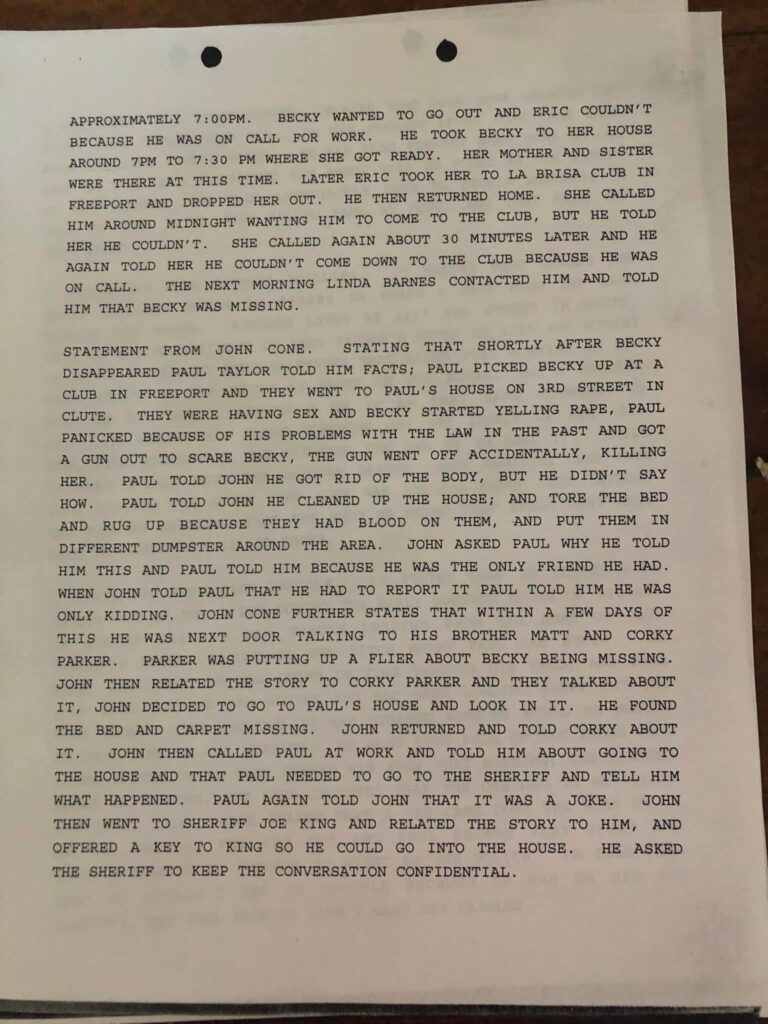
Police records show John Cone told investigators that Paul Taylor admitted Becky Beard died at his home. Cone also stated he personally entered the house, observed the mattress and carpet were missing, and reported those observations to Sheriff Joe King while offering a key to the residence.
Another major development came from John Cone.
Cone told investigators Paul Taylor admitted Becky died inside his Clute home after a gun discharged during an encounter.
However, Cone’s statement did not stop with the alleged confession.
He told investigators he personally:
entered Taylor’s home, observed the mattress missing, observed the carpet missing, reported those observations to Sheriff Joe King, and even offered the sheriff a key to the residence.
Those observations were based on what Cone said he personally witnessed, not simply what Taylor allegedly told him.
⸻
Matt Cone Appears to Corroborate Parts of the Story
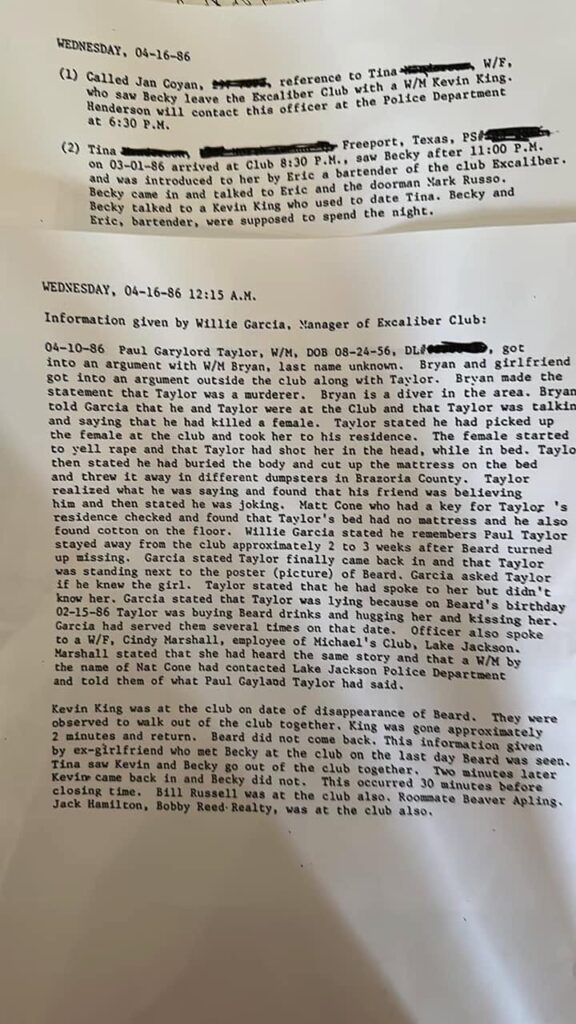
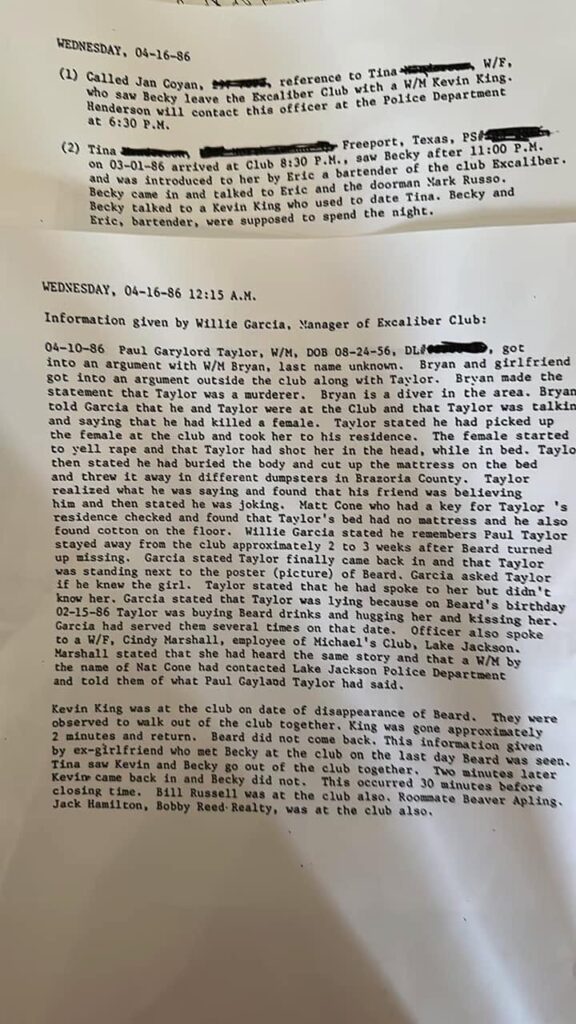
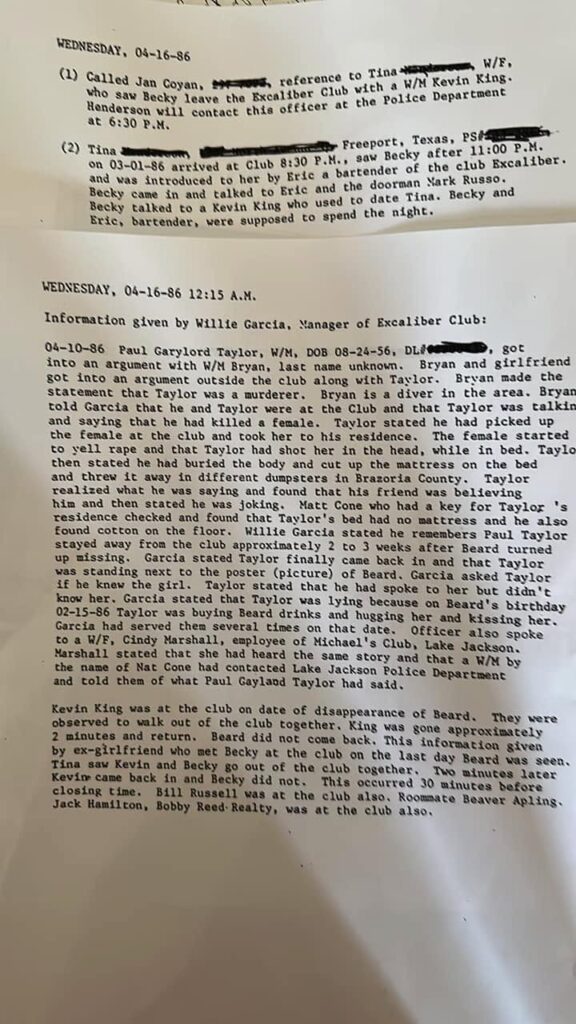
April 16, 1986 police records include statements from Tina and Excalibur Club manager Willie Garcia. The documents also reference Matt Cone, John Cone’s brother, whose name appears multiple times in the investigation as detectives continued interviewing witnesses and following leads.
The records also repeatedly reference Matt Cone.
John Cone told investigators he discussed the situation with his brother, Matt Cone, and Corky Parker before going to Taylor’s house.
Jack Hamilton also identified Matt Cone as someone he knew.
If Matt Cone independently observed the missing mattress and carpet, that would provide additional corroboration of John’s observations.
Whether Matt entered the home himself or relied on John’s account remains an important question raised by the records.
⸻
Beaver Aplin Continued Contacting Investigators
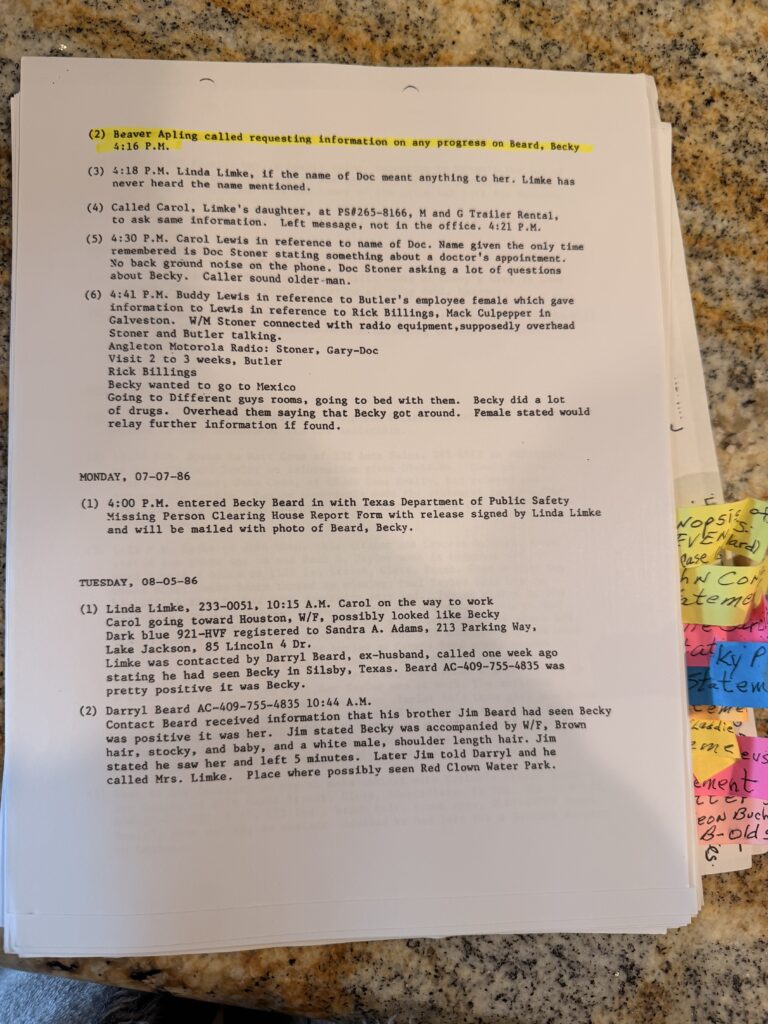
Police records show Beaver Aplin remained in regular contact with investigators after Rebecca Beard disappeared. The reports document Aplin requesting case updates, asking about posting a reward, and continuing to communicate with detectives as the investigation progressed.
Another interesting pattern involves Beaver Aplin.
The investigative file documents that:
Beaver was interviewed during the early stages of the case. Investigators noted he did not connect Becky to Paul Taylor. He later left messages for investigators. Months later, he again contacted police requesting an update on Becky’s case.
Those records do not suggest wrongdoing.
However, they do show Beaver remained engaged with investigators long after Becky disappeared.
⸻
The Investigation Evolved
As the investigation continued, the documentary record began shifting.
Later reports increasingly connected Becky to Paul Taylor.
Among them were statements from:
Willie Garcia, Kevin King, John Cone, and other witnesses who later appeared on the prosecution’s witness list.
That witness list outlined how prosecutors intended to build their case, including testimony that Becky left with Taylor, statements that Taylor admitted killing her, and witnesses describing evidence allegedly observed inside Taylor’s home.
That later theory differs considerably from many of the earliest reports documenting possible Surfside sightings, after-party sightings, and witnesses who initially said they did not know Paul Taylor.
⸻
Questions That Remain
Reading these records chronologically reveals an investigation that changed significantly over time.
The documents show detectives initially pursued multiple leads, including reports that Becky was seen after leaving Excalibur and accounts from witnesses who did not connect her to Paul Taylor.
As additional interviews were conducted, investigators documented statements that increasingly focused on Taylor and ultimately formed the basis of the prosecution’s case.
The records do not fully explain how every conflicting witness account was evaluated before investigators settled on the final timeline presented in court.
Nearly four decades later, those documents continue to provide important insight into how the Rebecca Beard investigation developed—and why reviewing the original records remains essential.
⸻
Read More in This Series
Part 1: Rebecca Beard: John Cone’s Confession and the Early Investigation
Disclosure: As an Amazon Associate, I earn from qualifying purchases at no additional cost to you. Your support helps fund my investigative reporting and allows me to continue researching and publishing stories like this one.
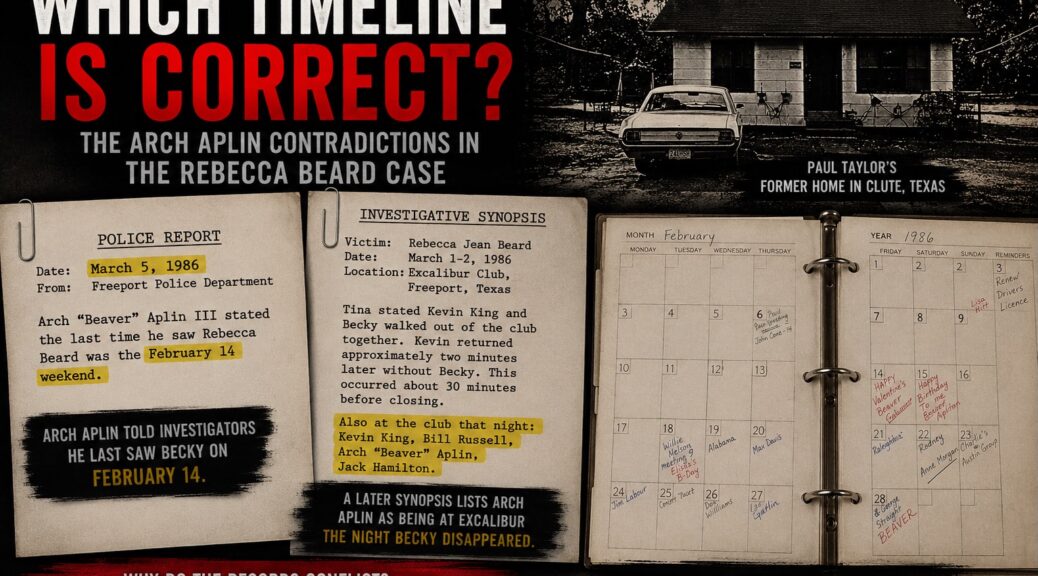
Early police records reveal conflicting timelines in the Rebecca Beard investigation. This graphic compares witness statements, investigative documents, and Rebecca’s personal planner to examine how the investigation evolved during its first days. Reporting by Investigative Reporter Tammy Rose.
Rebecca Beard Part 2: Early Police Reports Show How the Investigation Evolved
Rebecca Beard disappeared during the early morning hours of March 2, 1986, after spending the previous evening at the Excalibur Club in Freeport, Texas. During the first days of the investigation, detectives worked to reconstruct her final hours by interviewing friends, coworkers, club patrons, and anyone who may have seen her before she vanished.
The earliest police reports provide a snapshot of where the investigation began. At that stage, detectives had not narrowed their focus to one individual. Instead, they documented numerous interviews, followed multiple leads, and worked to establish Rebecca’s last known movements.
Nearly four decades later, those reports remain important because they show how the investigation developed over time.
Detectives Worked to Build Rebecca Beard’s Timeline
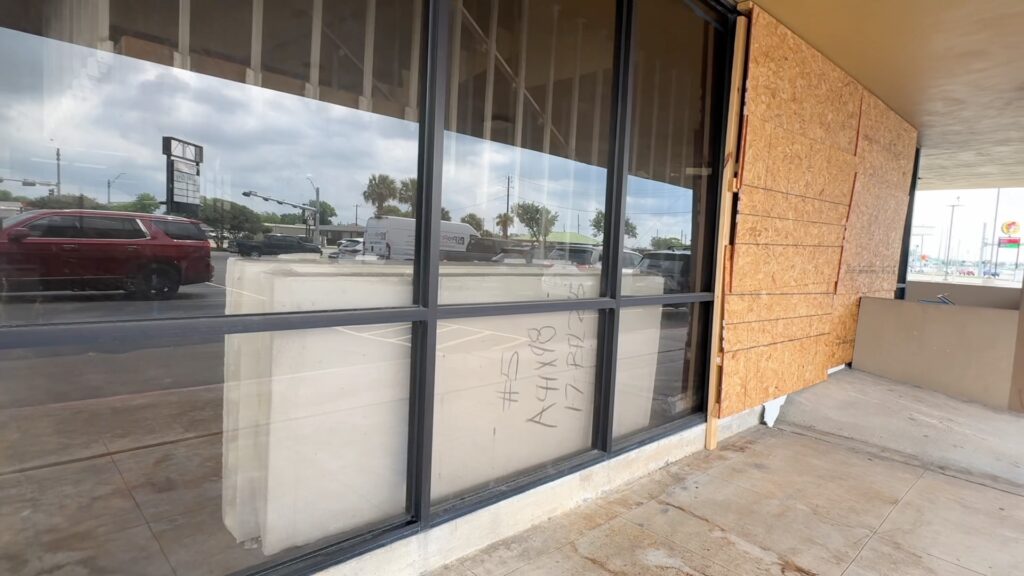
The former Excalibur Club in Freeport, Texas, as it appears today. Investigators interviewed witnesses who were at the nightclub as they worked to reconstruct Rebecca Beard’s movements during the early days of the 1986 investigation.
One of the first priorities involved determining Rebecca’s movements after she left the Excalibur Club.
Investigators interviewed witnesses who had been with Rebecca that evening or reported seeing her during the early morning hours. Detectives compared those statements in an effort to establish a reliable timeline.
The reports also reference a gold Chevrolet Camaro Z-28. Detectives attempted to identify the vehicle, determine who owned it, and learn whether it played a role in Rebecca’s disappearance.
Those early efforts demonstrate how investigators attempted to preserve every possible lead.
Arch “Beaver” Aplin Was Among the First Witnesses Interviewed
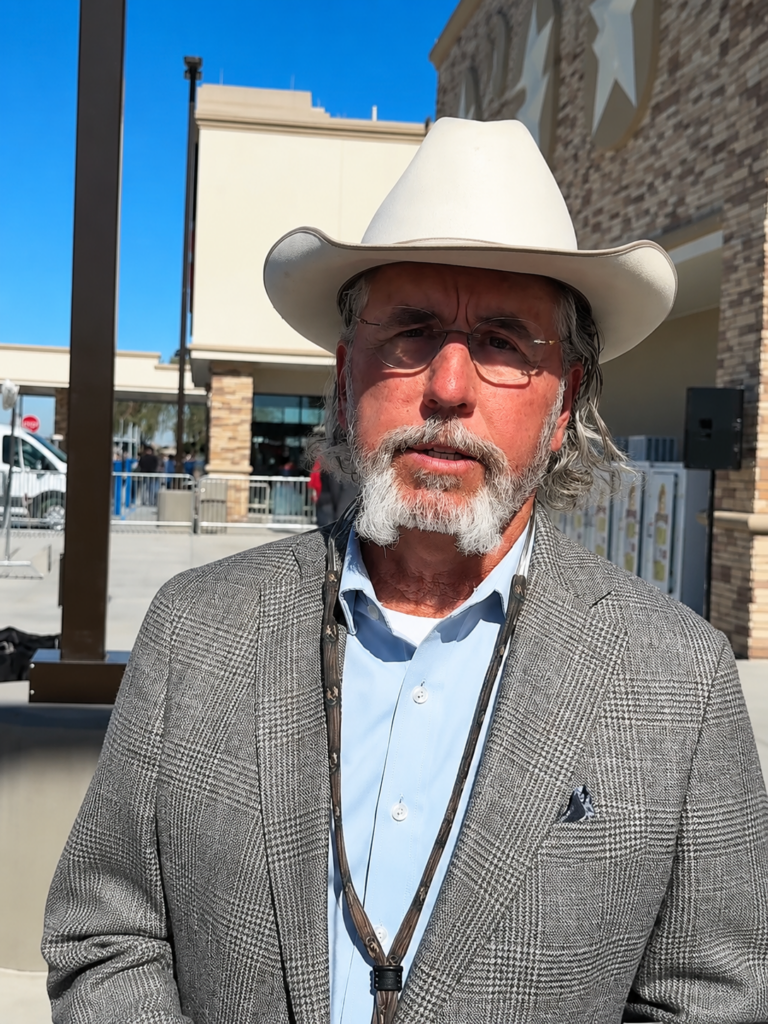
Arch “Beaver” Aplin III at the Buc-ee’s grand opening in Goodyear, Arizona. This image was captured by Investigative Reporter Tammy Rose. Aplin was interviewed by investigators on March 5, 1986, during the early stages of the Rebecca Beard investigation.
After Rebecca Beard disappeared, investigators interviewed Arch “Beaver” Aplin on March 5, 1986.
According to the police report, Aplin told detectives the last time he saw Rebecca was the weekend of February 14, when they had dinner together in Galveston. He also said he had called her several times afterward but never reached her.
At that point in the investigation, detectives documented Aplin’s account as one of many witness statements they were using to reconstruct Rebecca’s final movements.
Later Records Raised New Timeline Questions
This investigative synopsis includes a summary of Tina’s witness statement. According to the document, Tina reported seeing Kevin King leave the Excalibur Club with Rebecca Beard before he returned without her. The synopsis also lists Arch “Beaver” Aplin, Bill Russell, and Jack Hamilton as being at the club that night, raising additional questions about the investigation’s timeline.
This is where the investigation becomes more complicated.
A later investigative synopsis documents witness Tina’s account of the night Rebecca disappeared.
According to that synopsis, Tina told investigators Kevin King walked out of the Excalibur Club with Rebecca about 30 minutes before closing and returned approximately two minutes later without her.
The same synopsis also lists Kevin King, Bill Russell, Arch “Beaver” Aplin and Jack Hamilton as being at Excalibur that night.
When compared with Aplin’s March 5 statement that he had not seen Rebecca since February 14, the two records appear to present different timelines.
The investigative records reviewed for this series do not explain how detectives reconciled those accounts.
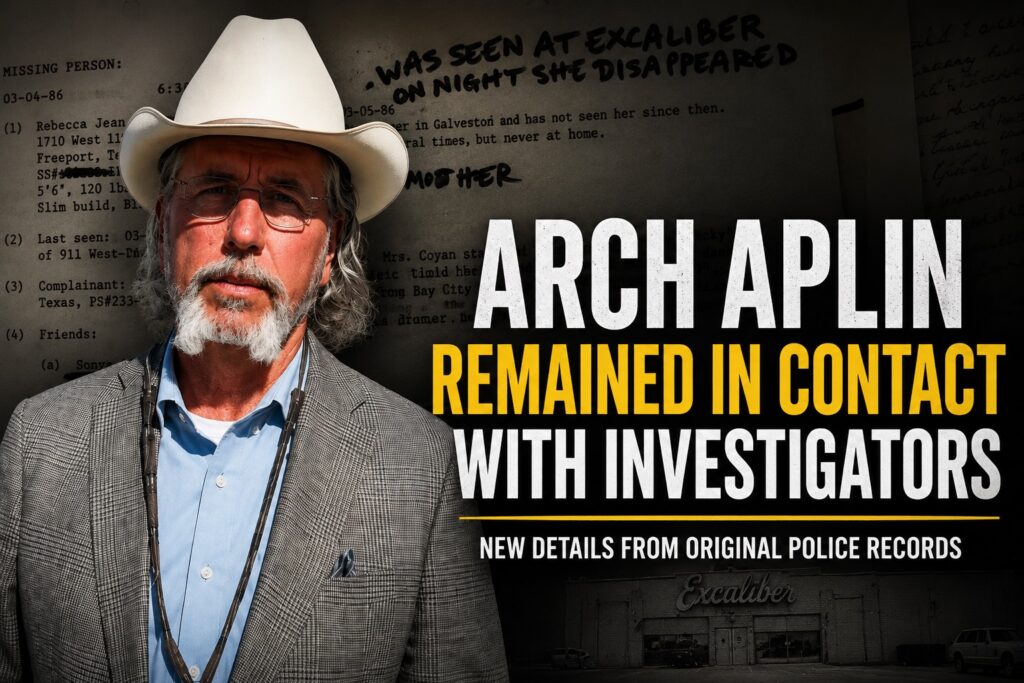
Arch “Beaver” Aplin Remained in Contact With Investigators
This graphic highlights original police records documenting that Arch “Beaver” Aplin remained in contact with investigators after Rebecca Beard disappeared. The records show detectives continued communicating with Aplin as they worked to reconstruct Rebecca’s final known movements during the 1986 investigation.
The early investigative records also document repeated contact between detectives and Arch “Beaver” Aplin, who had been at the Excalibur Club around the time Rebecca Beard disappeared.
Rather than disappearing from the investigation after giving an initial statement, the reports show Aplin continued communicating with law enforcement in the days and weeks that followed.
According to the investigative notes, Aplin contacted detectives seeking updates on the investigation and asked whether he could publicly offer a $10,000 reward for information leading to Rebecca’s whereabouts.
The records indicate detectives discussed the proposed reward with Aplin while continuing to investigate numerous leads.
Those contacts are significant because they demonstrate that investigators maintained communication with Aplin throughout the early stages of the case. The reports do not indicate that detectives viewed him as someone who had withdrawn from the investigation. Instead, the documented contacts suggest he remained interested in learning whether investigators had developed new information.
The investigative files also reflect that detectives continued interviewing numerous witnesses during this same period, including Rebecca’s friends, coworkers, and individuals believed to have seen her during the weekend she disappeared.
Another Witness Reported Seeing Rebecca Beard at a Surfside Beach Party
This graphic highlights Paula’s statement documented in the original police investigation. According to the police report, Paula told investigators she saw Rebecca Beard at a Surfside beach party on March 2, 1986. Her account added another reported timeline for detectives to evaluate as they worked to reconstruct Rebecca’s final known movements.
The original police investigation also documented a statement from another witness, Paula, who told investigators she saw Rebecca Beard at a Surfside beach party on the morning of March 2, 1986.
According to the police report, Paula said she recognized Becky and saw her with two males at the gathering. If her recollection was accurate, it could place Rebecca alive after the time she was believed to have left Excalibur, adding another timeline investigators had to evaluate.
Paula’s account does not prove what happened to Rebecca. However, it is one of several witness statements included in the original case file. When viewed alongside other reported sightings and witness interviews, it illustrates the challenges investigators faced while trying to reconstruct Rebecca’s final known movements.
More than 40 years later, these differing witness accounts continue to raise questions about Rebecca Beard’s disappearance and whether every lead documented in the original investigation was fully reconciled.
The Investigation Was Still Taking Shape
Reading the reports chronologically shows detectives working through dozens of leads while trying to establish Rebecca’s final movements.
Several witnesses interviewed in March 1986 told investigators they did not know Paul Taylor or had never heard Rebecca mention his name. At the same time, detectives continued following information involving several other individuals connected to the case.
These reports should be viewed as a snapshot of the investigation during its earliest weeks. Criminal investigations often evolve as detectives conduct additional interviews, gather new evidence, and revisit earlier leads.
The progression of the Rebecca Beard investigation reflects that process.
Coming in Part 3
The earliest police reports reveal how detectives began piecing together Rebecca Beard’s final known movements through witness interviews, follow-up leads, and investigative records. As the investigation continued, additional witness statements and investigative summaries documented new information and raised further questions.
In Part 3, I examine those later records, including additional witness statements, documented timeline discrepancies, and what they may reveal about the Rebecca Beard investigation nearly four decades later.
Every long-term investigation benefits from careful note-taking. A quality investigator’s notebook or case journal provides a simple way to organize timelines, document interviews, and track developing leads while reviewing historical records.
The former Clute home where Paul Taylor lived became a focus of later investigative records after John Cone reported that Taylor allegedly confessed to killing Rebecca Beard. The article examines why available records do not document an immediate crime scene search or forensic processing of the property following that report.
Rebecca Beard Case: Why Wasn’t Paul Taylor’s Home Investigated After John Cone’s Report?
Reviewed by Investigative Reporter Tammy Rose
Police records raise new questions
Nearly 40 years after Rebecca “Becky” Beard disappeared, police records raise a question that remains unanswered.
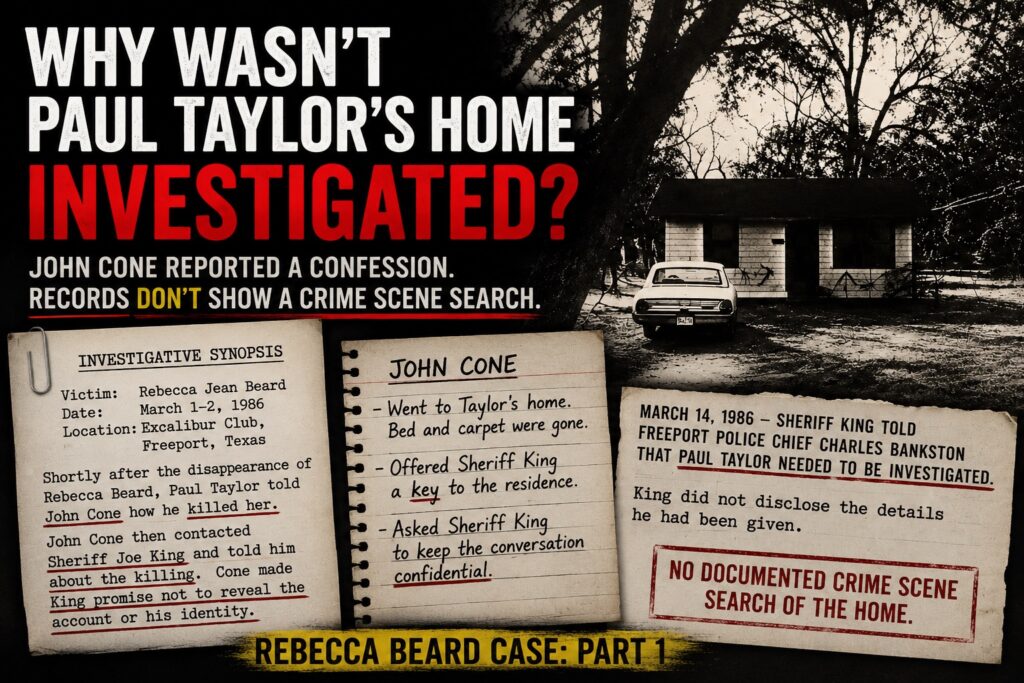
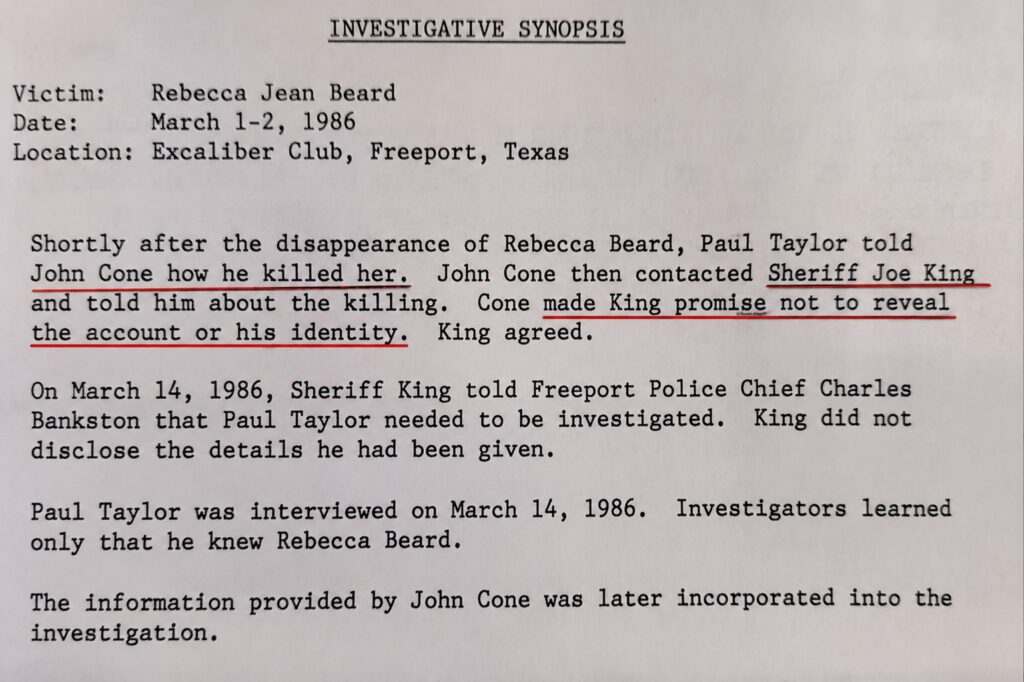
If Sheriff Joe King received details of an alleged confession from John Cone shortly after Becky vanished, why don’t the records reviewed by Investigative Reporter Tammy Rose document an immediate search or forensic examination of Paul Taylor’s home?
The question stands out because later investigative summaries describe a series of events that, if accurate, pointed investigators toward Taylor’s residence within days of Becky’s disappearance.
John Cone said Taylor admitted killing Becky
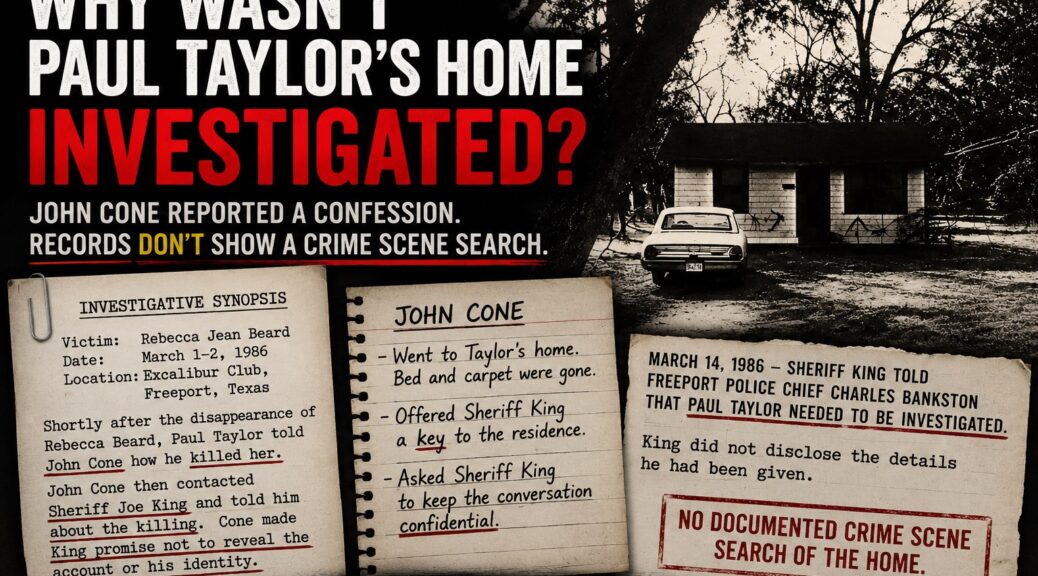
This investigative synopsis states that John Cone reported an alleged confession by Paul Taylor to Sheriff Joe King shortly after Rebecca Beard disappeared. According to the document, Cone asked King to keep both the information and his identity confidential. The synopsis also states King later advised Freeport Police that Taylor should be investigated, raising questions about what investigative steps followed.
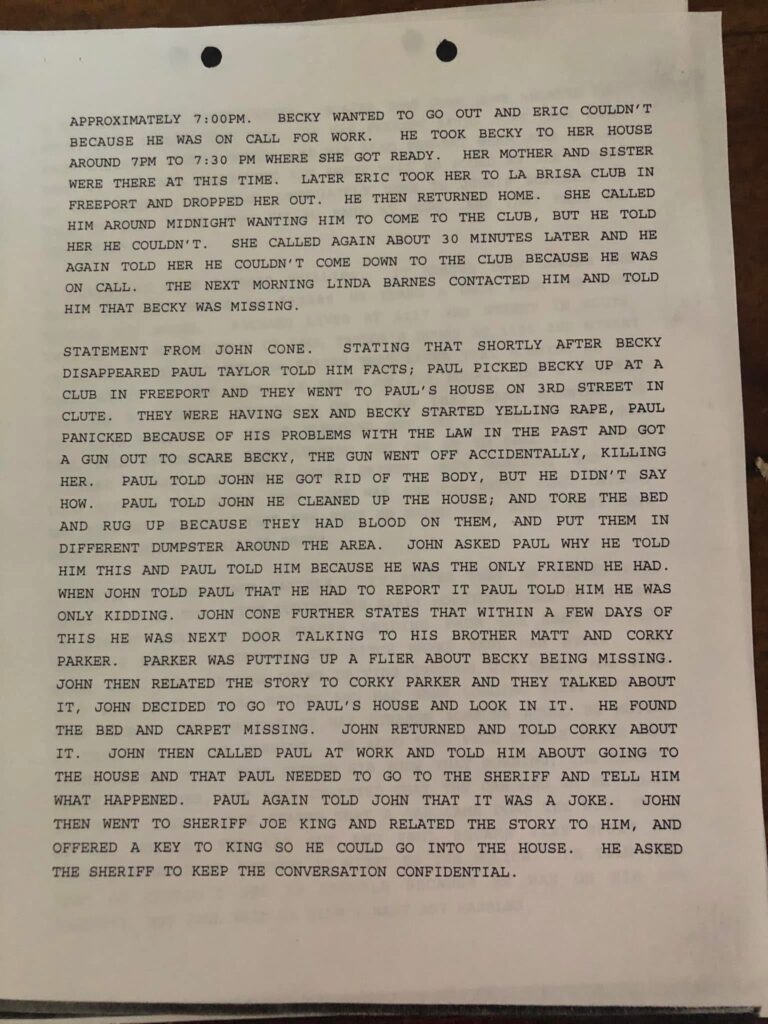
According to a later investigative synopsis, John Cone told investigators that Paul Taylor admitted Becky died inside his Clute home.
Cone’s statement says Taylor claimed he picked Becky up after she left a club, took her to his residence, and that she died after a gun discharged during a struggle.
Taylor allegedly told Cone he cleaned the residence, removed the bed and carpet because they contained blood, and discarded them in dumpsters.
Cone also said he entered Taylor’s home himself and noticed the bed and carpet were gone.
According to the records, Cone then contacted Brazoria County Sheriff Joe King and reported what Taylor allegedly told him.
Cone reportedly offered Sheriff Joe King a key
This investigative document summarizes John Cone’s account, including his claim that Paul Taylor allegedly confessed to killing Rebecca Beard. According to the document, Cone said he entered Taylor’s home, noticed the bed and carpet were missing, and later offered Sheriff Joe King a key to the residence. The document raises questions about what investigative steps followed after that information reached law enforcement.
One detail stands out in Cone’s statement.
Cone said he offered Sheriff Joe King a key to Taylor’s residence.
He also asked the sheriff to keep both the conversation and his identity confidential.
The investigative synopsis later states that King agreed to keep the information confidential.
According to that same synopsis, Sheriff King informed Freeport Police Chief Charles Bankston on March 14, 1986, that Paul Taylor needed to be investigated but did not relate the details Cone had provided.
Taylor was interviewed that day. The synopsis states investigators learned only that Taylor knew Becky.
Where is the documented crime scene investigation?
The records reviewed by Investigative Reporter Tammy Rose do not document that investigators immediately searched Paul Taylor’s residence or processed it as a possible crime scene.
The records also do not document officers collecting physical evidence, photographing the interior, looking for blood evidence, seizing the reportedly missing bed or carpet, or tracing the dumpsters where Taylor allegedly said he discarded evidence.
Those questions remain central to understanding the early investigation. The records reviewed for this report do not document that investigators immediately completed those investigative steps after John Cone reported what Taylor allegedly told him.
Those questions remain central to understanding the early investigation. The records reviewed for this report do not document that investigators immediately completed those investigative steps after John Cone reported what Taylor allegedly told him.
Another report raised similar concerns
The records contain another development one month later.
An April 16, 1986 report states the manager of Excaliber Club told investigators about another conversation involving Taylor.
According to the report, another witness claimed Taylor said he picked up a woman from the club, took her home, shot her, buried her body, cut up the mattress and discarded it in dumpsters.
The same report states Matt Cone checked Taylor’s residence and found the bed no longer had a mattress. Cotton stuffing reportedly remained on the floor.
Even then, the records reviewed by Investigative Reporter Tammy Rose do not document that officers immediately processed the residence as a homicide scene.
Another inconsistency emerges
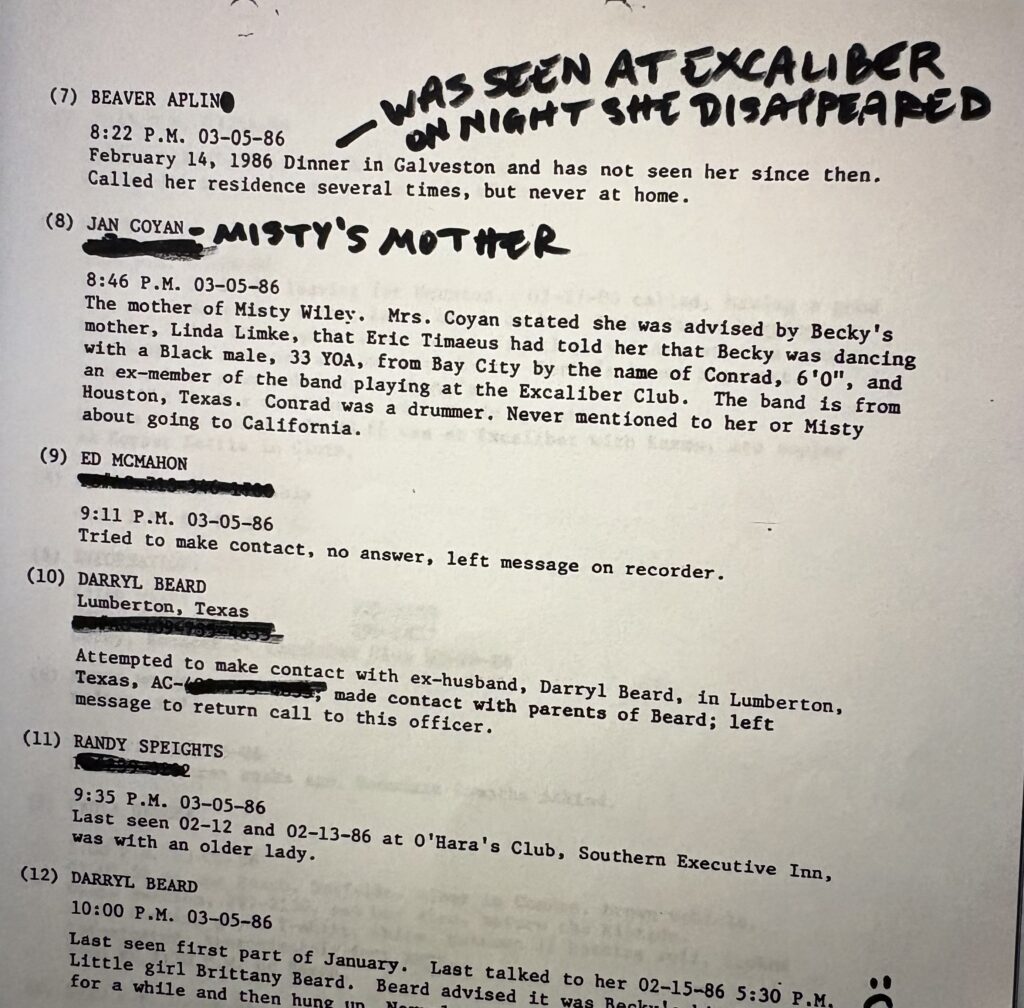
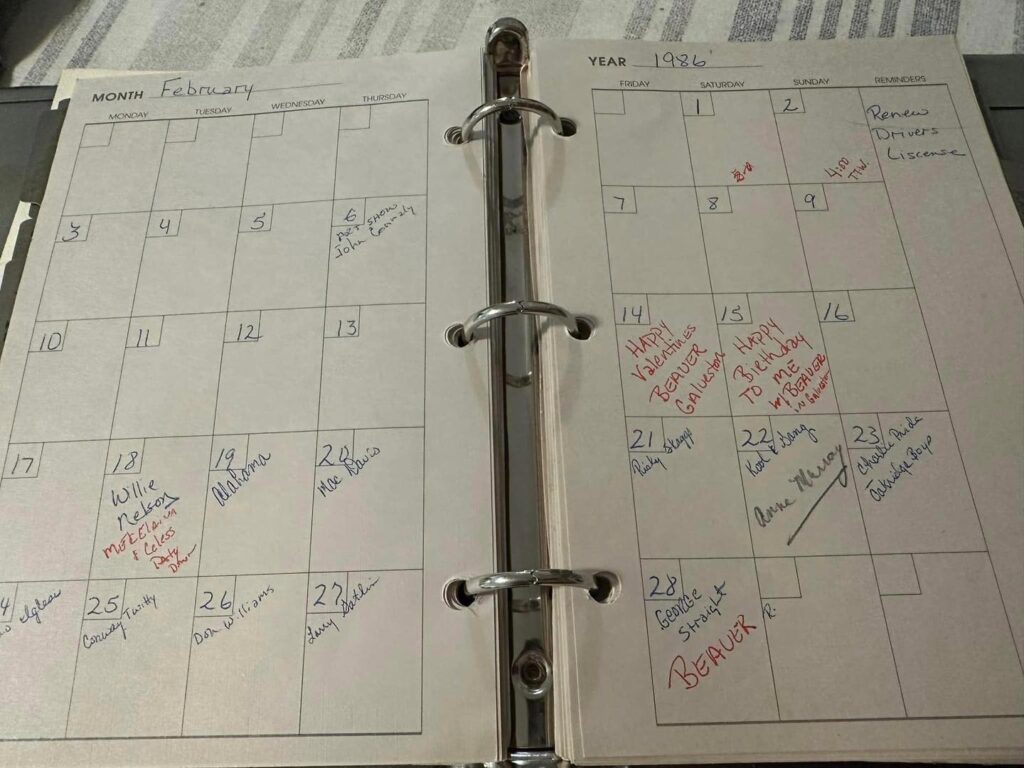
These records compare early police reports, a later investigative summary, and Rebecca Beard’s personal planner. One report states Beaver (Arch) Aplin last saw Rebecca on February 14, while a later investigative summary lists him among witnesses who reportedly saw her at Excalibur on the night she disappeared. The differing timelines raise questions about how investigators reconciled those statements during the investigation.
While reviewing the early investigation, another issue surfaced.
Police reports appear to contain conflicting information about Beaver (Arch) Aplin’s timeline.
One report says Aplin told investigators he had not seen Becky since February 14, 1986.
A later investigative report identifies Aplin as one of several people reportedly present at Excaliber on the night Becky disappeared.
That apparent inconsistency raises another question.
Did investigators ever reconcile those differing accounts?
That question will be examined in Part 2 of this series.
Questions that remain
The records reviewed for this article leave several unanswered questions:
Why wasn’t Taylor’s residence immediately documented as a potential crime scene after John Cone reported an alleged confession? Did Sheriff Joe King ever use the key Cone reportedly offered? Were investigators ever able to locate the missing bed, carpet or mattress? If those items were never recovered, how much potential evidence may have been lost?
Nearly four decades later, those questions remain central to understanding the early investigation into Rebecca Beard’s disappearance.
Keep detailed notes while following complex investigations. A structured notebook makes it easier to compare timelines, witness statements and evidence.
⸻
Disclosure: As an Amazon Associate, I earn from qualifying purchases at no additional cost to you. Your support helps fund my investigative reporting and allows me to continue researching and publishing stories like this one.