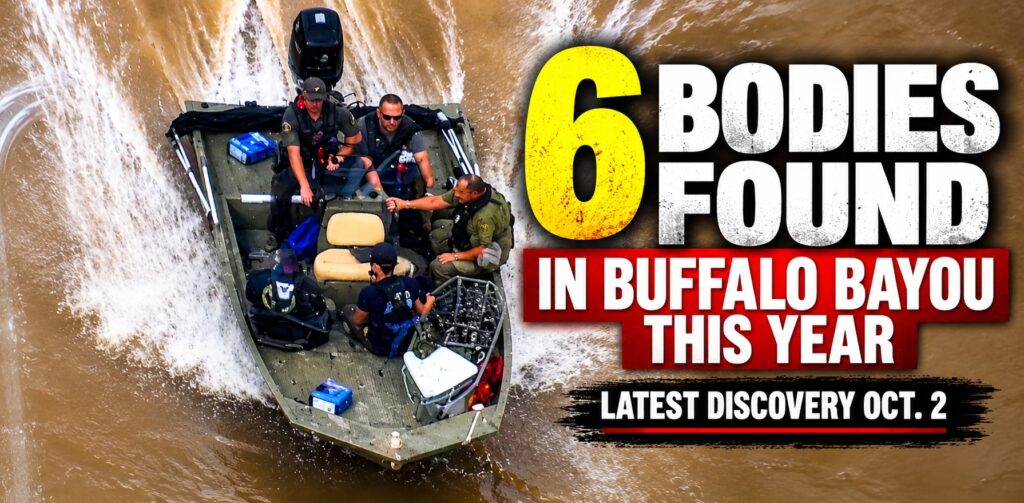
At least six bodies have been recovered from Buffalo Bayou or its banks in 2026. The latest discovery happened Oct. 2.
Another body found in Buffalo Bayou is raising questions in Houston.
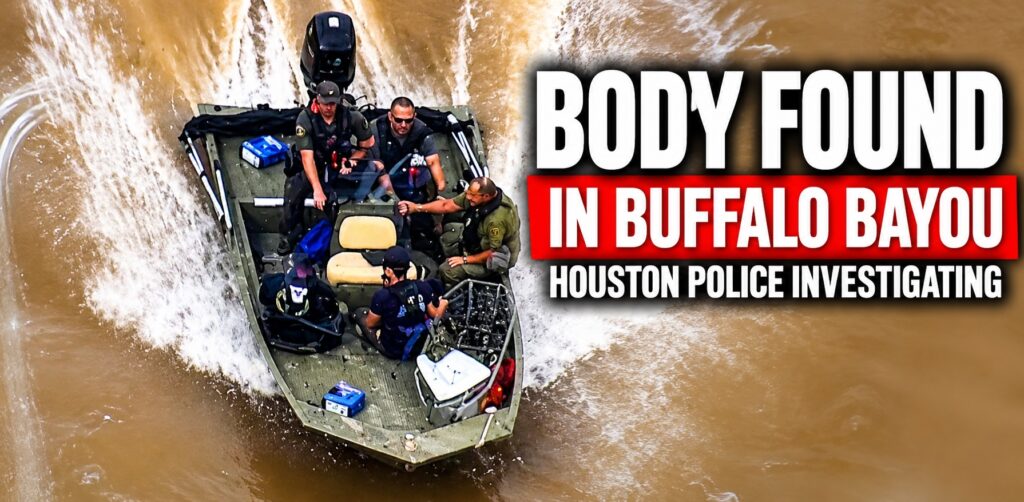
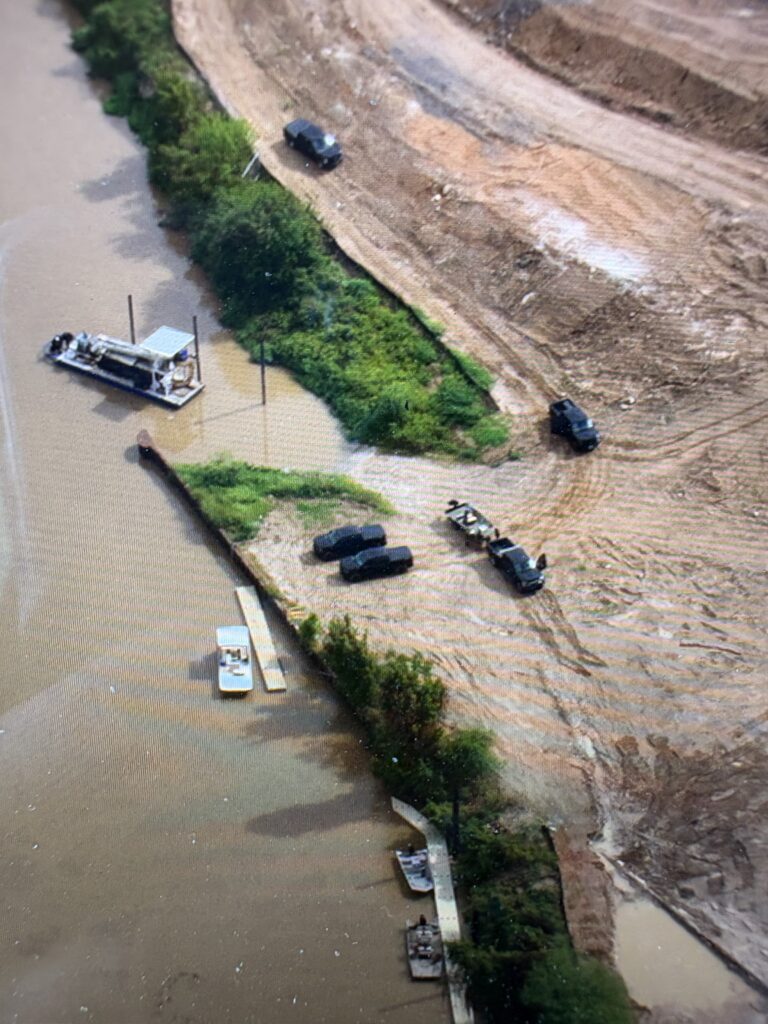
Houston police are investigating after firefighters recovered a man’s body from Buffalo Bayou Friday morning, October 2. The discovery happened near Hirsch Road and Clinton Drive in east Houston.
It is at least the sixth documented body recovered from Buffalo Bayou or its banks in 2026.
The cases stretch from downtown Houston to the Houston Ship Channel. Some victims have been identified. Other cases still have unanswered questions.
Man found in Buffalo Bayou on October 2
The latest discovery happened Friday morning.
Houston firefighters responded after someone spotted a body floating in Buffalo Bayou. Crews launched a rescue boat near the 7300 block of Clinton Drive.
Firefighters recovered the body of a man.
Houston police homicide detectives are investigating. Authorities have not released the man’s name or age.
The Harris County Institute of Forensic Sciences will determine his cause and manner of death.
January 6: First Buffalo Bayou body of 2026
The first reported Buffalo Bayou recovery of the year happened January 6 near downtown Houston.
A maintenance crew spotted a man’s body in the water near Commerce and Main streets.
Houston firefighters received the call around 1:46 p.m.
Police said the man was clothed and wearing a gray jacket. Authorities did not immediately release his identity.
The discovery came just days into the new year.
February 2: Fisherman found near Port of Houston
Houston police recovered another man from Buffalo Bayou on February 2.
The discovery happened at 8300 High Level Road near the Port of Houston.
HPD said the 62-year-old man wore several layers of clothing and appeared dressed for cold-weather fishing.
Detectives learned that a missing man had last been seen fishing at the same location on January 26. Investigators also found his vehicle and fishing equipment along the shore.
Police reported no obvious signs of foul play.
April 30: Kenneth Young found near Buffalo Bend Nature Park
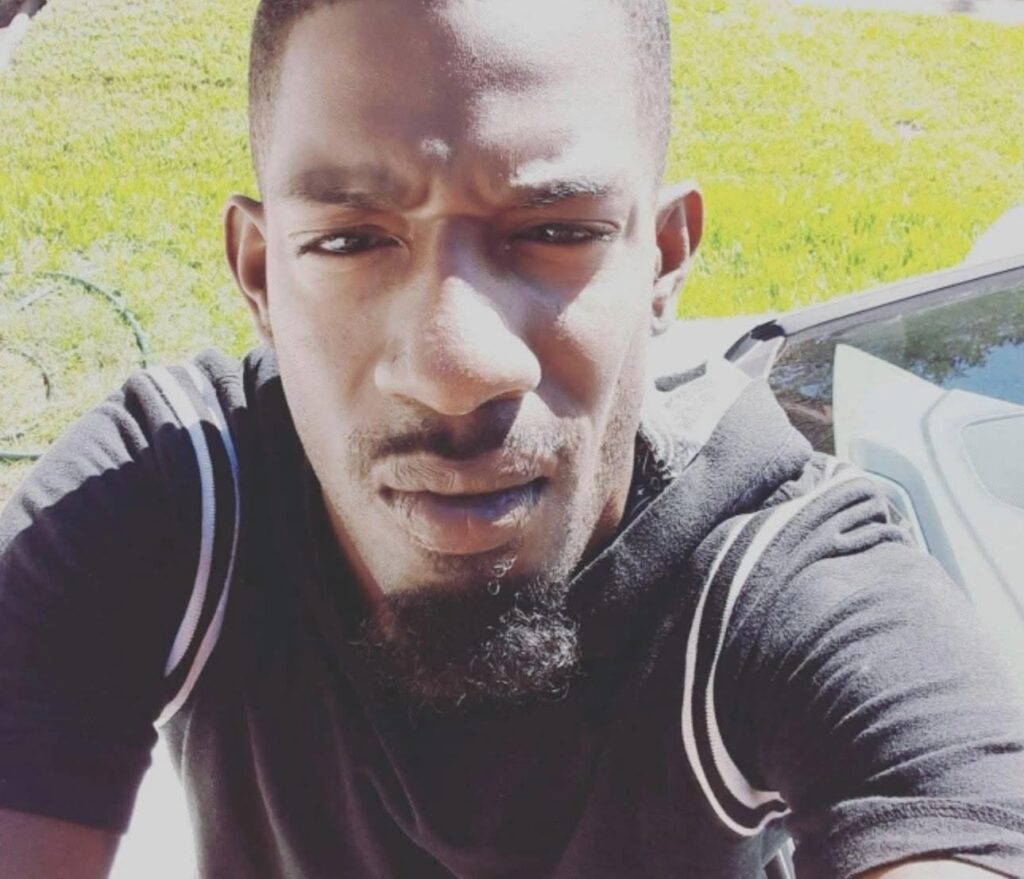
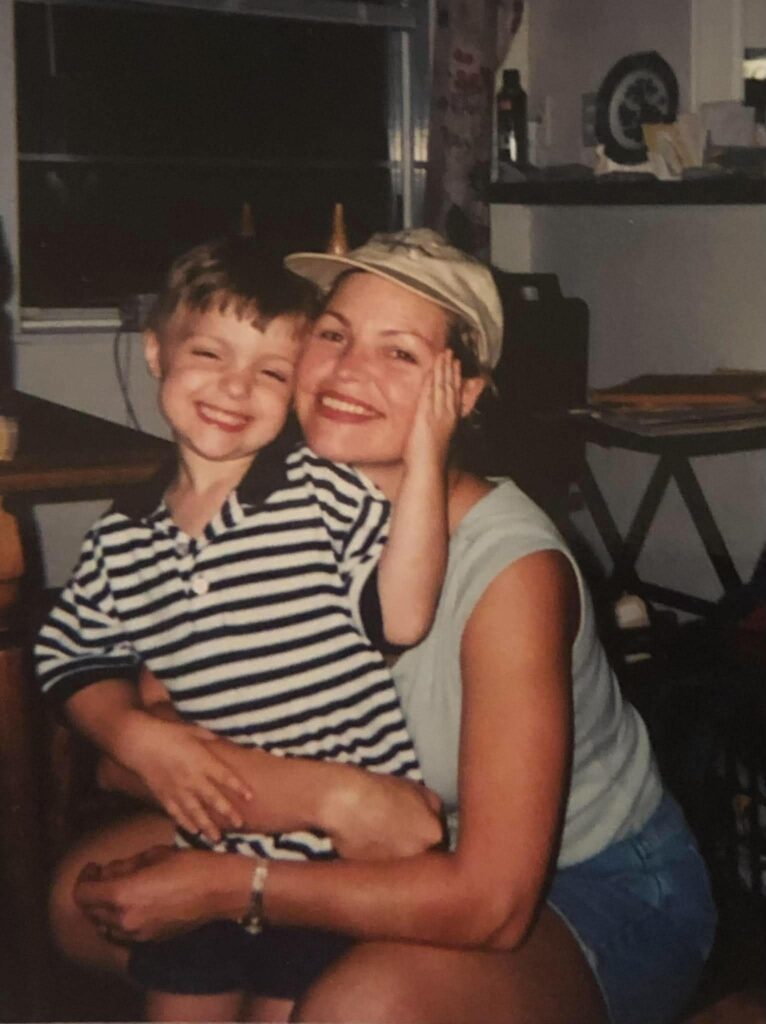
Kenneth Young, 33, was found dead near Buffalo Bend Nature Park along Buffalo Bayou on April 30, 2026. Photo courtesy of Young’s family.
A cleanup crew found another body along Buffalo Bayou on April 30.
The crew spotted the badly decomposed body near Sgt. Macario Garcia Drive and Buffalo Bend Nature Park.
Authorities later identified the man as 33-year-old Kenneth Young.
Authorities identified Young through his fingerprints.
His family has continued searching for answers about what happened to him.
July 20: Workers find decomposed body near J.W. Peavy Drive
Workers made another discovery on July 20.
They found a man’s decomposed body along the banks of the Buffalo Bayou Ship Channel at 7220 J.W. Peavy Drive.
Houston firefighters pronounced the man dead at the scene.
HPD said investigators found no apparent wounds or trauma.
At the time of the initial investigation, authorities were waiting for an autopsy to determine the man’s cause of death.
August 11: Body later identified as Carl “Clint” Mueller
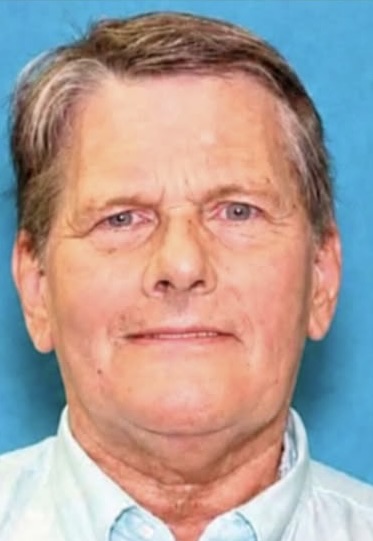
Carl “Clint” Mueller, 73, was found dead along Buffalo Bayou near Nance Street on Aug. 11, 2026. Photo courtesy of Texas EquuSearch.
Houston police responded to another Buffalo Bayou discovery on August 11.
Officers found a man’s body along the banks of the bayou in the 2200 block of Nance Street.
The body was in an advanced state of decomposition.
HPD reported no obvious signs of trauma.
Texas EquuSearch later identified the man as 73-year-old Carl “Clint” Mueller.
Mueller had been missing since July 30. He was last seen near the 1400 block of Saint Joseph Parkway in downtown Houston.
Another August case happened near Buffalo Bayou
Police also investigated a body found August 7 in a wooded area near Buffalo Bayou and Beltway 8.
Officers responded to the 10400 block of Deerwood Road.
Police said that investigators were handling that death as a suicide.
Because the body was found in a wooded area near the bayou, rather than confirmed in Buffalo Bayou or along its banks, it is not included in the six confirmed Buffalo Bayou recoveries listed here.
Bodies have also been recovered from other waterways across Houston and Harris County in recent years.
Those deaths do not all share the same circumstances.
Some involved accidents or medical issues. Others involved drugs, drowning, suicide or violence. In some cases, investigators could not immediately determine how the person died.
That distinction matters.
Finding several bodies in Houston’s bayous does not mean the deaths are connected.
More than 200 bodies recovered from Houston-area bayous
More than 200 bodies have been recovered from Houston-area bayous since 2017, according to Harris County medical examiner records.
The Buffalo Bayou cases are part of a much larger issue across Houston.
Records from the Harris County Medical Examiner’s Office show that more than 200 bodies have been recovered from Houston-area bayous since 2017. By February 2026, the documented total had already reached 208.
The cases involve several Houston-area waterways, not just Buffalo Bayou. Causes of death have varied widely. Drowning has been the leading cause, while other deaths involved drugs, injuries or other circumstances. Some cases remain undetermined.
Authorities have also pushed back against speculation that the deaths are connected or the work of a serial killer.
What happens next?
The October 2 case remains under investigation.
Houston police have not announced the man’s identity or cause of death.
The Harris County Institute of Forensic Sciences will conduct the examination.
For now, Friday’s discovery adds another case to a troubling list of deaths involving Buffalo Bayou in 2026.
Investigative Reporter Tammy Rose will continue following the case as authorities release new information.
My new book, When Two Worlds Collide During WWII, follows two families on opposite sides of World War II and the remarkable events that eventually brought their lives together in Wisconsin.
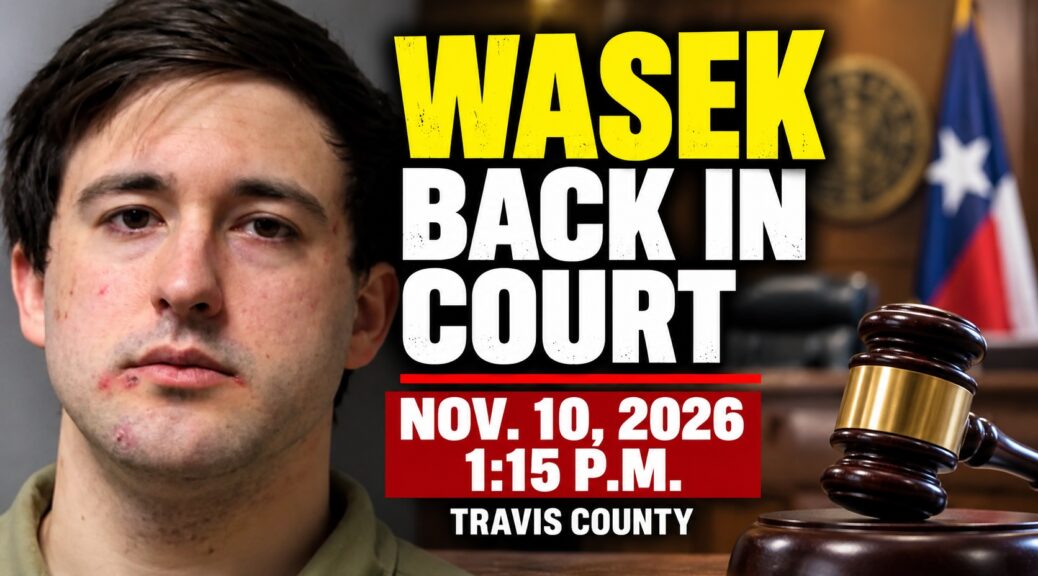
Mitchell Wasek has another court date in Travis County.
Court records show Wasek will return to the 167th District Court on Nov. 10, 2026, at 1:15 p.m.
The hearing involves several criminal cases that I have followed for years.
One of Wasek’s original 2023 cases lists a writ hearing. His separate 2025 case lists a pretrial hearing at the same time.
The Nov. 10 setting is not a trial date.
Wasek’s original cases remain in court
Wasek faces six invasive visual recording cases filed in 2023.
Those cases carry cause numbers D-1-DC-23-500314 through D-1-DC-23-500319. Travis County previously listed all six for writ hearings in the 167th District Court.
The latest Odyssey record I reviewed on Oct. 2 shows a Nov. 10 writ hearing in case D-1-DC-23-500314.
The older cases have also gone through appellate proceedings.
Separate 2025 case heads to pretrial hearing
Wasek also faces a separate felony case filed in 2025.
That case carries cause number D-1-DC-25-500122.
The Travis County docket lists the 2025 charge as possession of child pornography.
The latest Odyssey record shows a pretrial hearing on Nov. 10 at 1:15 p.m.
The newer case and at least one of Wasek’s original cases now have hearings set for the same date and time.
Defense wants evidence suppressed
The 2025 case includes two major defense challenges.
Wasek’s attorneys filed a motion to suppress on April 14.
The docket describes it as a motion to suppress evidence obtained by theft and breach of computer security.
The public docket I reviewed does not show an order resolving that motion.
Defense also seeks dismissal
Wasek’s attorneys filed another motion on June 2.
That motion asks the judge to dismiss the indictment due to an expired statute of limitations.
The filing does not mean the court has dismissed the indictment.
The public docket I reviewed does not show an order granting that request.
Court records also show several subpoena applications filed in June.
What happens next in the Mitchell Wasek cases?
Mitchell Wasek faces felony charges in Travis County as his defense seeks to suppress evidence and dismiss the indictment.
The Nov. 10 hearings could provide answers about the pending legal challenges.
The 167th District Court handles felony criminal cases in Travis County. Judge Dayna Blazey presides over the court.
For now, Wasek’s cases remain pending.
I will continue reviewing the court records and report any new rulings before the Nov. 10 hearings.
My new book, When Two Worlds Collide During WWII, follows two families on opposite sides of World War II and the remarkable events that eventually brought their lives together in Wisconsin.
The story is based on my own family history, with real people, family photographs and stories passed down through generations.
Disclosure: As an Amazon Associate, I earn from qualifying purchases.
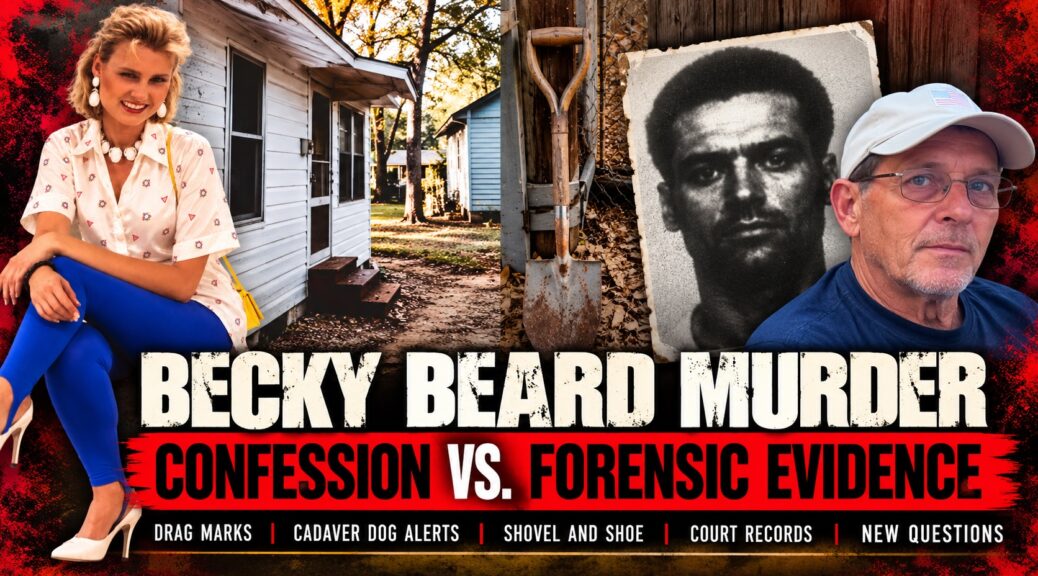
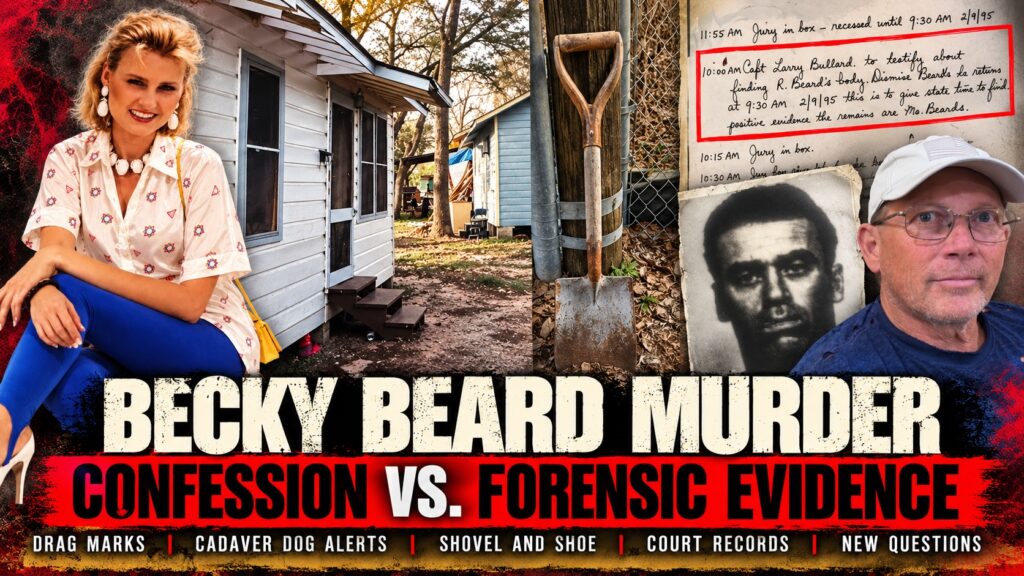
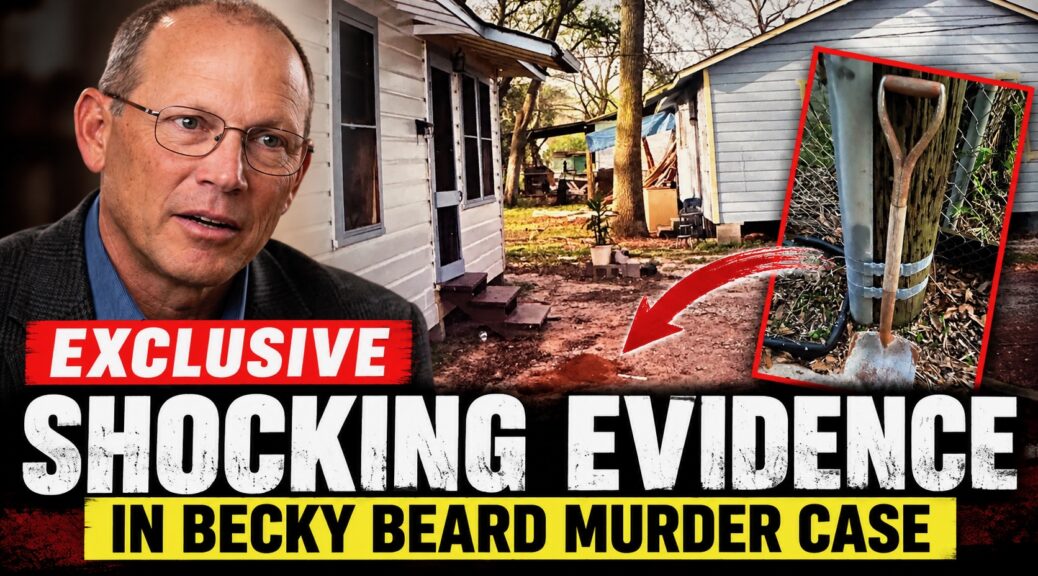
Paul Taylor’s confession vs. forensic evidence. An exclusive investigation reveals new questions about drag marks, cadaver dog alerts, a shovel found beneath the house and court records referencing Becky Beard’s remains.
Did Paul Taylor tell investigators everything about what happened to Rebecca “Becky” Beard?
Nearly 40 years after the 22-year-old disappeared from Freeport, Texas, new questions surround her murder.
A comparison of Taylor’s confession and previously undisclosed investigative findings reveals significant differences.
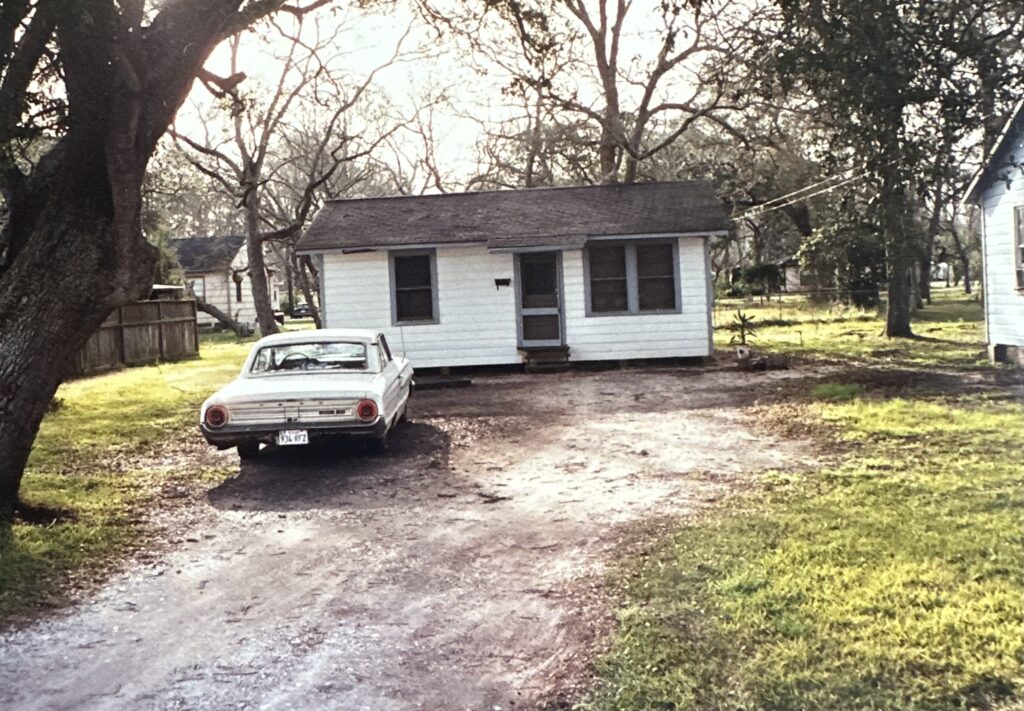
In my exclusive interview, retired Freeport police captain Richard Miller described apparent blood evidence and drag marks inside a home linked to Becky’s murder.
Two cadaver dogs also alerted beneath the property.
Miller began digging and discovered unidentified white material. However, officials ordered him to stop before he could identify it.
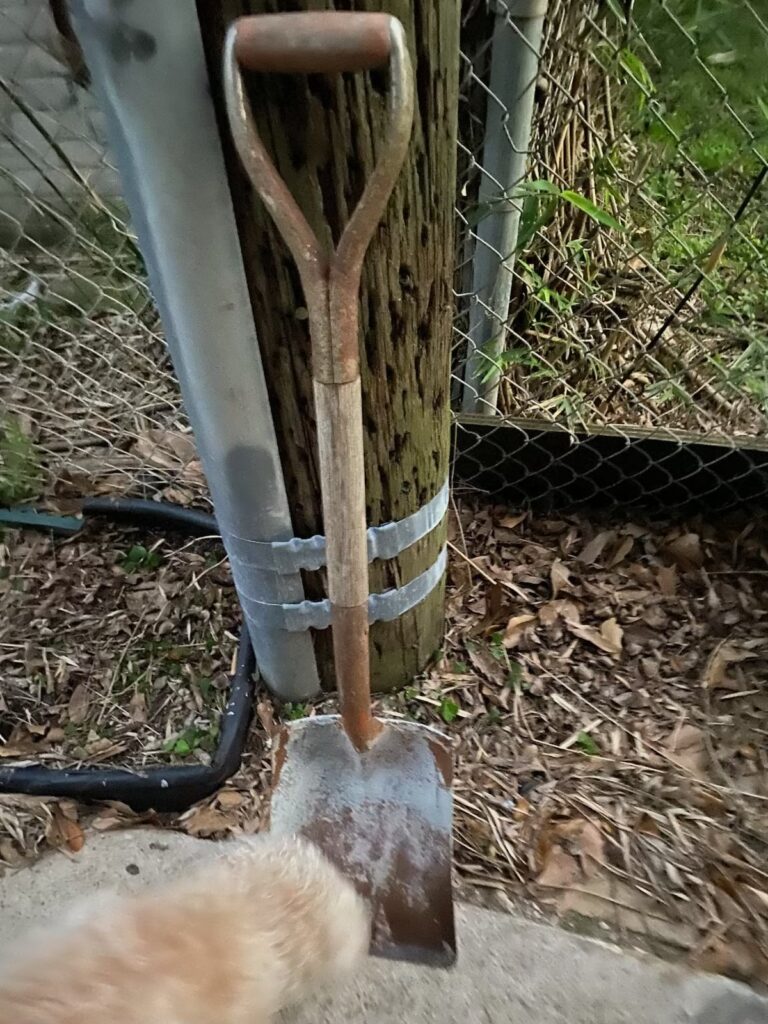
Becky’s mother, Linda Barnes, also found a shovel and shoe beneath the house. According to the family, investigators never entered either item into evidence.
Newly uncovered court records raise even more questions. They reference Becky’s body and a Remington shotgun after Taylor’s guilty plea.
What really happened inside that house? And where are Becky’s remains?
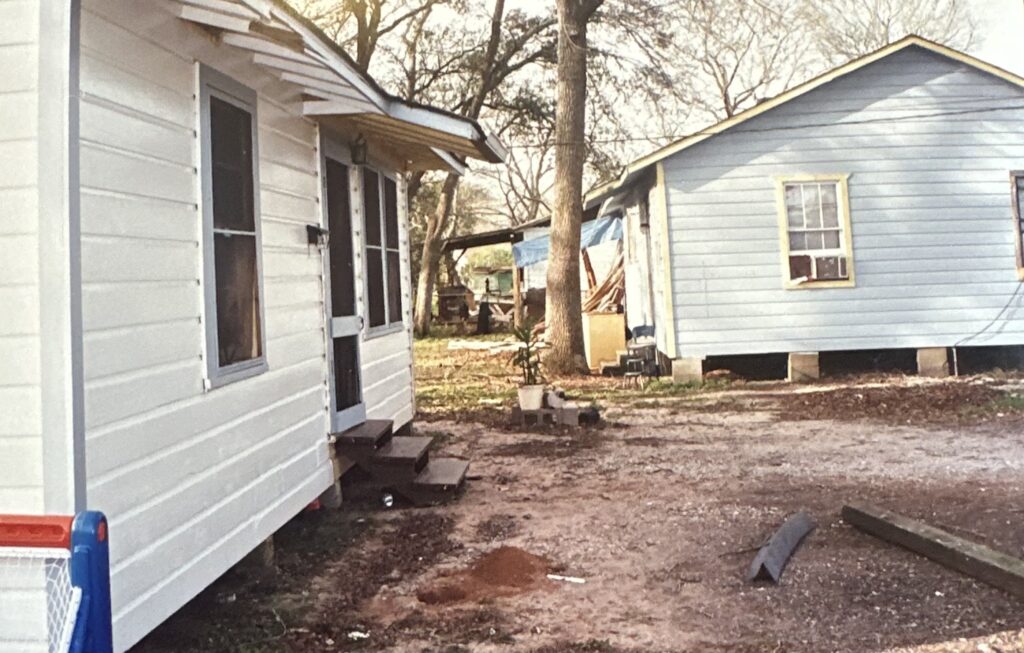
The home linked to Becky Beard’s murder. Retired Freeport police captain Richard Miller says investigators found apparent blood evidence and drag marks inside. Two cadaver dogs also alerted beneath the property.
What Paul Taylor said happened to Becky Beard
Becky disappeared after visiting the Excalibur Club in Freeport on March 1, 1986.
Taylor admitted that Becky left the club with him. He said they drove to his home, where an argument eventually turned violent.
During a recorded interview with Becky’s mother, Taylor claimed an argument over cocaine led to the shooting.
He said he had promised to obtain cocaine but could not reach his supplier.
According to Taylor, Becky became angry and threatened to call police.
Taylor admitted that he grabbed a gun and tried to frighten her.
He then told Linda that he shot Becky between the eyes.
Taylor claimed Becky died immediately.
He later pleaded guilty to her murder in 1995. However, investigators never recovered her body.
Forensic evidence reveals apparent drag marks inside the home
The home linked to Becky Beard’s murder. Retired Freeport police captain Richard Miller says investigators found apparent blood evidence and drag marks inside. Two cadaver dogs also alerted beneath the property.
Taylor described wrapping Becky’s body in bedsheets before placing her in his car.
However, Miller’s account raises questions about how someone moved her body.
During his investigation around 1994, Miller returned to the home where investigators believed the murder occurred.
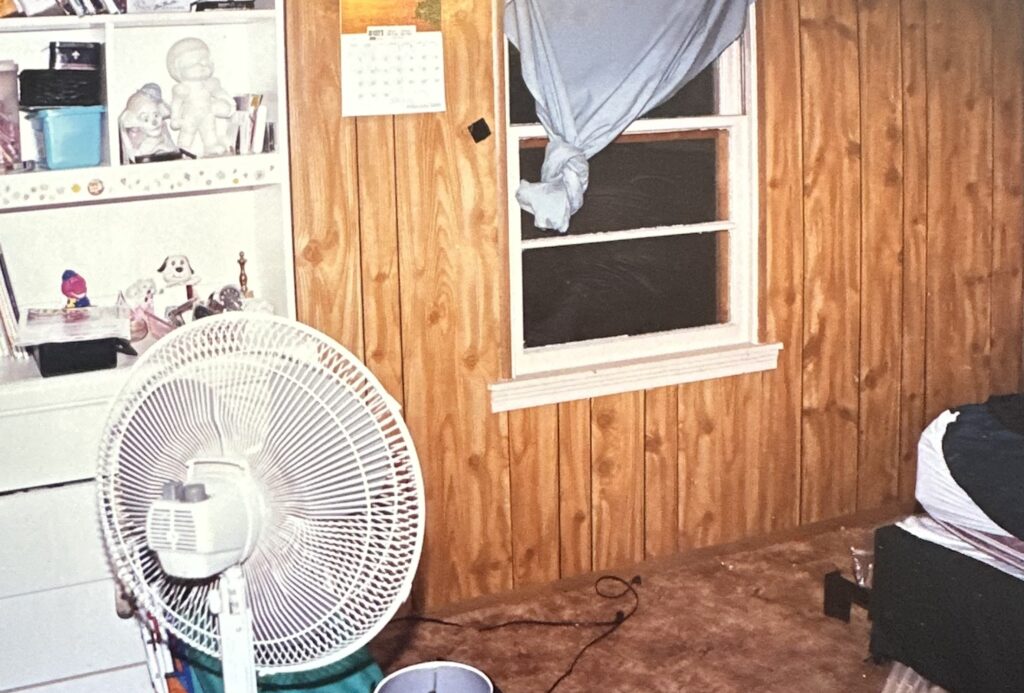
He removed wall paneling and conducted luminol testing.
Miller said the testing revealed apparent blood smears on the bedroom wall and floor.
He also observed what appeared to be drag marks.
Those marks extended from the bedroom, through a common area and toward the back door.
According to Miller, the marks ended at that door.
Could someone have dragged Becky through the house before placing her body in a vehicle?
Taylor’s account does not explain the apparent drag marks.
However, additional forensic testing would need to establish what caused them.
Two cadaver dogs alerted beneath the house
Another view of the home linked to Becky Beard’s murder, where retired police captain Richard Miller says investigators discovered apparent blood evidence and drag marks.
Miller’s investigation took another unexpected turn when a dog handler brought two cadaver dogs to the property.
The first dog searched the house and alerted beneath the kitchen area, near the back door.
The handler then brought in a second dog.
That dog searched from another direction and alerted at the exact same location.
Miller crawled beneath the house and began digging by hand.
A few inches below the surface, he discovered soft white material.
He immediately thought about the clothing Becky reportedly wore when she disappeared.
However, Miller never determined what he had found.
He said a district attorney’s investigator and the Clute police chief arrived at the property.
They ordered him to stop digging because Taylor’s trial was approaching.
Miller complied and left the excavation unfinished.
Officials never secured the home as a crime scene during that investigation.
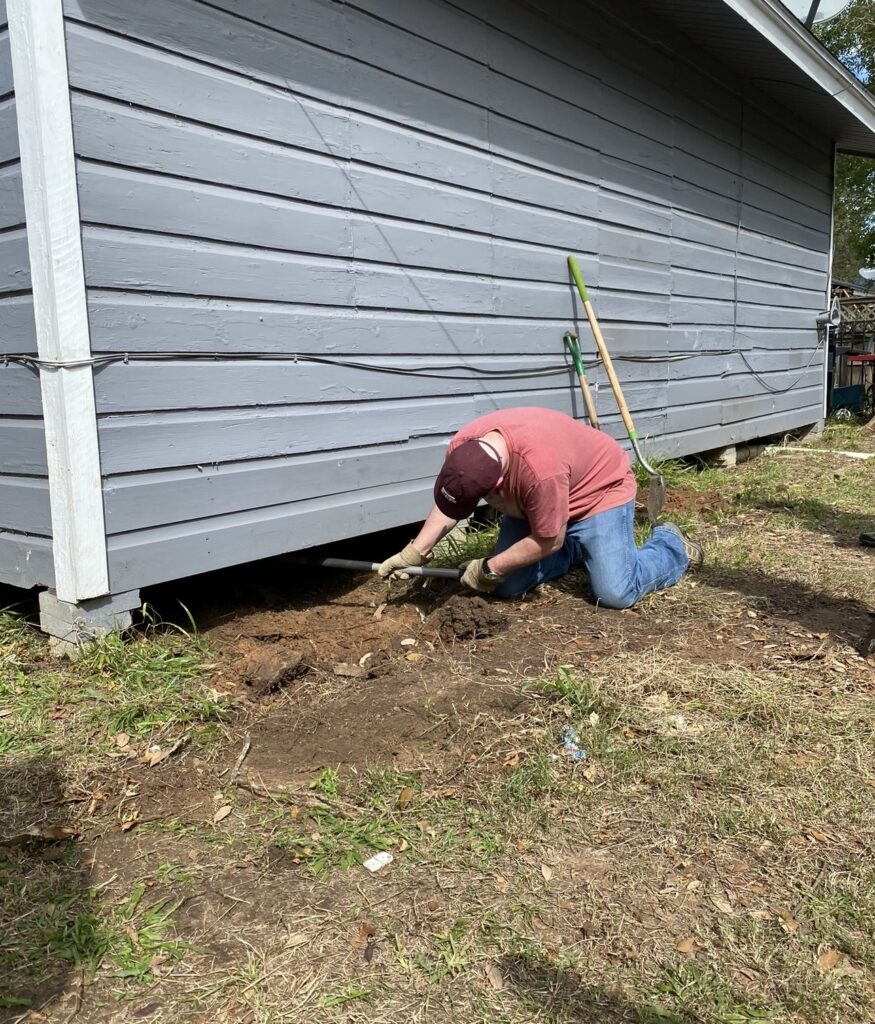
Linda Barnes found a shovel and shoe beneath the house
Linda Barnes discovered this shovel beneath the Clute home linked to Becky Beard’s murder. The family says investigators never entered it into evidence.
Becky’s mother conducted her own investigation into her daughter’s disappearance.
During her search beneath Taylor’s former home, Linda discovered a short-handled shovel and a shoe.
Linda described burn marks on the shovel. She also claimed it carried dirt similar to soil at the suspected burial site.
According to the family, investigators never entered either item into evidence.
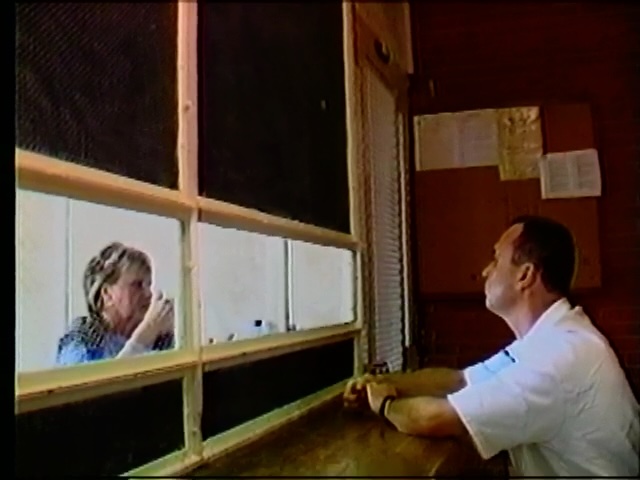
During her recorded interview with Taylor, Linda confronted him about the shovel.
Taylor said he could not remember leaving it beneath the house.
He suggested he might have obtained it from his father or mother.
Years later, Miller discovered apparent blood evidence and drag marks inside the same home.
Two cadaver dogs also alerted beneath the property.
Miller began digging and uncovered unidentified white material.
However, officials ordered him to stop before he could identify it.
Did Linda and Miller discover evidence connected to Becky’s disappearance?
Investigators never established that connection through the forensic testing documented in the available interviews.
Did Paul Taylor place Becky beneath the house?
Thumbnail for an article examining conflicting accounts regarding whether Paul Taylor Jr. declined legal representation in the Rebecca Beard murder case.
Taylor claimed he wrapped Becky in bedsheets and roofing paper before placing her body in his car.
He said he later drove to a remote location and buried her.
However, Linda confronted him about the shovel she had discovered beneath his home.
Taylor said he could not remember placing it there.
Miller’s discovery raises another question.
Why did two cadaver dogs alert beneath the home if Taylor immediately transported Becky to another location?
The alerts alone cannot establish that Becky’s body was beneath the house.
They also cannot determine whether someone moved her remains.
Investigators would need additional physical evidence to establish either possibility.
Did investigators recover evidence of a handgun or shotgun?
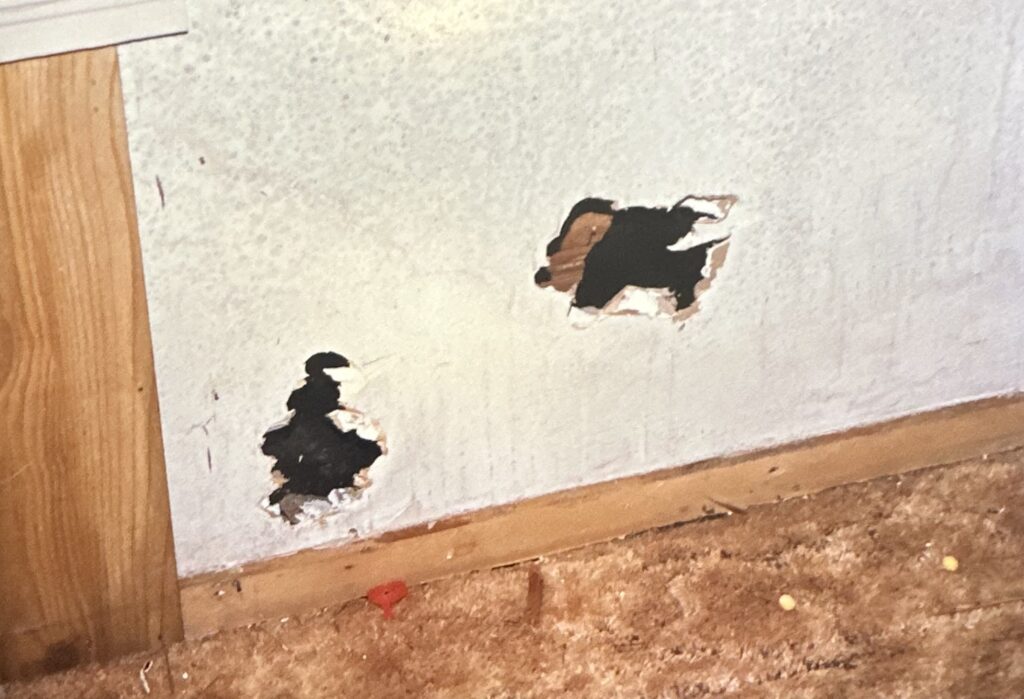
Two suspected bullet holes documented inside the Clute home. Retired Freeport police captain Richard Miller believes a large-caliber handgun, possibly a .357, could have caused them. He disputes the theory that they came from a shotgun.
Taylor admitted that he shot Becky but did not identify the firearm’s caliber during his interview with Linda.
He claimed he found a gun in his mother’s attic and brought it home.
Miller recalled discovering two holes through the bedroom floor, behind the baseboard.
He believed the holes appeared consistent with a large-caliber handgun.
During my interview, Miller examined photographs from the investigation.
He rejected the suggestion that the holes showed evidence of a shotgun blast.
Miller said he believed a handgun could have caused them. He mentioned a .357 as one possibility.
However, he did not identify a specific weapon.
Newly uncovered case records also reference a Remington shotgun.
Miller said he had never heard about that shotgun during his involvement in Becky’s case.
He also explained that investigators sometimes collect multiple firearms for elimination testing.
The available interviews do not establish whether investigators recovered bullets or conducted ballistics testing in Becky’s murder.
Did investigators ever identify the weapon that killed Becky?
Paul Taylor’s timeline raises additional questions
Linda Barnes confronts Paul Taylor about her daughter’s murder during a prison interview. Taylor claimed heavy drinking affected his memory of the night Becky disappeared.
Taylor repeatedly claimed that heavy drinking affected his memory.
He estimated that he and Becky left the Excalibur Club around 12:30 or 1 a.m.
He said he drank approximately 10 alcoholic drinks that night.
After the shooting, Taylor claimed he struggled to decide what to do with Becky’s body.
He described wrapping her in sheets and placing her in his car during daylight.
However, he also said he spent much of the following day recovering from the alcohol and cleaning the house.
Linda confronted him about another reported incident.
According to Linda, a tow-truck operator and a neighbor described Taylor backing his car into a ditch near his home.
Taylor claimed he could not remember the incident.
He also disputed whether it happened.
These details leave questions about when Taylor moved Becky’s body and what happened outside the home.
What happened to Becky’s missing remains?
A recreation of the outfit Becky Beard reportedly wore the night she disappeared from Freeport, Texas, on March 1, 1986. Her family continues searching for her remains nearly 40 years later.
Taylor maintained that he took investigators to the correct burial site.
He described parking near a tree to conceal his activities from a farmer working nearby.
He said he wrapped Becky in bedsheets and roofing paper before burying her.
However, investigators failed to recover her remains.
Taylor expressed surprise that they found neither her body nor the sheets.
He suggested wild animals, including feral hogs, might have disturbed the burial site.
That explanation remains unverified.
Meanwhile, Miller’s account introduces another location that investigators never fully examined.
The area beneath the house could hold answers about what happened to Becky after her death.
However, the available evidence does not establish that anyone buried her there.
Court records reference possible remains after Taylor’s guilty plea
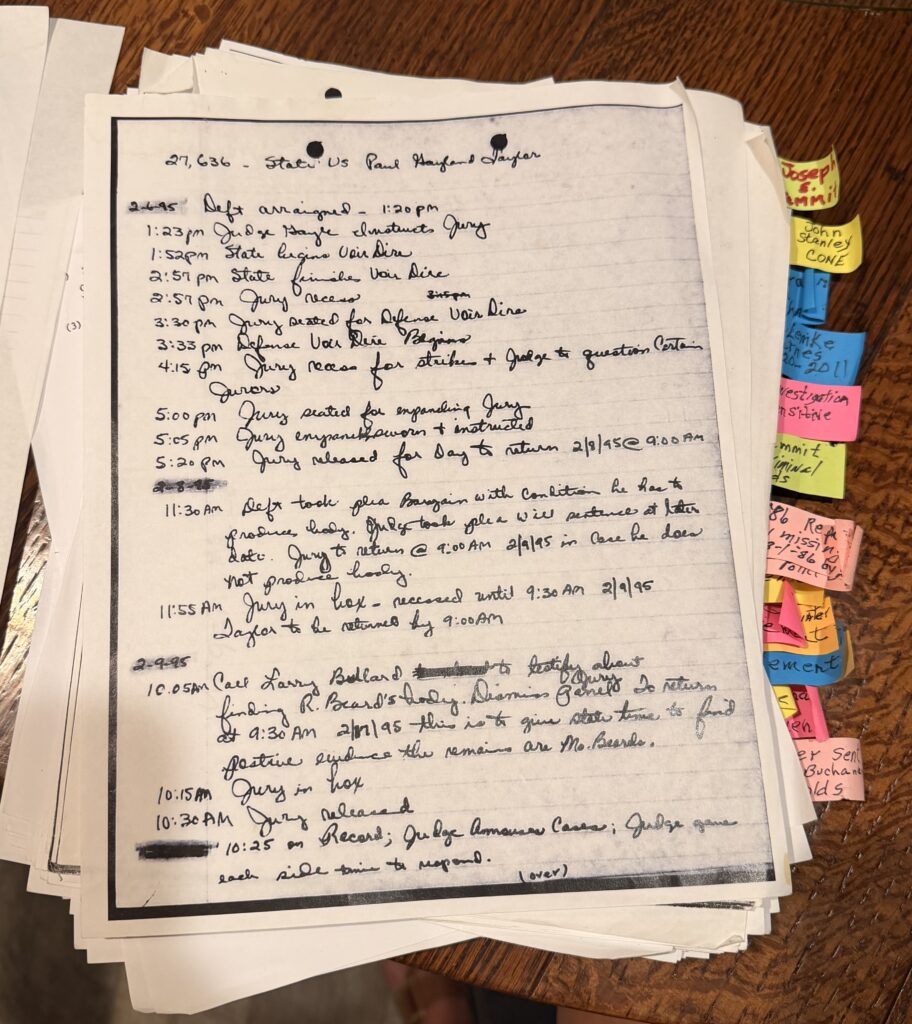
Court records uncovered by Becky Beard’s family reference the discovery of her body and plans to establish positive identification after Paul Taylor’s guilty plea in 1995. Becky’s remains have never been recovered or positively identified.
Becky’s family has spent decades searching for answers.
Their investigation uncovered court records that reference her body and a Remington shotgun after Taylor’s guilty plea in February 1995.
The handwritten court notes also reference investigator Larry Bullard.
One entry describes plans for Bullard to testify about finding Becky’s body. It also references additional time to establish positive identification.
The family says it learned about these records decades later.
During my exclusive interview, Miller said he knew nothing about investigators recovering Becky’s remains.
He also said he had never heard about a Remington shotgun in connection with the case.
Miller questioned why the family would not have learned about such a discovery.
He explained that investigators would ordinarily seek identification through dental records, DNA testing or other forensic methods.
The court documents raise questions about what investigators recovered after Taylor’s guilty plea.
Did investigators discover possible human remains?
Where did those remains go?
Did anyone submit them for forensic identification?
Why did Becky’s family learn about these records decades later?
The documents do not establish that investigators positively identified Becky’s body.
Her family continues to search for her remains.
Why did officials stop the excavation?
The home linked to Becky Beard’s murder. Retired Freeport police captain Richard Miller says investigators found apparent blood evidence and drag marks inside. Two cadaver dogs also alerted beneath the property.
Miller’s account presents one of the most significant unanswered questions in this investigation.
Investigators had apparent blood evidence inside the home.
They observed possible drag marks leading toward the back door.
Two cadaver dogs independently alerted beneath the property.
Miller then discovered unidentified white material while digging at that location.
Yet officials ordered him to stop before he could identify it.
Miller said they cited concerns about the upcoming trial.
He never personally entered physical evidence from that excavation into the case.
Nearly four decades after Becky disappeared, her family continues to search for her remains.
Taylor’s confession established his involvement in her murder. However, it did not answer every question about what happened inside the home or where Becky’s body went.
The original forensic reports, evidence logs and sealed court records could help resolve those questions.
Did investigators overlook evidence that could finally lead Becky’s family to her remains?
For Becky’s mother, sister and daughter, the search for answers continues.
My new book, When Two Worlds Collide During WWII, follows two families on opposite sides of World War II and the remarkable events that eventually brought their lives together in Wisconsin.
The story is based on my own family history, with real people, family photographs and stories passed down through generations.
Disclosure: As an Amazon Associate, I earn from qualifying purchases.
Retired Freeport police captain Richard Miller reveals evidence discovered inside a home linked to the Becky Beard murder case, including apparent blood evidence, drag marks and cadaver dog alerts.
Nearly 40 years after Rebecca “Becky” Beard disappeared, a retired Freeport police captain is revealing evidence investigators discovered inside a home believed to be connected to her murder.
In my exclusive interview, Richard Miller describes apparent blood evidence, drag marks and two cadaver dogs that alerted beneath the home. He also recalls finding unusual material while digging before officials ordered him to stop.
Despite those discoveries, investigators never secured the home as a crime scene.
Watch my exclusive interview with Richard Miller
Richard Miller reveals evidence discovered inside the home
Retired Freeport police captain Richard Miller speaks exclusively with Investigative Reporter Tammy Rose about evidence discovered inside a home linked to Becky Beard’s murder.
Miller spent 22 years with the Freeport Police Department. He was a rookie when Becky disappeared in March 1986. Years later, he revisited the investigation as a police captain.
During a search of the home, investigators used luminol to look for possible blood evidence. Miller describes apparent blood smears on a wall and floor, along with marks leading toward the back door.
Two cadaver dogs also alerted beneath the house.
Officials ordered Miller to stop digging
Miller says he began digging beneath the home after the dogs alerted. During that search, he discovered unusual white material.
Before he could determine what he had found, officials ordered him to stop.
The material has not been confirmed as human remains. However, Miller’s account raises questions about evidence investigators may have left behind.
Why wasn’t the home secured as a crime scene?
Inside the home investigators searched in connection with Becky Beard’s murder. Retired Freeport police captain Richard Miller describes evidence discovered during the investigation.
John Cone previously told investigators that Paul Taylor Jr. allegedly confessed to him about Becky’s death.
Cone reported that Taylor had removed a mattress and carpet from the home. He also offered authorities a key to the property.
Yet investigators did not immediately secure and process the residence following Cone’s report.
Miller’s account now provides additional details about what investigators discovered during a later search.
Newly uncovered records raise more question
Newly uncovered investigative notes reference finding Becky Beard’s body. Her family says they were never informed of such a discovery, raising questions about what investigators knew in 1995.
Becky’s family has spent decades searching for her remains. They have also reviewed investigative reports and court records in their effort to uncover what happened.
Records involving possible human remains have raised additional questions for the family.
Miller’s interview offers a new perspective on the evidence discovered beneath the house. However, it does not establish that investigators recovered human remains.
Paul Taylor Jr. pleaded guilty in connection with Becky’s death in 1995. Her body has never been recovered.
My new book, When Two Worlds Collide During WWII, follows two families on opposite sides of World War II and the remarkable events that eventually brought their lives together in Wisconsin.
The story is based on my own family history, with real people, family photographs and stories passed down through generations.
Disclosure: As an Amazon Associate, I earn from qualifying purchases.
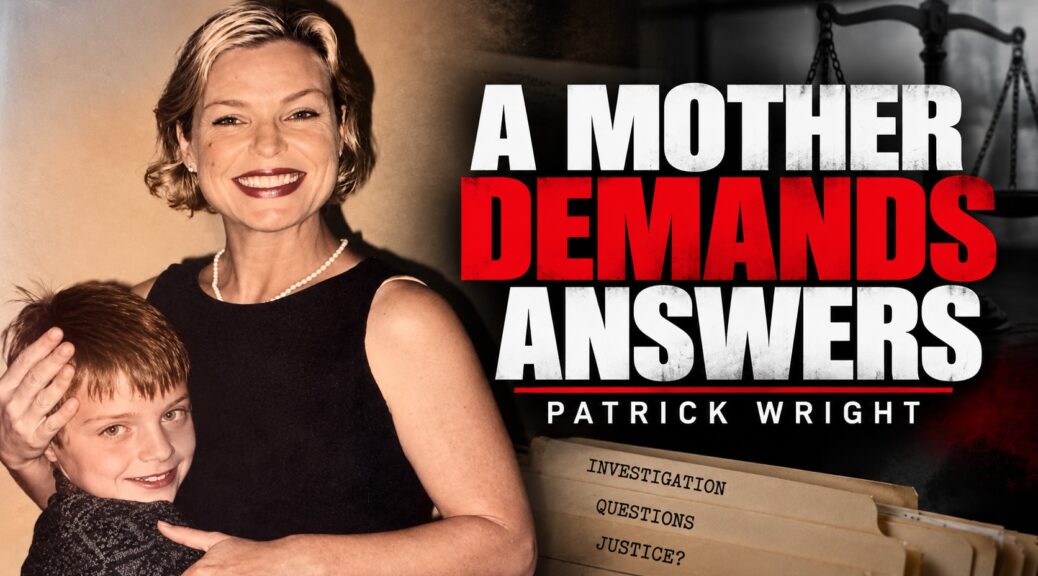
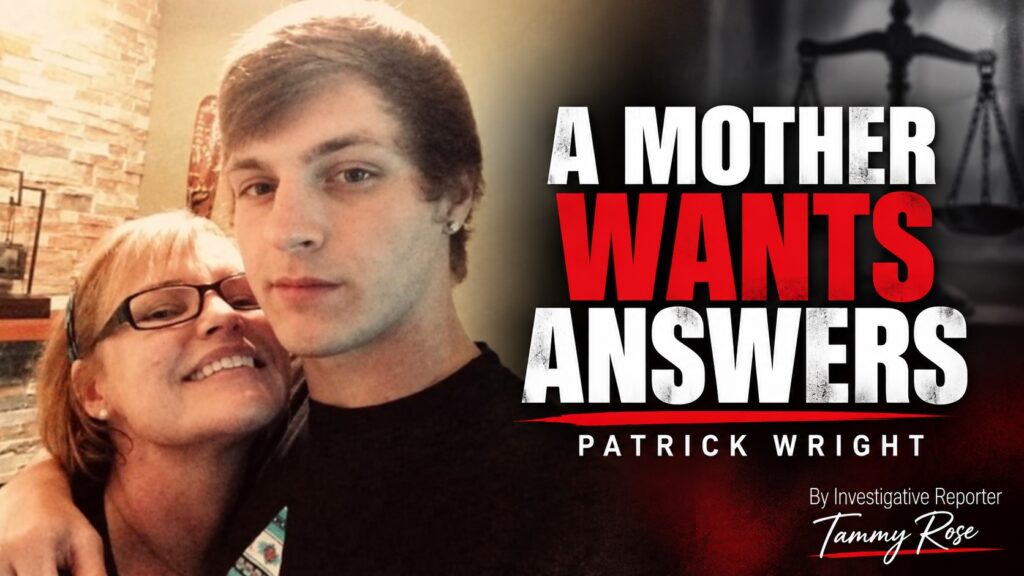
More than a year after the Patrick Wright killing in Galveston, his mother, Kim Lain, says she still has serious questions about the investigation.
Kim Lain was there when her son died. She says she saw the man involved in the confrontation. She spoke directly to him. Moments later, she watched her son collapse after he was shot.
The investigation took several unexpected turns. Police first arrested the wrong man on a murder charge. Investigators later acknowledged problems with gunshot residue testing.
Authorities eventually identified another man as the shooter. They said he admitted firing the shots but claimed self-defense.
Watch the full investigation
Investigative Reporter Tammy Rose sat down with Kim Lain to discuss her son’s death, the investigation and the questions she says remain unanswered. Watch the full report below.
A Galveston County grand jury later took no action in the case.
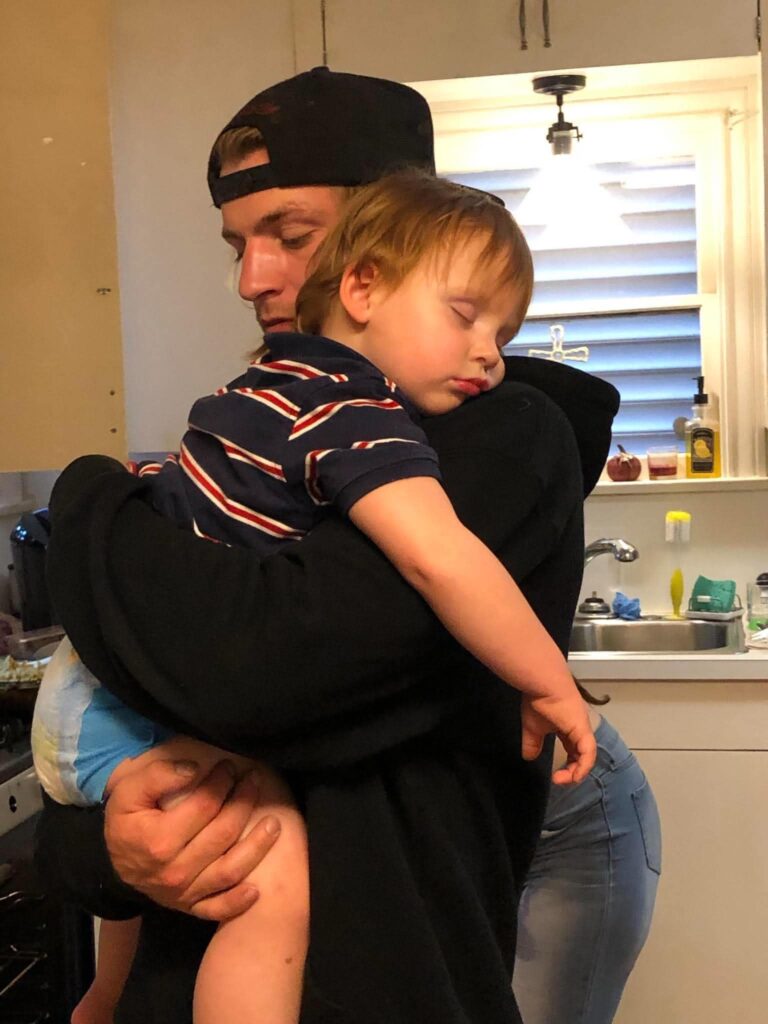
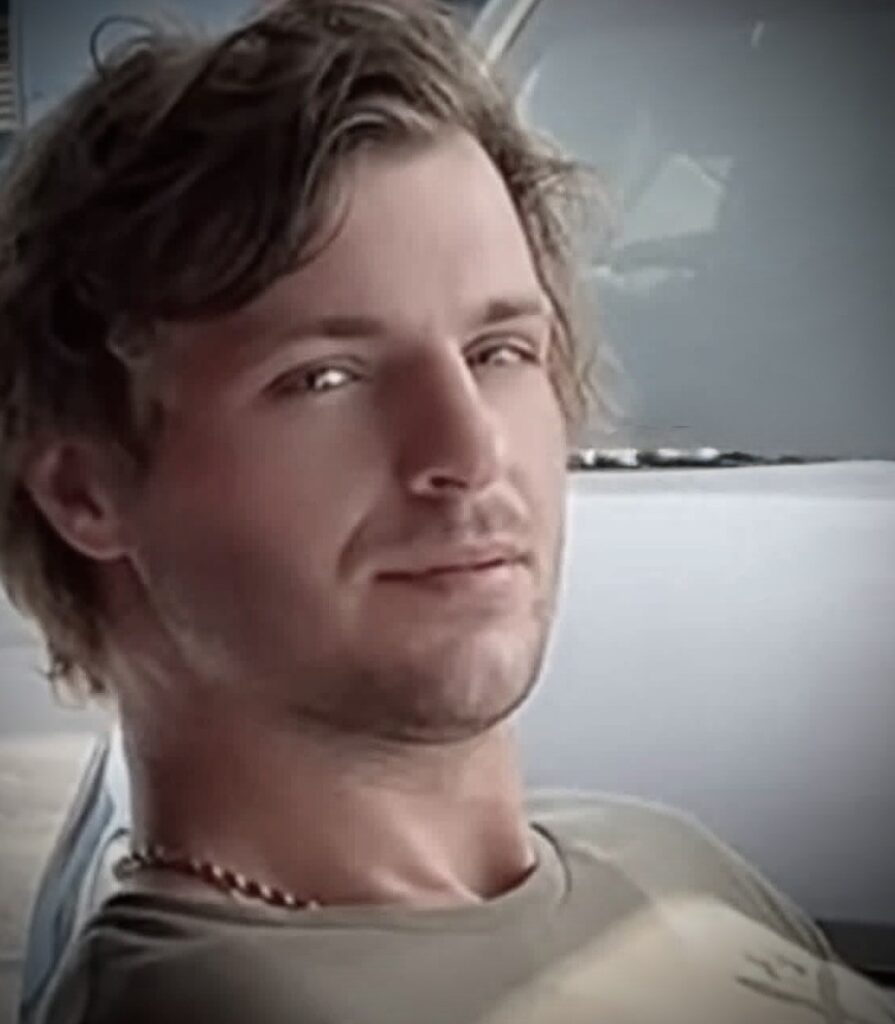
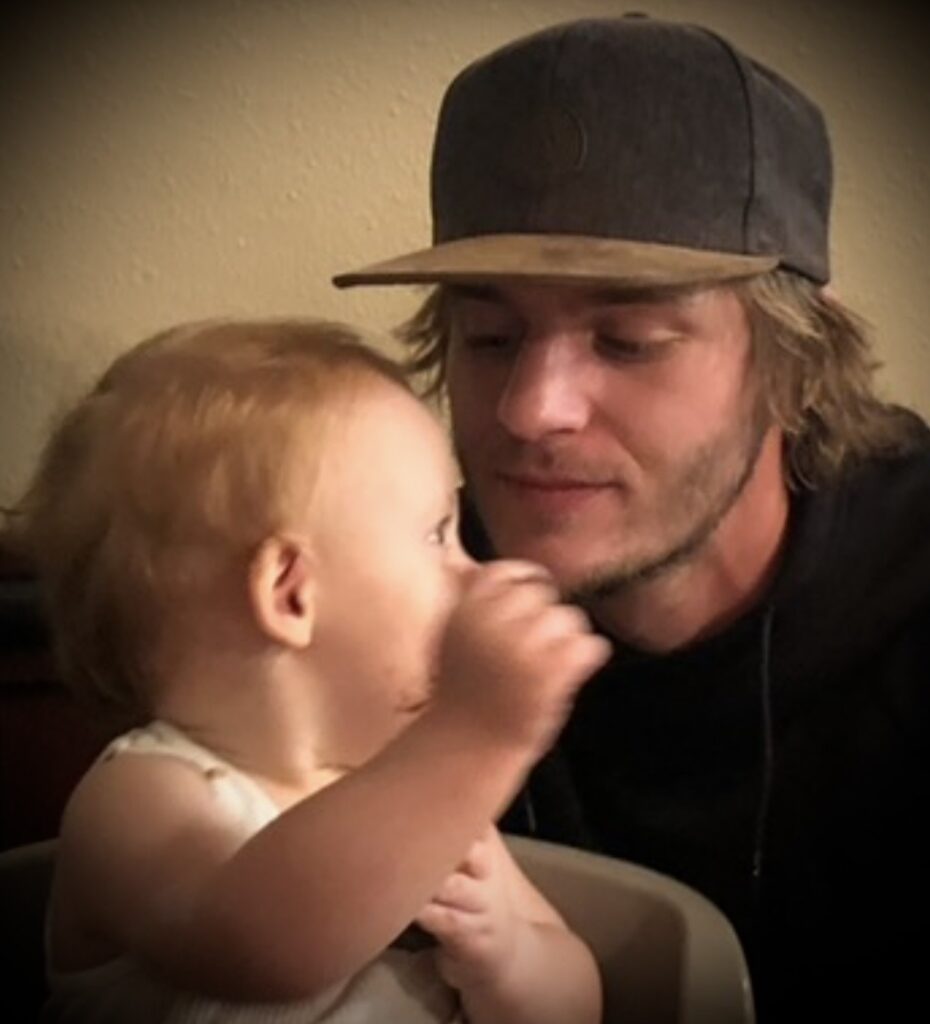
Patrick William Wright with one of his children. His mother, Kim Lain, remembers him as a devoted father who put family first.
Now Lain is questioning how investigators handled her son’s death and why no one faces charges.
Patrick Wright killed in Galveston
Patrick William Wright was 29 when he died on June 20, 2025.
Lain remembers her son for much more than the circumstances surrounding his death.
“He was a very pure soul, that is for sure,” Lain said. “Family was everything to him.”
She described Patrick as someone who held doors open for strangers and helped people who needed it.
“He’s the guy that would give the homeless a few bucks and something to eat, no questions asked,” she said. “I admired that about him.”
A confrontation on Avenue R
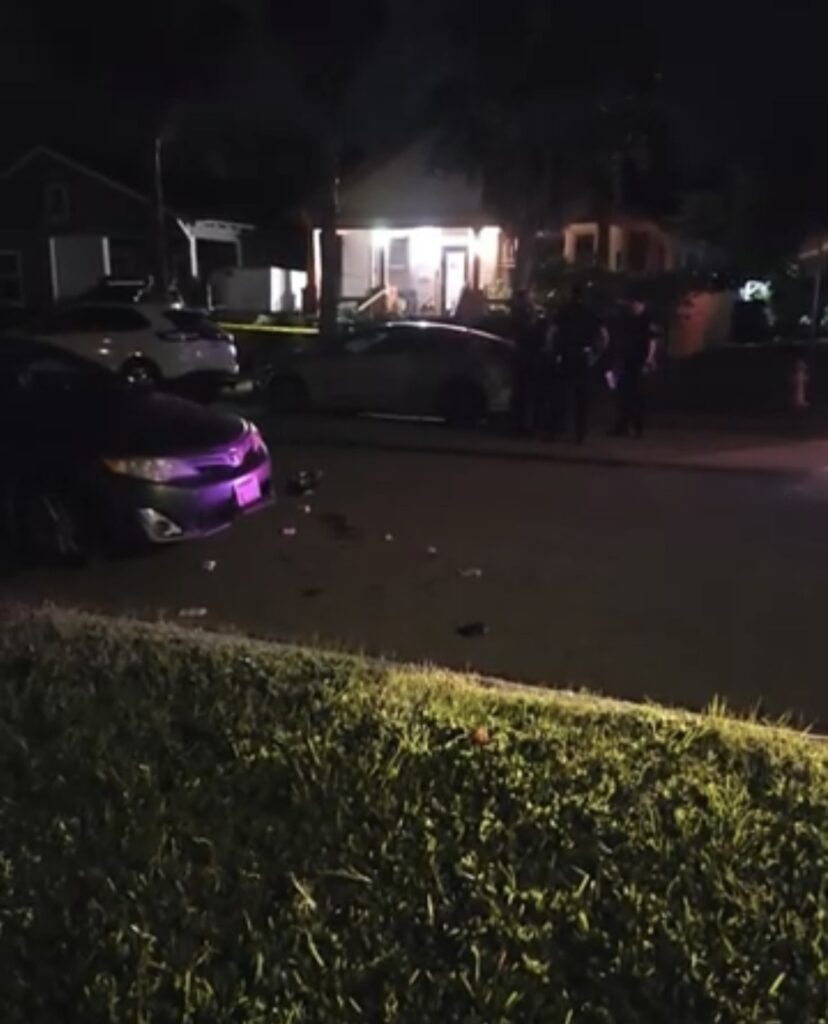
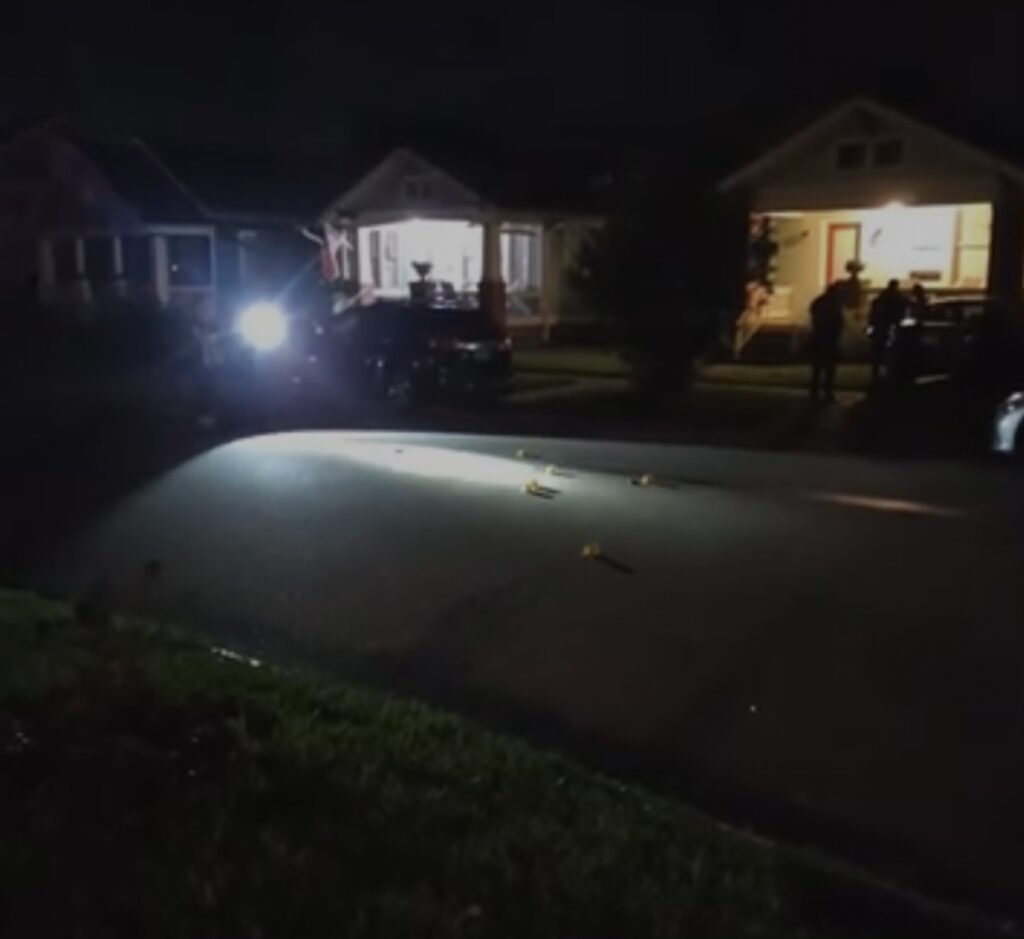
Police at the scene following the fatal shooting of 29-year-old Patrick William Wright in Galveston.The scene on Avenue R in Galveston following the fatal shooting of 29-year-old Patrick William Wright.
Lain says she and Patrick were traveling along Avenue R in Galveston when another vehicle made a wide U-turn and came close to them.
She says Patrick wanted the vehicle’s license plate number. He backed up until the two vehicles were next to each other.
“I heard my son say something to the effect of, ‘Hey, you know, what’s your problem? You almost hit me,’” Lain said.
Patrick eventually got out.
Lain says she repeatedly asked her son not to engage with the other driver. She also asked the other driver to leave.
Seconds later, she heard gunfire.
“It sounded like four shots to me,” Lain said. “It was more than two.”
Patrick then appeared at her window.
“He clenched his chest, and he said, ‘I’ve been shot,’” she recalled.
Lain called 911 at 10:14 p.m.
“He collapsed on the hood, and I lost him there,” she said.
Patrick had been shot twice in the chest.
Lain says less than three minutes passed between the U-turn and the shooting.
Police initially arrested the wrong man
The investigation soon took an unexpected turn.
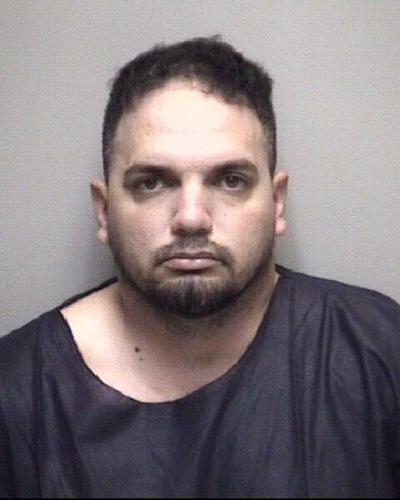
Galveston police initially arrested Uber driver Sanddy Diaz Pino on a murder charge. Police later determined he was not the shooter.
Galveston police initially arrested Uber driver Sanddy Diaz Pino and charged him with murder.
Days later, police determined he was not the shooter.
Investigators said video evidence raised questions about his involvement. Police also acknowledged problems with preliminary gunshot residue testing that produced false-positive results.
Authorities dismissed the murder charge against Diaz Pino.
Investigators later identified another ride-share driver.
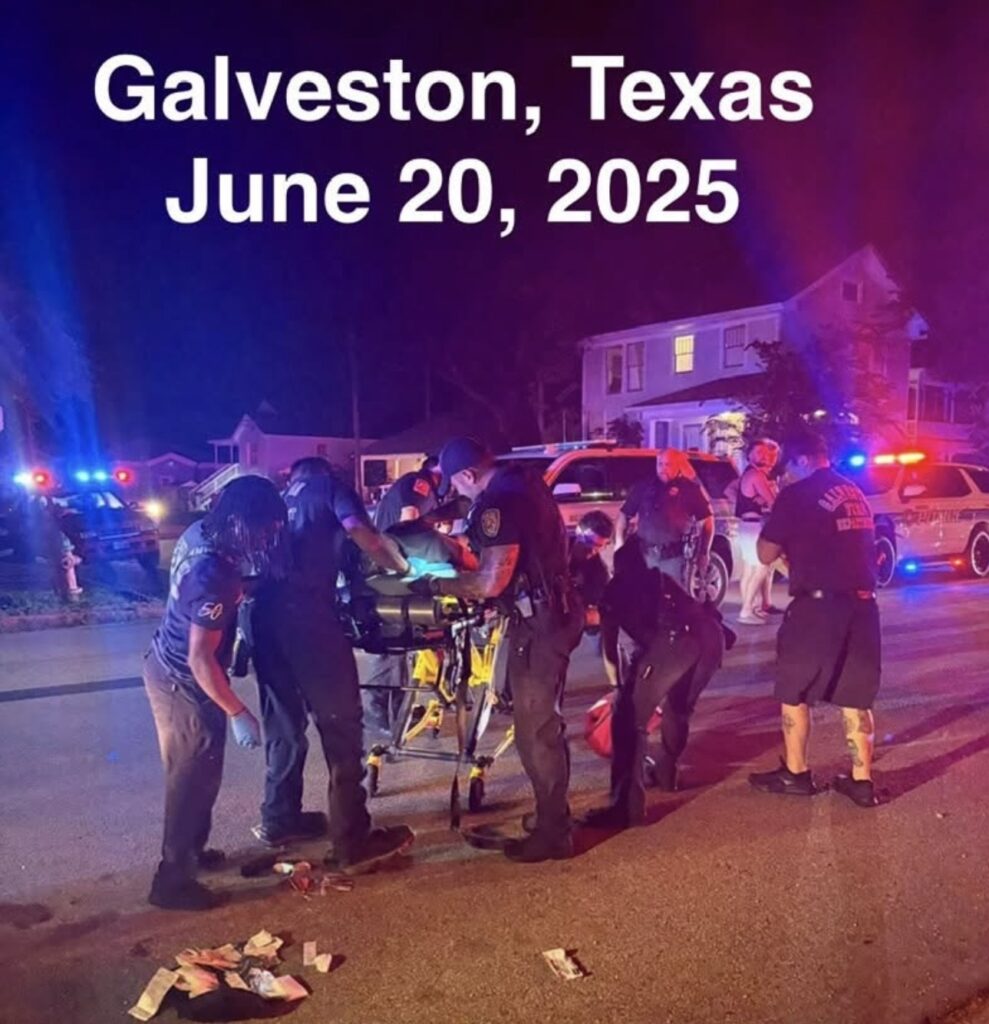
Emergency responders tend to 29-year-old Patrick William Wright after he was shot in Galveston on June 20, 2025.
Authorities said that man admitted shooting Patrick but claimed he acted in self-defense.
Lain disputes part of the shooting account
Early reports cited a witness and a probable cause affidavit. They said Patrick lunged toward the driver’s open window before the shooting.
Lain says she did not see that happen.
“It hurts immensely,” she said. “It also hurts how things have been characterized … because that is not what I witnessed at that scene.”
Lain also disputes the identity of the driver.
She says she looked directly at the man behind the wheel and spoke to him during the confrontation.
Lain says she later made a sworn identification of the man she saw that night. She says the man she identified was not the same person authorities identified during their investigation.
She later took her eyewitness identification to authorities.
Lain says authorities told her it did not qualify as new evidence.
Grand jury takes no action
Patrick William Wright was 29 years old when he was shot and killed in Galveston in June 2025.
The case went before a Galveston County grand jury. The grand jury returned no indictment.
Grand jury proceedings remain secret under Texas law. That means the public cannot independently determine all the evidence prosecutors presented or why jurors reached their decision.
Lain has also discussed her own involvement in the grand jury process. Before publishing, I would confirm with Kim that she personally testified and then add that fact here. Your package does not establish that point clearly enough for me to put it in as fact yet.
Lain questions evidence in the case
Kim Lain with her son, Patrick William Wright, years before his death in Galveston.
Lain says the prosecutor who presented the case later discussed the evidence with her.
According to Lain, the prosecutor said the case went before the grand jury without a firearm, ballistics evidence, eyewitness identification or physical evidence tying the person under investigation to the scene.
Lain says the prosecutor told her authorities did have a confession and information from Uber placing that person there.
Those statements reflect Lain’s account of what the prosecutor told her. Grand jury secrecy prevents the public from independently confirming everything jurors saw or heard.
Lain says authorities told her she would need new evidence before they could consider the case again. She says they gave a firearm as one example.
She also questions why authorities want her to produce new evidence while opposing the release of Patrick’s complete autopsy file.
Lain believes that file could contain forensic evidence relevant to the case.
A mother continues searching for answers
Patrick William Wright was a father of three. His mother, Kim Lain, says family meant everything to him.
Lain says she was also told that another grand jury would reach the same outcome even if she produced new evidence.
She questions how anyone could know what another grand jury would decide.
“I feel violated. I feel betrayed,” Lain said. “I feel pain for my son. I feel pain for myself. Every day is hell.”
More than a year after Patrick’s death, Lain wants authorities to take another look at the case.
She wants investigators to consider her eyewitness identification and her account of her son’s final minutes.
For Lain, Patrick is more than a name in an investigative file.
He was a 29-year-old father whom she remembers for his kindness and devotion to his family.
“Family was everything to him,” she said.
A grand jury’s decision not to indict does not determine guilt or innocence. Grand jury proceedings are secret, and the evidence presented to jurors generally remains outside public view.
My new book, When Two Worlds Collide During WWII, follows two families on opposite sides of World War II and the remarkable events that eventually brought their lives together in Wisconsin.
The story is based on my own family history, with real people, family photographs and stories passed down through generations.
Disclosure: As an Amazon Associate, I earn from qualifying purchases.
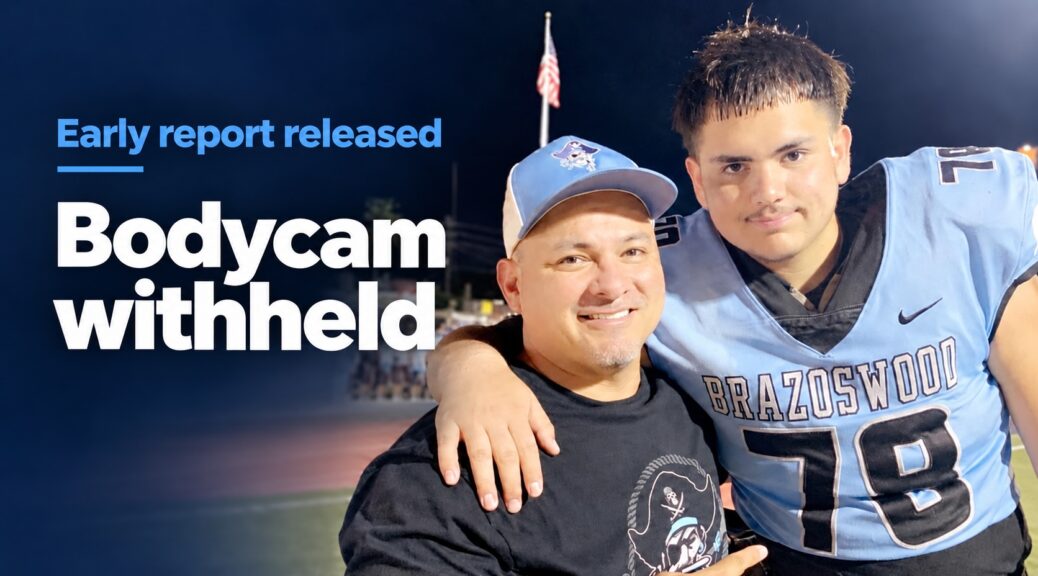
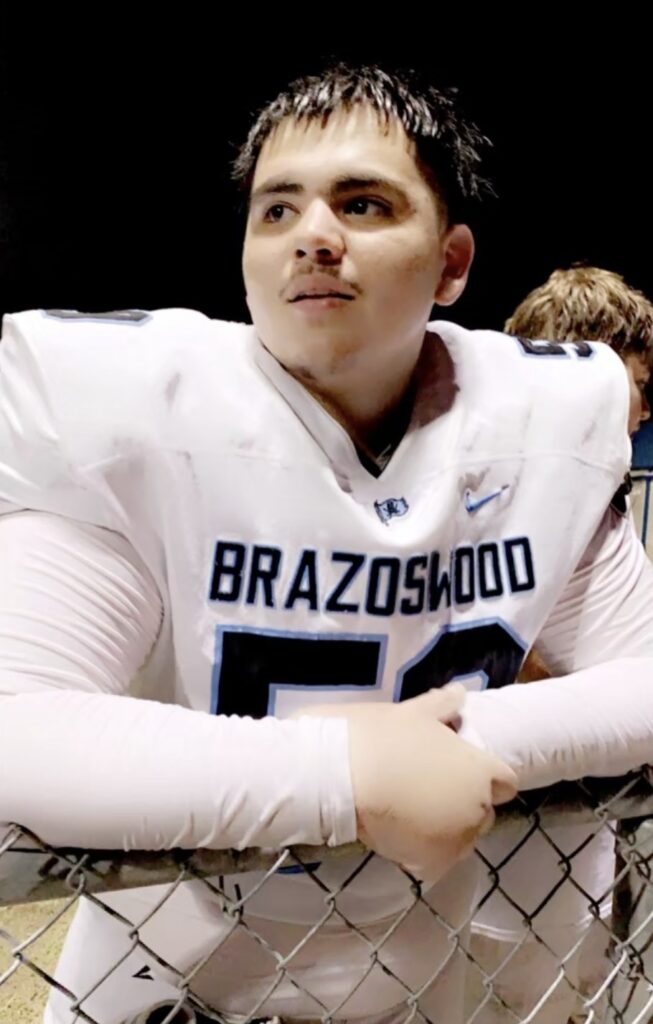
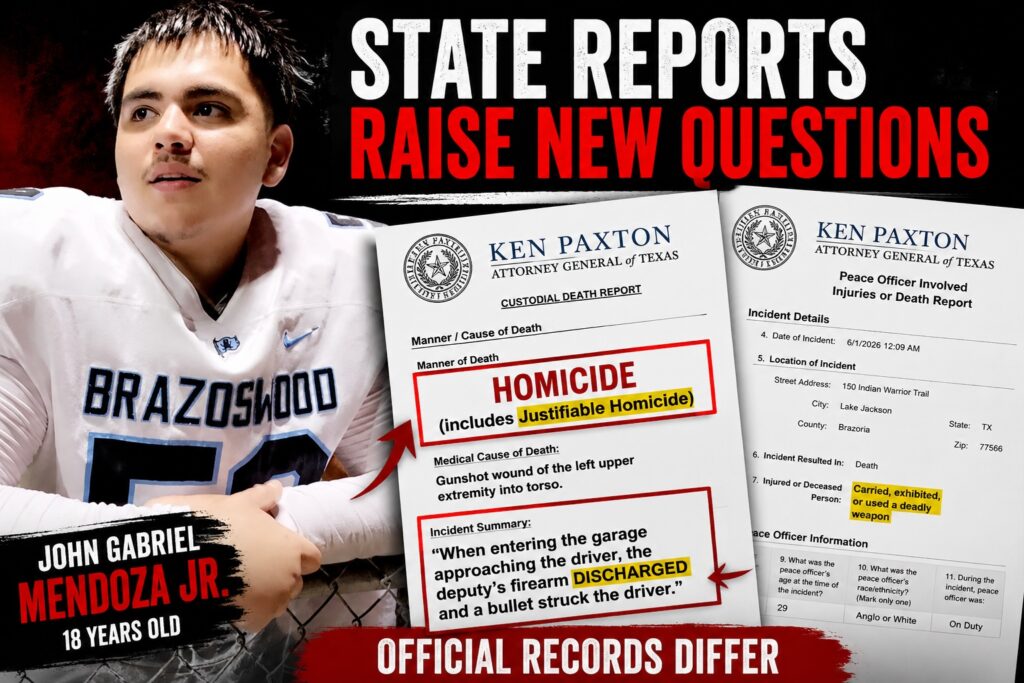
John Gabriel Mendoza Jr., 18, was a Texas State University student who died following the June 1, 2026 shooting involving former Brazoria County deputy Kevin Daniel Tippit.
Months after the fatal shooting of John Gabriel Mendoza Jr., Brazoria County released an incident report printed two days after the shooting.
The sheriff’s office printed the report on June 3, 2026, at 7:39 a.m. The report warns that it only reflects the investigation as it existed at that time.
The county released the early John Mendoza report on September 14. However, it withheld the bodycam, dashcam and nearly the entire detailed narrative.
What the John Mendoza report shows
The Brazoria County Sheriff’s Office lists the incident under case number 2606-0001.
The report identifies the original allegation as evading arrest or detention with a vehicle. It lists the location as the 1100 block of FM 2004 in Lake Jackson.
The report identifies the vehicle as a red 2021 Dodge Challenger.
A short summary states that deputies attempted a traffic stop before the vehicle fled.
The report lists the State of Texas as the victim. It identifies Mendoza as the suspect in the alleged evading offense.
That classification only concerns the original pursuit report. It does not establish that Mendoza committed a crime.
County redacts Tippit’s narrative
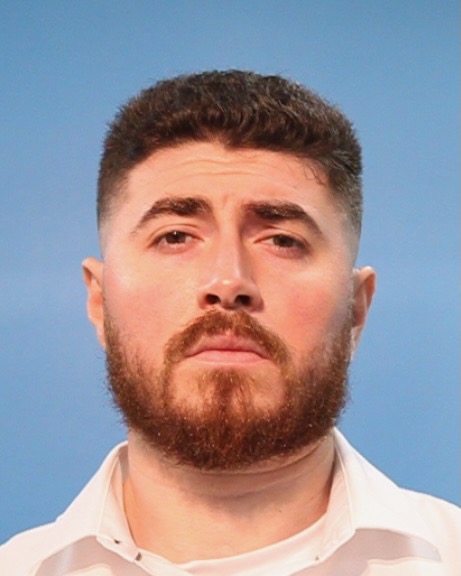
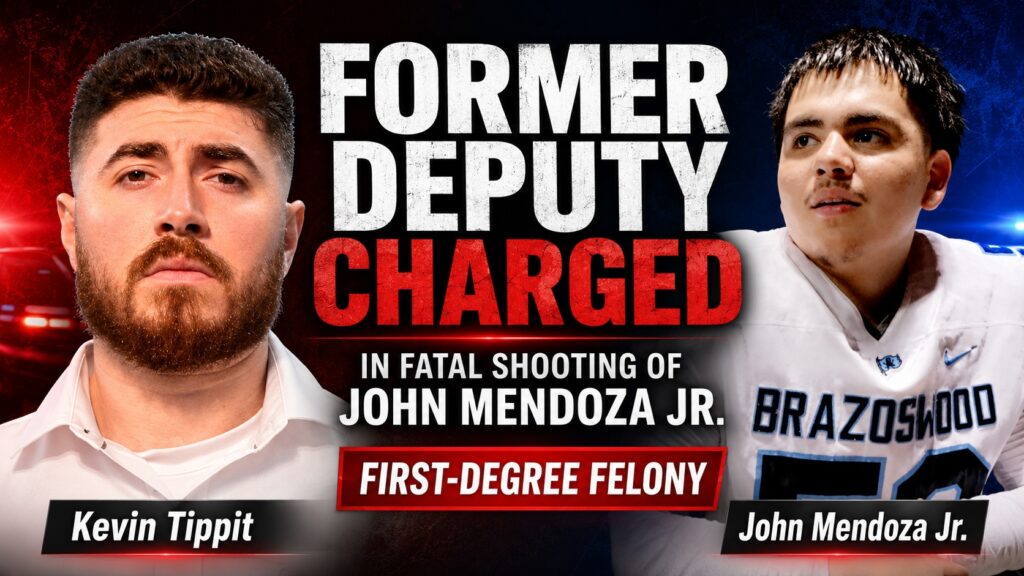
Former Brazoria County Sheriff’s Deputy Kevin Daniel Tippit faces a charge of aggravated assault by a public servant in connection with the June 1, 2026 shooting of John Gabriel Mendoza Jr. Photo credit: Brazoria County Sheriff’s Office.
The detailed narrative contains one visible line about former Brazoria County Deputy Kevin Daniel Tippit.
The report states that Tippit advised he was in pursuit at about 12:09 a.m.
The county covered nearly every word that follows with black boxes. It also redacted the names of the assisting officers.
The visible line does not establish when the pursuit began. It only records when the report says Tippit advised that he was in pursuit.
Records do not contradict Ranger affidavit
Former Brazoria County Sheriff’s Deputy Kevin Tippit has been charged with first-degree felony aggravated assault by a public servant in connection with the fatal shooting of 18-year-old John Gabriel Mendoza Jr.
The new report does not contradict the timeline in the Texas Ranger affidavit.
The Ranger affidavit says Tippit observed the Challenger around 12:06 a.m. It also says he activated his emergency lights and siren.
The available scanner recording begins carrying pursuit traffic around 12:08 a.m. The sheriff’s report then places Tippit’s pursuit notification at about 12:09 a.m.
Those times describe different points during the encounter. They do not prove that investigators provided an incorrect timeline.
The newly released report also does not reveal the “accidental discharge” statement. The previously obtained scanner audio already captured Tippit making that report.
Rangers reviewed bodycam and dashcam
The Texas Ranger affidavit says investigators reviewed Tippit’s bodycam and dashcam.
According to the affidavit, the Challenger reached approximately 120 mph and ran six red lights. The pursuit ended inside the garage at Mendoza’s family home.
The affidavit says Tippit entered the garage and fired through the driver’s-side window.
Scanner traffic later captured Tippit reporting what he described as an “accidental discharge.”
The new John Mendoza report offers no additional account of the shooting. Brazoria County withheld the videos that could allow the public to examine the encounter independently.
Attorney General allows county to withhold records
The Texas Attorney General issued ruling OR2026-038106 on August 28, 2026.
The ruling covered eight public-information requests, including Brazoria County request number 26-1859.
Brazoria County argued that releasing the evidence could interfere with an active criminal case. The Attorney General allowed the county to withhold most of the investigative material.
However, the ruling required the county to release basic information.
Investigative Reporter Tammy Rose then requested the information covered by the ruling. Brazoria County assigned that follow-up request number 26-2947.
The county responded on September 14 with the early report and extensive redactions.
Report predates major developments
The sheriff’s office printed the released report on June 3.
That date matters because the report predates several major developments in the case.
Sheriff Bo Stallman fired Tippit on June 9. Stallman cited policy violations involving the handling and discharge of Tippit’s firearm.
A Brazoria County grand jury later indicted Tippit on aggravated assault by a public servant. Texas Rangers arrested him on August 11.
The court has scheduled Tippit’s trial for February 1, 2027. Court dates can change.
An indictment does not establish guilt. The law presumes Tippit innocent unless prosecutors prove the charge in court.
Release offers no updated shooting account
The records released in September provide an early account of the alleged evading offense. They do not provide a current summary of the shooting investigation.
The packet contains no updated narrative following Tippit’s firing, indictment or arrest. It also contains no bodycam, dashcam or complete radio record.
The release confirms that Tippit advised he was in pursuit at about 12:09 a.m. Beyond that entry, it adds little to the established public record.
The most important evidence remains outside public view.
Investigative Reporter Tammy Rose will continue seeking the bodycam, dashcam and other records as the criminal case moves forward.
Read the documents
The Attorney General ruling, Brazoria County’s response and the sanitized incident report appear below.
My new book, When Two Worlds Collide During WWII, follows two families on opposite sides of World War II and the remarkable events that eventually brought their lives together in Wisconsin.
The story is based on my own family history, with real people, family photographs and stories passed down through generations.
Disclosure: As an Amazon Associate, I earn from qualifying purchases.
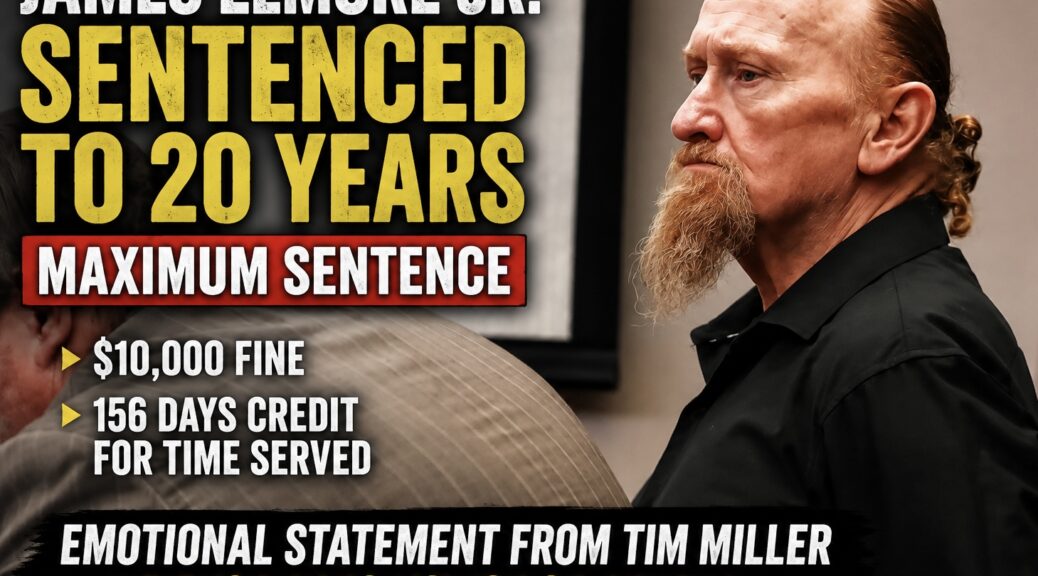
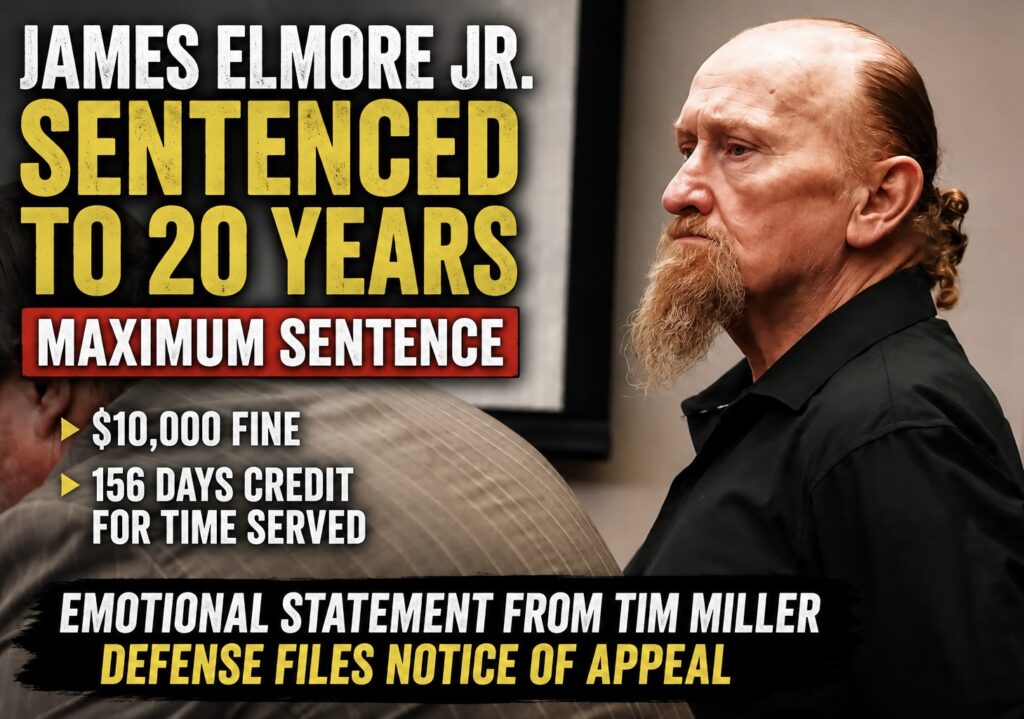
James Elmore Jr. was sentenced to 20 years in prison in the Laura Miller case. The judge also imposed a $10,000 fine and credited him with 156 days served.
James Elmore Jr. received a 20-year prison sentence Thursday in the Laura Miller case.
The judge also imposed a $10,000 fine.
The sentencing came after an emotional statement from Laura’s father, Tim Miller. He spoke directly to Elmore before the judge announced the punishment.
Tim Miller addresses James Elmore Jr.
Miller told Elmore about the damage Laura’s death caused his family.
He also spoke about Elmore’s own family.
Miller said Elmore’s son had recently posted messages suggesting he did not want to live. Despite everything that happened, Miller said he would do what he could to help keep Elmore’s son alive.
Miller then turned his attention back to Laura.
He told Elmore he once wanted to believe Elmore had not played a larger role in what happened to his daughter.
Miller said he no longer believed that.
He ended his statement by telling Elmore that he hoped he could someday find peace.
Judge sentences Elmore to 20 years
After Miller finished speaking, the judge sentenced Elmore to 20 years in the Texas Department of Criminal Justice.
The judge also ordered Elmore to pay a $10,000 fine.
Elmore received credit for 156 days already spent in custody.
The sentence followed a jury trial in Galveston County.
Elmore plans to appeal
The defense also confirmed plans to appeal the case.
Elmore’s trial attorney asked the court to release him as counsel. The judge said the court would appoint another attorney to handle the appeal.
The notice of appeal had already been filed when the judge addressed the issue in court.
Laura Miller case reaches another milestone
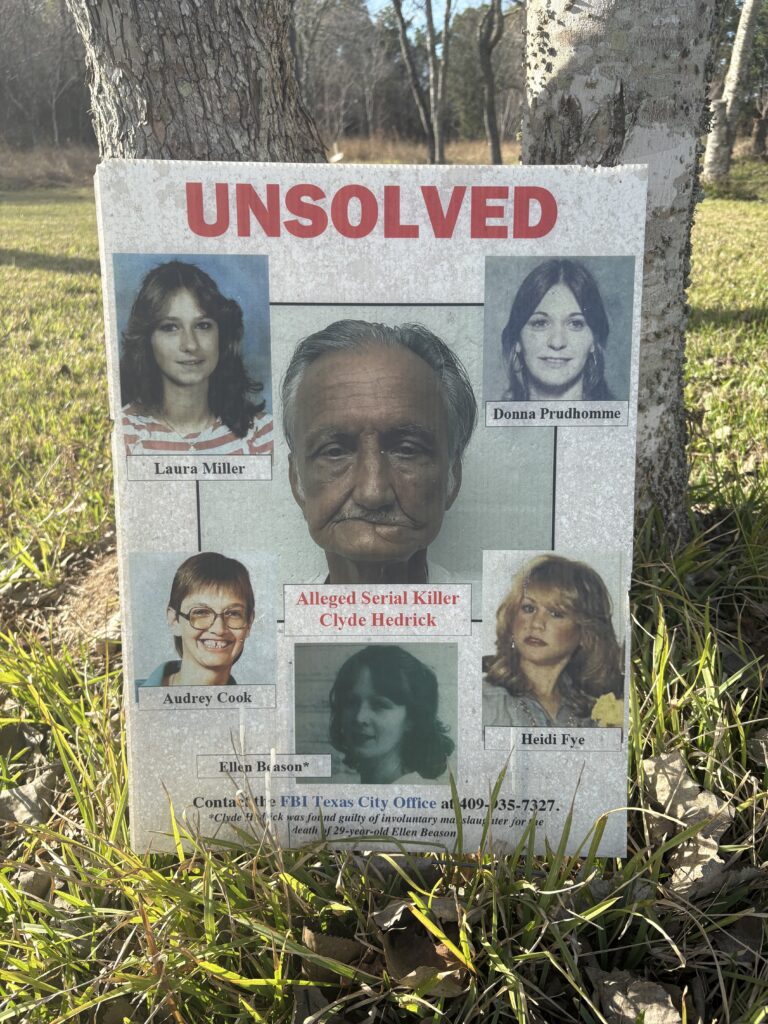
Memorial sign highlighting four victims whose cases have been linked to the same recovery site during the investigation into Clyde Hedrick and several unsolved homicides.
Laura Miller disappeared in September 1984.
Her remains were discovered near Calder Road in League City in February 1986.
Her father later founded Texas EquuSearch and spent decades searching for missing people while continuing to seek answers about Laura.
The sentencing marks another major development in a case that has remained part of the Texas Killing Fields story for more than four decades.
Outside the courtroom, I have also been working on a deeply personal project.
My new book, When Two Worlds Collide During WWII, follows two families on opposite sides of World War II and the remarkable events that eventually brought their lives together in Wisconsin.
The story is based on my own family history, with real people, family photographs and stories passed down through generations.
Disclosure: As an Amazon Associate, I earn from qualifying purchases.
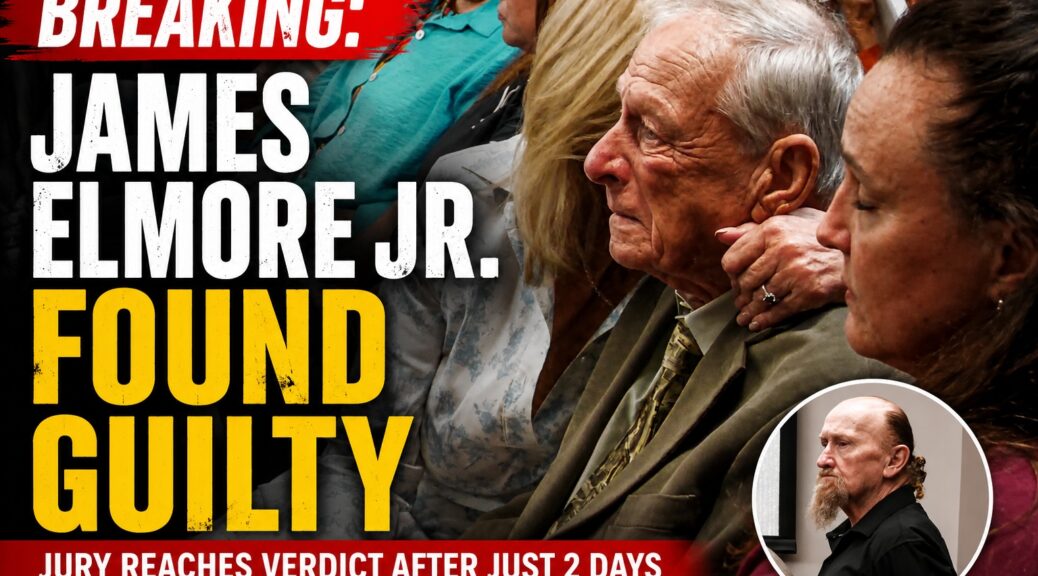
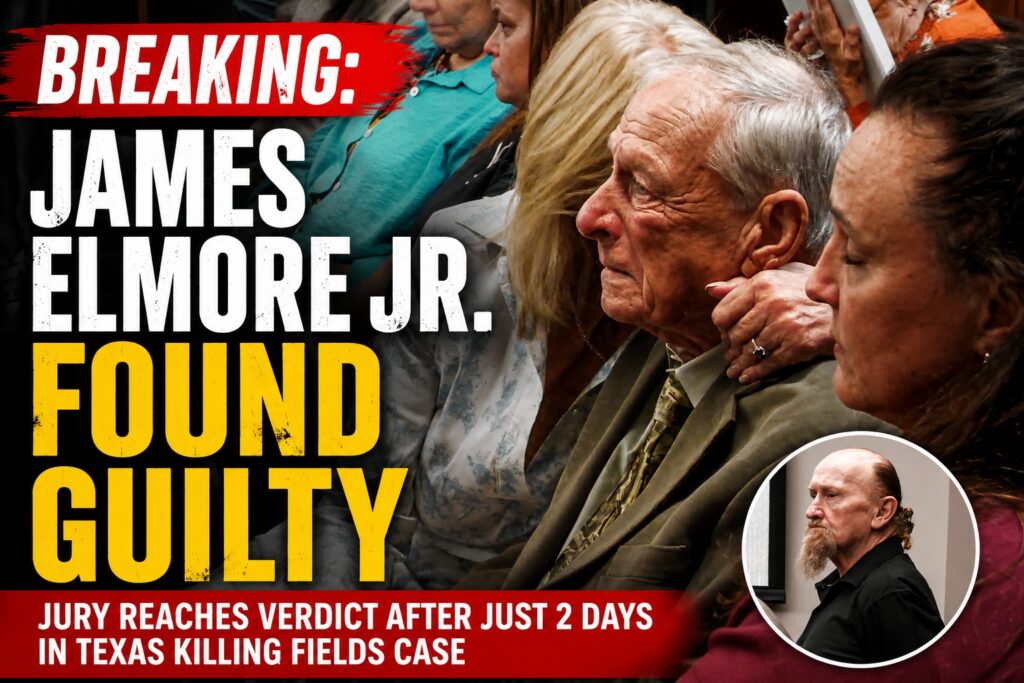
James Elmore Jr. was found guilty after a two-day trial in Galveston County tied to the death of Laura Miller.
A Galveston County jury found James Elmore Jr. guilty Wednesday following a fast-moving trial connected to the death of Laura Miller.
The verdict came after just two days of testimony.
Jurors began deliberating Wednesday afternoon. A short time later, the court notified the media that the jury had reached a verdict.
Elmore stood trial on charges tied to Laura Miller and Audrey Cook, two women whose remains were found in the League City area decades ago.
Jury reaches verdict in James Elmore Jr. trial
The case moved quickly Wednesday.
Prosecutors rested their case. The defense then called witnesses before both sides completed their cases.
Six women and six men ultimately received the case.
The jury returned its verdict later Wednesday afternoon.
Elmore was found guilty.
I will update this story with the verdict on each individual count and sentencing information as the court releases those details.
Tim Miller takes the stand
Laura Miller’s father, Tim Miller, was among the key witnesses called by prosecutors.
Miller testified about his years of contact with Elmore and his efforts to learn what happened to his daughter.
Jurors also heard about information Elmore allegedly knew concerning Laura and the location where her remains were found.
The defense later cross-examined Miller about those conversations and the investigation.
Jurors watched recorded interviews
The jury also watched recordings involving Elmore.
Those recordings became an important part of the prosecution’s case.
Investigators questioned what Elmore knew about Laura Miller and events surrounding her death.
The testimony focused on whether Elmore knew details that had not been released to the public.
Decades after Laura Miller disappeared
Memorial sign highlighting four victims whose cases have been linked to the same recovery site during the investigation into Clyde Hedrick and several unsolved homicides.
Laura Miller disappeared in 1984.
Her remains were later discovered near Calder Road in League City.
The area eventually became associated with several unsolved deaths and disappearances.
Laura’s death remained under investigation for decades.
Elmore’s arrest brought the case back into a Galveston County courtroom more than 40 years later.
What happens next
The case now moves to the next phase following the guilty verdict.
I am continuing to follow developments from the courthouse and will update this story with the verdict on each charge and sentencing information as those details become available.
Full courtroom video and continuing coverage will also be posted on Tammy Rose Reports on YouTube.
Outside the courtroom, I have also been working on a deeply personal project.
My new book, When Two Worlds Collide During WWII, follows two families on opposite sides of World War II and the remarkable events that eventually brought their lives together in Wisconsin.
The story is based on my own family history, with real people, family photographs and stories passed down through generations.
Disclosure: As an Amazon Associate, I earn from qualifying purchases.
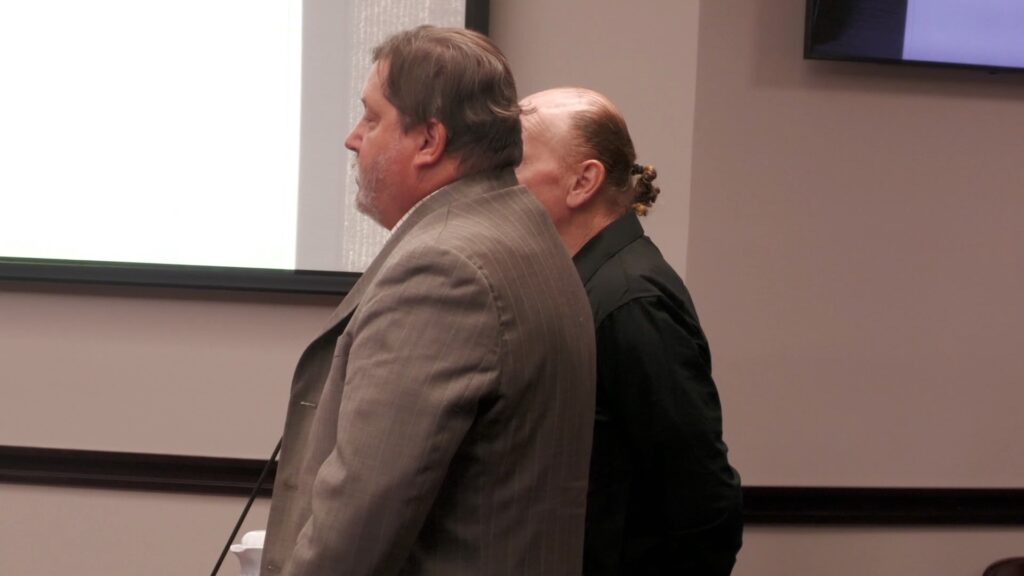
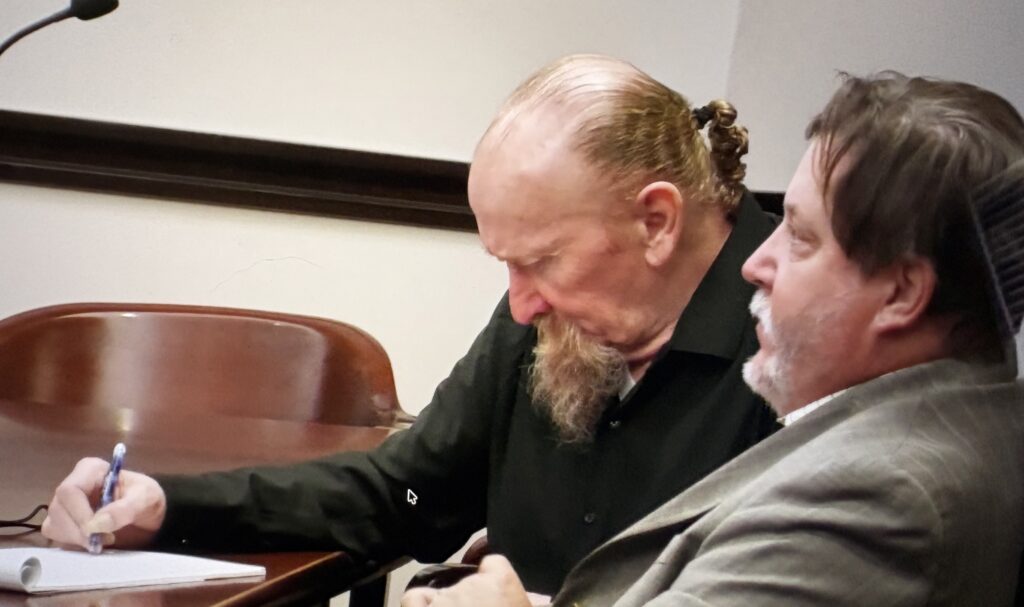
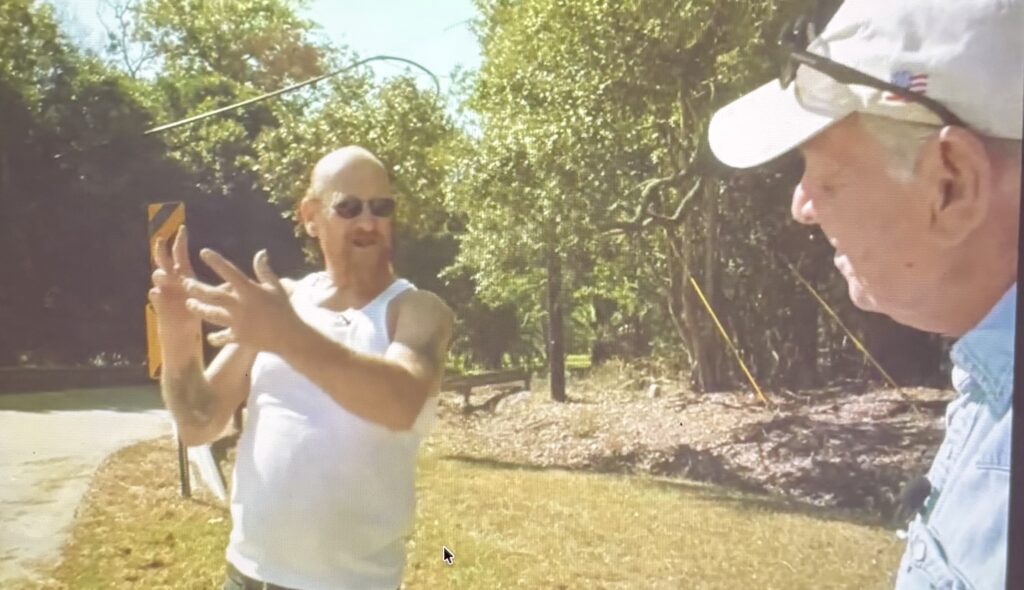
James Elmore Jr. sits with his defense attorney during his trial in Galveston County.
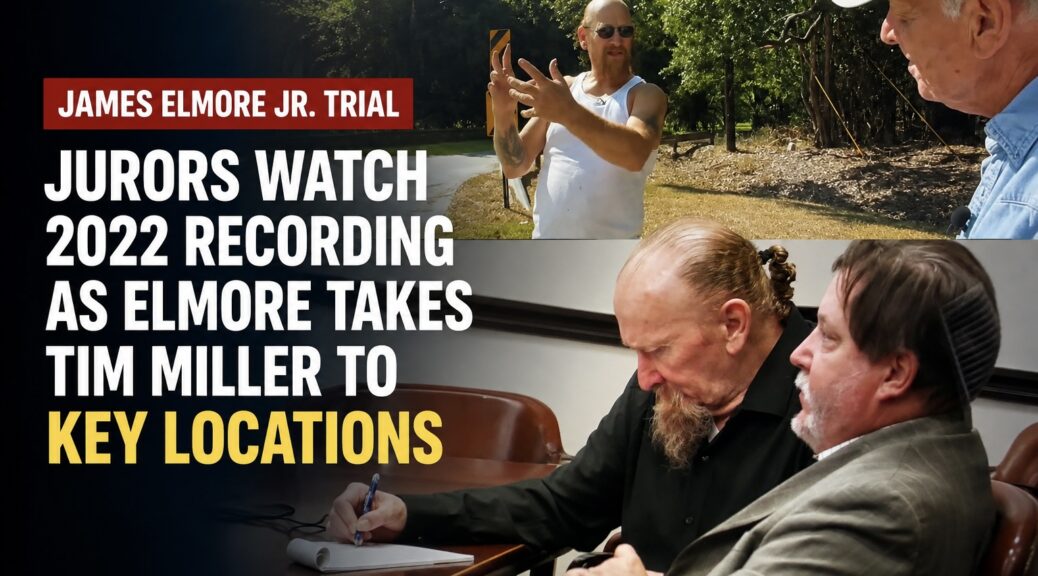
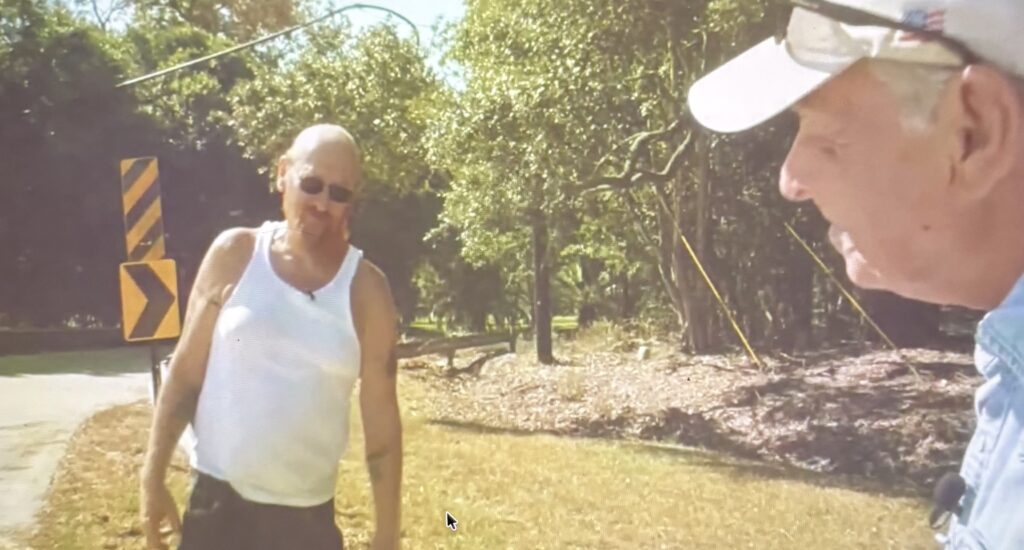
Jurors in the James Elmore Jr. trial watched a lengthy 2022 recording Wednesday that put Elmore’s own words at the center of the case.
The video shows Elmore riding with Tim Miller through League City. Elmore points out locations tied to Laura Miller, Audrey Cook and Clyde Hedrick.
The recording also captures Elmore making claims about what happened to Laura before and after her death.
Prosecutors played the video during Day 3 of the trial.
Tim Miller explains why he recorded Elmore
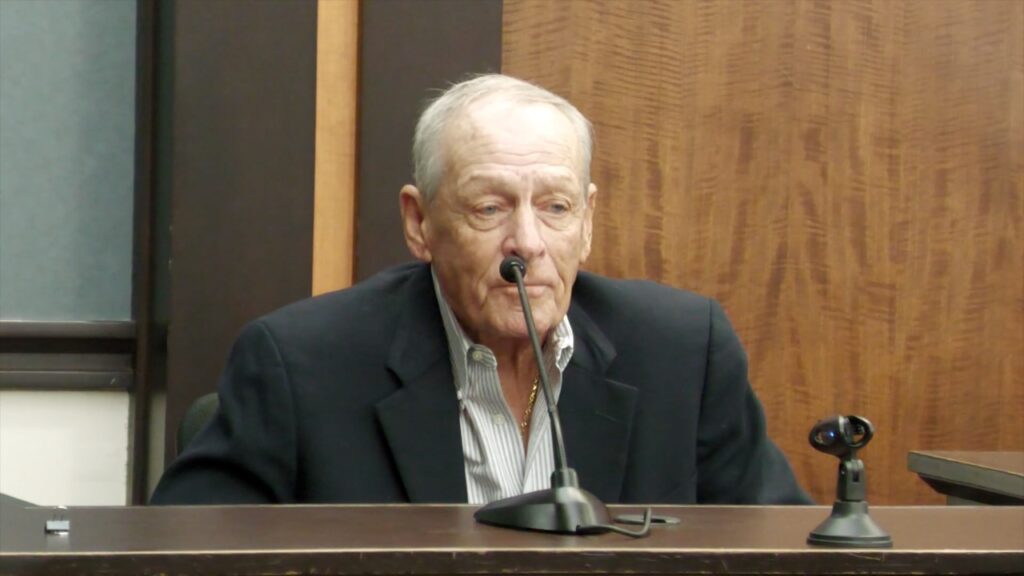
Tim Miller testifies about his conversations with James Elmore Jr. during the trial.
Miller told jurors he wanted to preserve what Elmore had told him.
He said Elmore had discussed several health problems. Miller feared Elmore could die before investigators resolved the case.
Miller said he contacted a friend with a production company and arranged the recording.
He told jurors he wanted Elmore to repeat what he had previously told him.
Miller also stressed during the recording that Elmore had contacted him voluntarily.
The video dates to Oct. 10, 2022.
Elmore returns to Calder Road
James Elmore Jr. points out an area near Calder Road during a 2022 recording with Tim Miller that was shown to jurors.
The recording shows Miller and Elmore driving through areas connected to the investigation.
They returned to Calder Road, where investigators found the remains of Laura Miller and Audrey Cook in 1986.
Elmore pointed out areas where he claimed the bodies had been placed.
He also discussed how the area looked decades earlier. Elmore described thick vegetation and fewer homes.
Miller questioned Elmore about the locations as they drove through the area.
Elmore claims he saw Laura at Hedrick’s house
One of the most significant portions of the recording focused on Clyde Hedrick’s former home.
Elmore claimed he saw Laura at the house.
Memorial sign highlighting four victims whose cases have been linked to the same recovery site during the investigation into Clyde Hedrick and several unsolved homicides.
He also described events involving drugs inside the home. Elmore claimed he prepared drugs and warned Hedrick that the amount was too much.
Elmore said he later saw Laura covered with a shirt. He claimed he initially thought she was sleeping.
Elmore also described returning to the house days later.
His account forms a key part of the prosecution’s case against him.
Cemetery becomes another focus
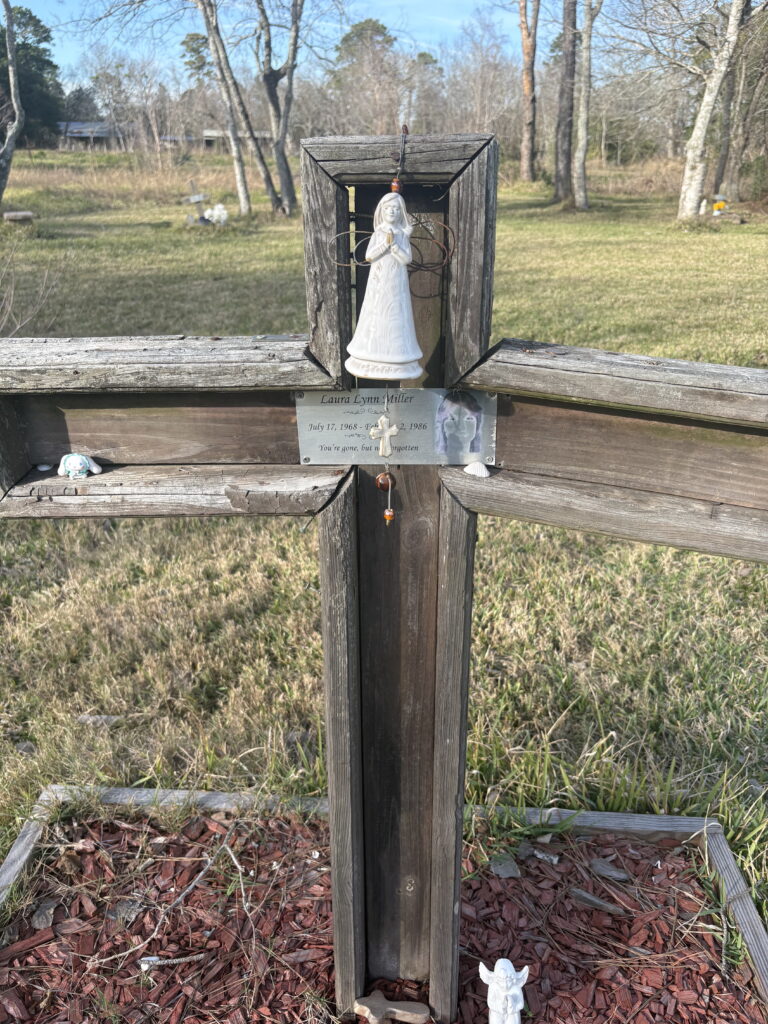
A cross memorial for Laura Miller stands near the Calder Road area where her remains were found in 1986.
The recording also took jurors to a cemetery near the neighborhood where Laura lived.
Elmore claimed Laura sometimes went to the cemetery.
He said Hedrick had seen and spoken with her there before her death.
Elmore described an encounter in which Hedrick approached Laura while Elmore and another man were nearby.
That claim could become important because it addresses whether Hedrick knew Laura before she died.
Elmore discusses shirt found near Laura Miller
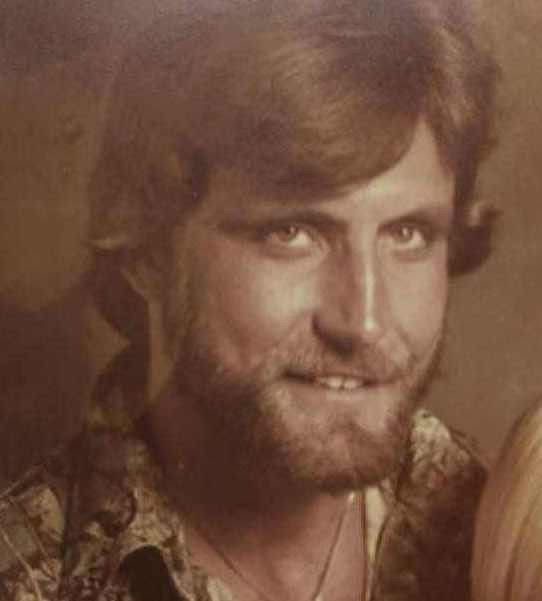
Clyde Hedrick in an undated photograph. His clothing became relevant during testimony about a shirt found near Laura Miller’s remains.
The shirt found near Laura Miller’s remains also came up during the recording.
Elmore claimed Hedrick often wore cowboy-style shirts.
He also claimed Hedrick later complained about losing a favorite shirt.
Investigators found a man’s shirt near Laura’s remains.
Jurors will have to decide what weight to give Elmore’s statements and whether they connect to other evidence presented during the trial.
Jurors hear Elmore in his own words
James Elmore Jr. talks with Tim Miller near Calder Road during a 2022 recording later played for jurors.
The recording marks a significant point in the trial.
Until now, jurors have heard witnesses describe statements Elmore allegedly made about Laura Miller and the investigation.
Wednesday, they heard Elmore make claims himself.
The video allowed jurors to watch him point out locations and answer Miller’s questions.
Elmore faces a manslaughter charge in connection with Laura Miller’s death. He also faces tampering charges involving the remains of Laura Miller and Audrey Cook.
The trial continues in Galveston County.
Editor’s note: Statements attributed to James Elmore Jr. in this story come from the recorded interview played for jurors in court. The allegations and evidence remain for the jury to evaluate.
Outside the courtroom, I have also been working on a deeply personal project.
My new book, When Two Worlds Collide During WWII, follows two families on opposite sides of World War II and the remarkable events that eventually brought their lives together in Wisconsin.
The story is based on my own family history, with real people, family photographs and stories passed down through generations.
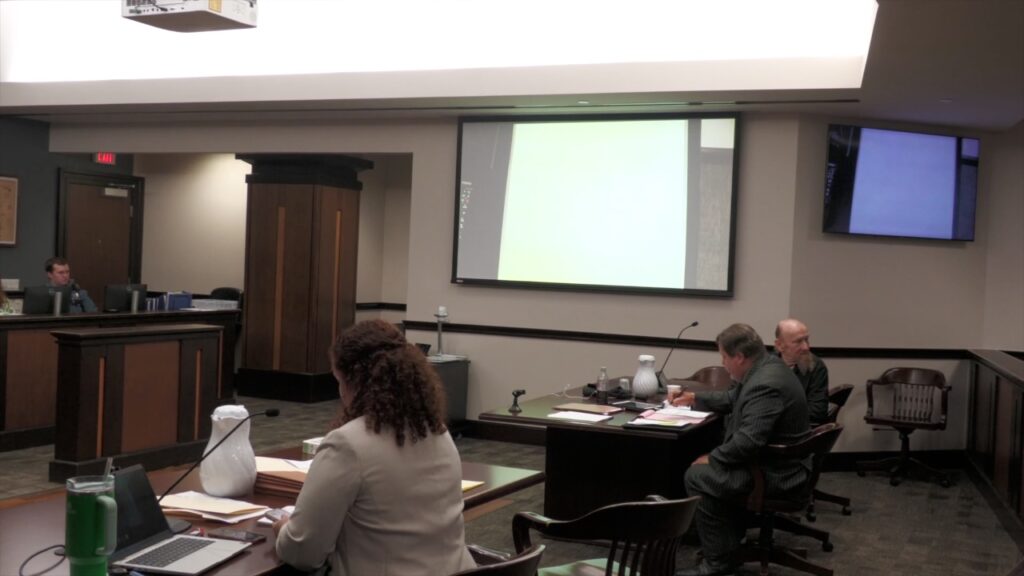
Tim Miller testifies Tuesday afternoon about Laura Miller’s disappearance and the information he says James Elmore Jr. gave him.
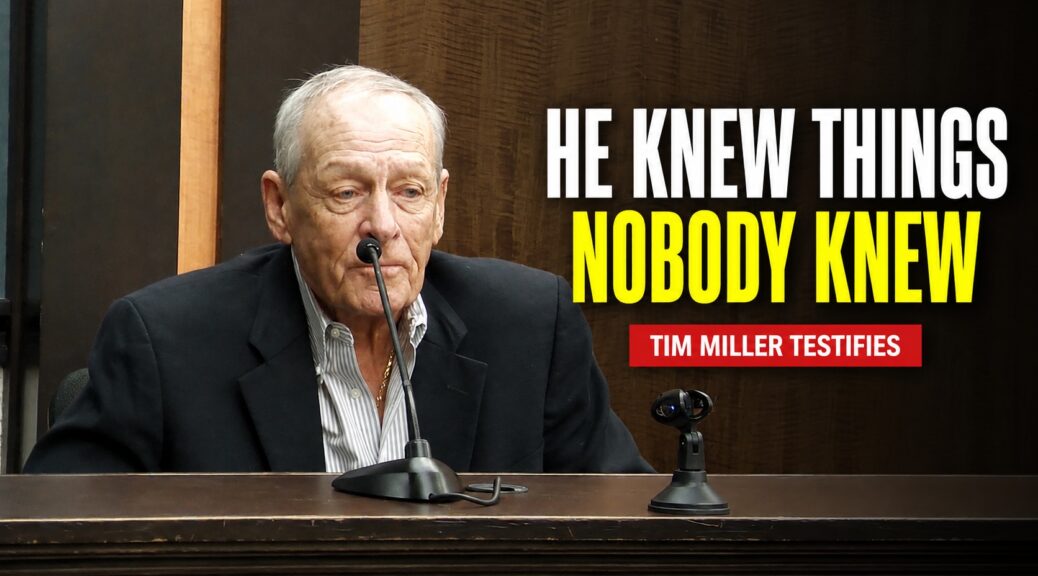
Tim Miller delivered emotional testimony Tuesday afternoon in the James Elmore Jr. trial. He described the day his daughter vanished and the 2022 call that changed the decades-old investigation.
Miller told jurors that Elmore knew details about Laura Miller and Audrey Cook that the public did not know. He also testified that Elmore described his alleged role in Laura’s death.
Elmore has pleaded not guilty. He faces a manslaughter charge in Laura Miller’s death. He also faces charges of tampering with the bodies of Miller and Cook.
Watch Tim Miller’s afternoon testimony below. This is the court video currently available for download. I will add any additional testimony when the remaining recordings become available.
Tim Miller describes Laura’s disappearance
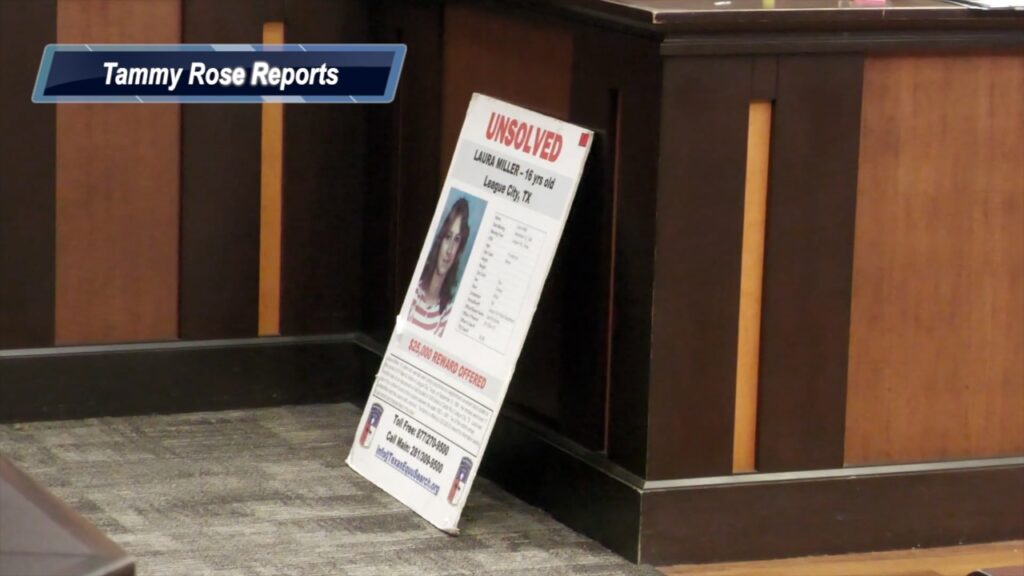
Prosecutors display a reward flyer for Laura Miller while Tim Miller testifies on September 1, 2026.
Laura Miller disappeared on September 10, 1984. She was 16 years old.
Tim Miller described the last morning he saw his daughter alive. He also told jurors about the 17 months he spent searching for answers.
Miller learned in February 1986 that investigators had found the remains of two young women near Calder Road. He took a newspaper article about the discovery to police.
Investigators later identified one of the victims as Laura.
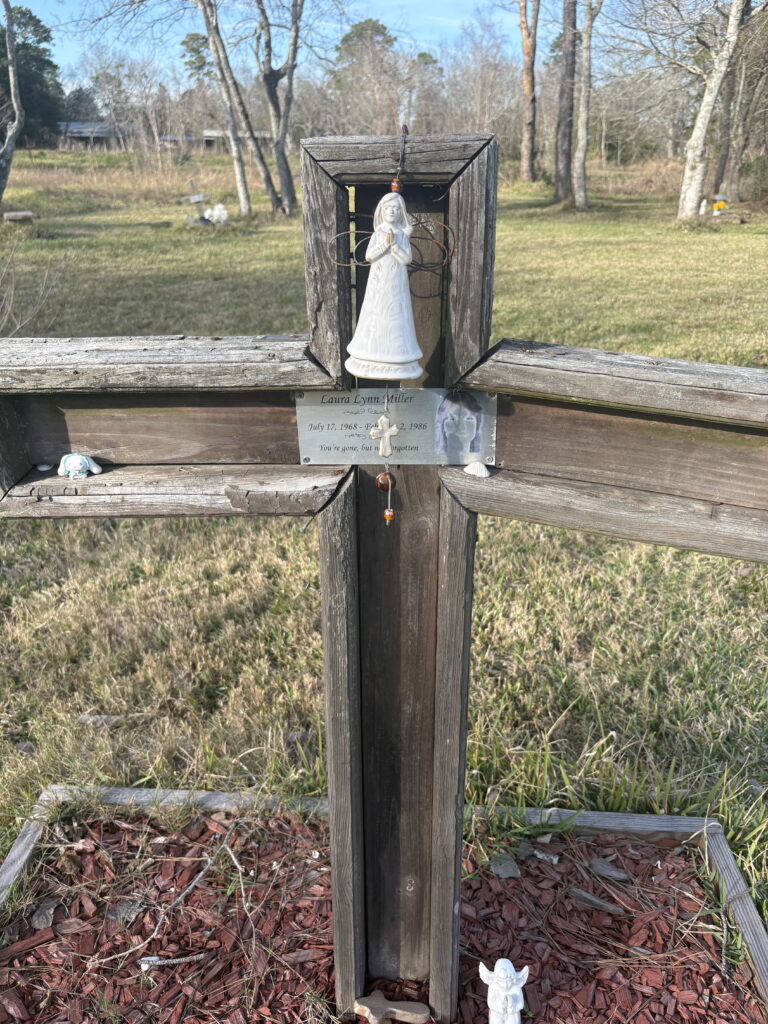
Miller said he repeatedly returned to the field where investigators found her. He searched for her clothing and necklace. He also built a cross near the location.
Years later, Miller founded Texas EquuSearch. The organization has searched for missing people across the United States and in other countries.
Miller called the organization Laura’s legacy.
James Elmore contacted Texas EquuSearch
James Elmore Jr. sits at the defense table during the afternoon testimony on September 1, 2026.
Miller testified that Elmore contacted Texas EquuSearch in April 2022. The message said Elmore wanted to discuss a missing-person case and “get some things off his chest.”
Miller called Elmore and asked which case he wanted to discuss.
According to Miller, Elmore named Laura Miller and Clyde Hedrick.
Miller then drove to Elmore’s home in Bacliff. Elmore asked him to take a ride to Calder Road.
Once there, Miller said Elmore pointed toward an area behind a church. Miller initially questioned whether Elmore had real information. The location of the so-called Killing Fields had received widespread attention.
That changed during their next stop.
Cemetery detail convinced Miller
A wooden cross stands in memory of Laura Lynn Miller near the site where her remains were found.
Miller testified that Elmore directed him to a home on Nevada Street in Dickinson. Hedrick once lived near the Miller family.
Elmore then directed Miller toward a nearby cemetery.
According to Miller, Elmore pointed toward trees and said Hedrick had hidden there to watch Laura when she visited the cemetery.
Miller said Laura’s visits to that cemetery were not public knowledge.
“That’s when I knew this guy was real,” Miller told jurors.
Miller asked Elmore whether he would speak with law enforcement. He then took him to an FBI office.
Miller recounts Elmore’s alleged statements
Jurors view a map showing Clyde Hedrick’s former home near the Miller family’s house in Dickinson.
Miller testified that Elmore slowly revealed more information during later conversations.
According to Miller, Elmore said Laura was with Hedrick and other men on the night she died. Miller testified that Elmore described mixing cocaine in a syringe and handing it to Hedrick.
Miller said Elmore claimed that he warned Hedrick not to inject Laura. According to Miller, Elmore then described watching Laura shake and take her final breath.
The state has accused Elmore of recklessly causing Laura’s death by preparing a syringe that contained cocaine and another substance.
Miller also testified about a shirt connected to the case. He said Elmore described the shirt before seeing a photograph of it.
According to Miller, that detail had never become public.
Testimony turns to Audrey Cook
Memorial sign highlighting four victims whose cases have been linked to the same recovery site during the investigation into Clyde Hedrick and several unsolved homicides.
Miller said Elmore also provided details about Audrey Cook.
Cook’s remains were found near Calder Road in 1986. Investigators did not identify her until 2019.
Miller testified that he first visited the location with one of the people who found Cook’s body. Days later, he returned to the area with Elmore.
Miller said he did not tell Elmore where to go. According to Miller, Elmore walked to the same location and pointed toward the same tree.
Miller also testified that Elmore described Cook’s alleged shooting. He said Elmore identified the ammunition as a .22-caliber Federal hollow-point rifle bullet.
Miller told jurors that Cook’s autopsy findings were not public at that time.
Miller paid Elmore nearly $33,000
The defense will likely focus on money that Miller gave Elmore.
Miller testified that a reward offered $25,000 for information in Laura’s case. He said Elmore had already implicated himself and revealed key details before receiving any money.
Miller first gave Elmore $5,000. He later made additional payments.
In total, Miller said he gave Elmore nearly $33,000. That amount included the reward and additional money for Elmore’s personal and medical needs.
Miller denied paying Elmore to make the statements.
He said Elmore had information about Laura and other missing women. Miller also feared Elmore could die before investigators solved the case.
“He was the only one left,” Miller testified.
Recorded interview will play for jurors
Miller arranged a recorded interview with Elmore in 2022. He said he wanted to preserve the information because Elmore had discussed cancer and heart problems.
The interview lasts more than 90 minutes.
Prosecutors introduced the recording as evidence Tuesday afternoon. They plan to play it for jurors Wednesday.
Miller said he did not watch the video until two days before his testimony because it was too painful.
Miller says he believes Elmore
Miller continued communicating with Elmore for several years. He also connected Elmore with Hitchcock Police Detective Cory Williams.
According to Miller, Williams later began investigating the case and spoke directly with Elmore.
Prosecutors ended the afternoon by asking Miller whether he believed the information Elmore gave him.
“Yes, ma’am,” Miller answered.
They then asked whether he believes Elmore bears responsibility for Laura’s death.
My new book, When Two Worlds Collide During WWII, follows two families separated by war—one in Wisconsin and one in Germany—whose lives eventually collide in a way neither could have imagined. Order your copy on Amazon.
Affiliate disclosure: As an Amazon Associate, I earn from qualifying purchases. I may also earn a commission from eligible Hotels.com bookings, at no additional cost to you.