Tag Archives: Tammy Rose:

Rebecca Beard Part 3: How Witness Statements Changed During the Investigation

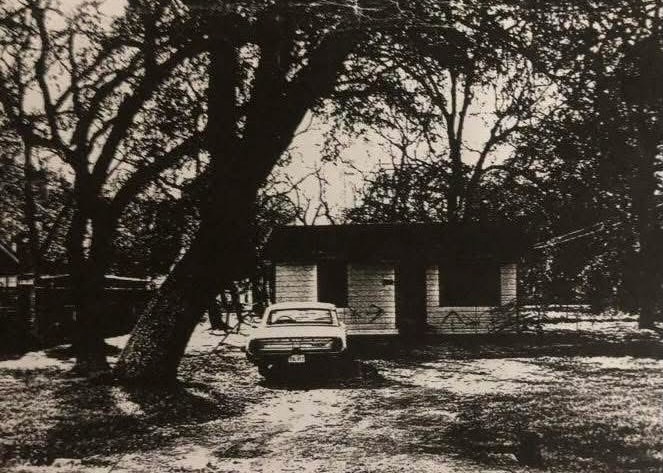
Historic photograph of Paul Taylor’s former Clute home featured in Part 3 of the Rebecca Beard investigation series, examining how witness statements and investigative timelines evolved during the case.
Paul Taylor’s former Clute residence, where investigators later focused much of the Rebecca Beard investigation as witness statements and the case timeline evolved over time.

Rebecca Beard Part 3: How Witness Statements Changed During the Investigation

By Investigative Reporter Tammy Rose

As I continued reviewing the original investigative file in the Rebecca Beard case, one pattern became impossible to ignore.

The earliest reports tell a very different story than the theory prosecutors ultimately presented years later.

During the first weeks of the investigation, detectives documented witnesses who said they did not know Paul Taylor or had never heard Becky mention him. At the same time, investigators pursued reports that Becky was seen after leaving the Excalibur Club, including at a Surfside beach party and an after-party.

Months later, investigators had assembled a very different timeline.

The records show how that evolution occurred.

Early Witnesses Did Not Connect Becky to Paul Taylor
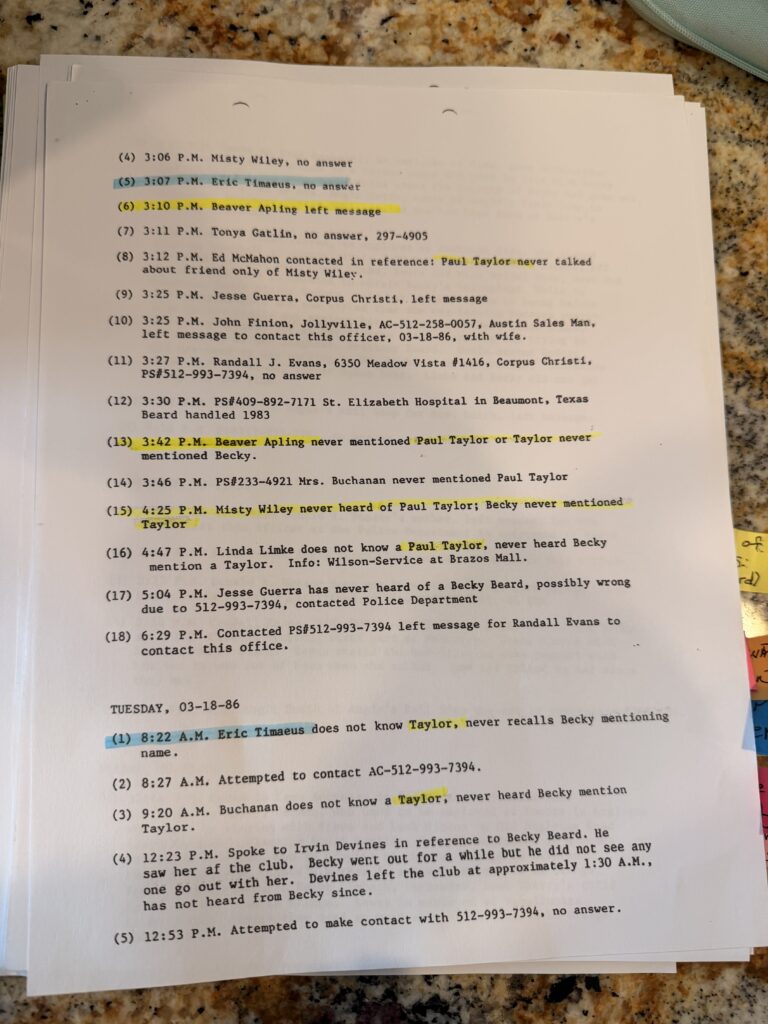
March 1986 police report documenting early witness interviews in the Rebecca Beard investigation, including statements from people who told investigators they did not know Paul Taylor or had never heard Becky mention him.
A March 1986 police report documents early witness interviews in the Rebecca Beard investigation. Several witnesses told detectives they did not know Paul Taylor or had never heard Becky mention him, reflecting one of the investigation’s earliest lines of inquiry.

One of the strongest themes in the March 1986 reports is how often investigators documented witnesses saying they had no connection between Becky Beard and Paul Taylor.

Among those interviewed were:

Beaver Aplin, who investigators noted never mentioned Paul Taylor, and Taylor had never mentioned Becky.


Eric Timaeus, Becky’s friend, who said he did not know Paul Taylor and never recalled Becky mentioning his name.


Misty Wiley, who said she had never heard of Paul Taylor and Becky never mentioned him.


Linda Barnes (identified in some records as Linda Limke), who said she had never heard Becky mention Paul Taylor.


Mrs. Buchanan, who also said she did not know Taylor.

At this point in the investigation, detectives had not yet developed the theory that Paul Taylor was the last person with Becky.

Several Witnesses Reported Becky Alive After Leaving Excalibur

The earliest reports also show investigators pursuing multiple leads suggesting Becky continued socializing after leaving the Excalibur Club in Freeport.

Paula’s Surfside Account

One witness, Paula, told investigators she saw Becky at a Surfside beach party during the morning hours after she disappeared.

That account suggested Becky may have left the club and traveled elsewhere.

Jack Hamilton’s Statement
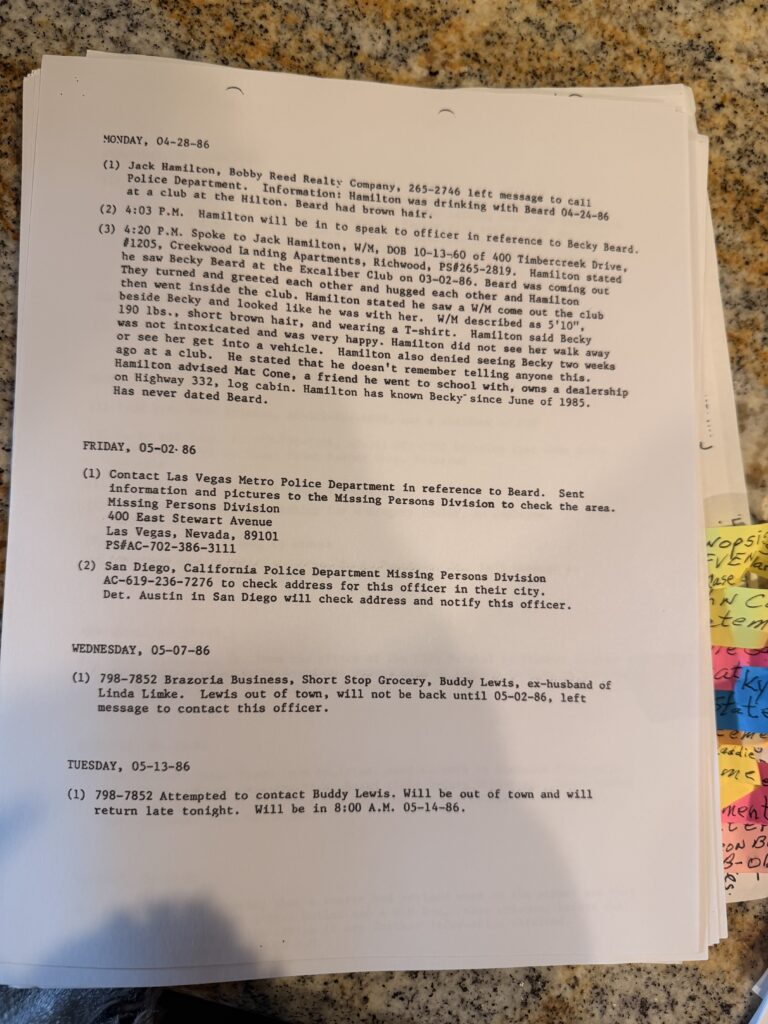
April 28, 1986 police report documenting witness interviews in the Rebecca Beard investigation, including statements from Jack Hamilton and dancer Mel Scroggins regarding Becky’s movements after leaving the Excalibur Club.
An April 28, 1986 police report documents interviews with Jack Hamilton and dancer Mel Scroggins. Both described seeing Becky Beard after she left the Excalibur Club, adding to the early investigative timeline detectives were working to reconstruct.

On April 28, 1986, Jack Hamilton told investigators he saw Becky outside the Excalibur Club.

Hamilton said:

Becky appeared happy.
She was not intoxicated.
The two greeted each other and hugged.
He saw an unidentified white male walk out beside Becky who appeared to be with her.
He never saw Becky get into a vehicle.

Importantly, Hamilton did not identify the man as Paul Taylor.

Hamilton also told investigators he knew Matt Cone, a longtime friend.

Dancer Reported Seeing Becky at an After-Party
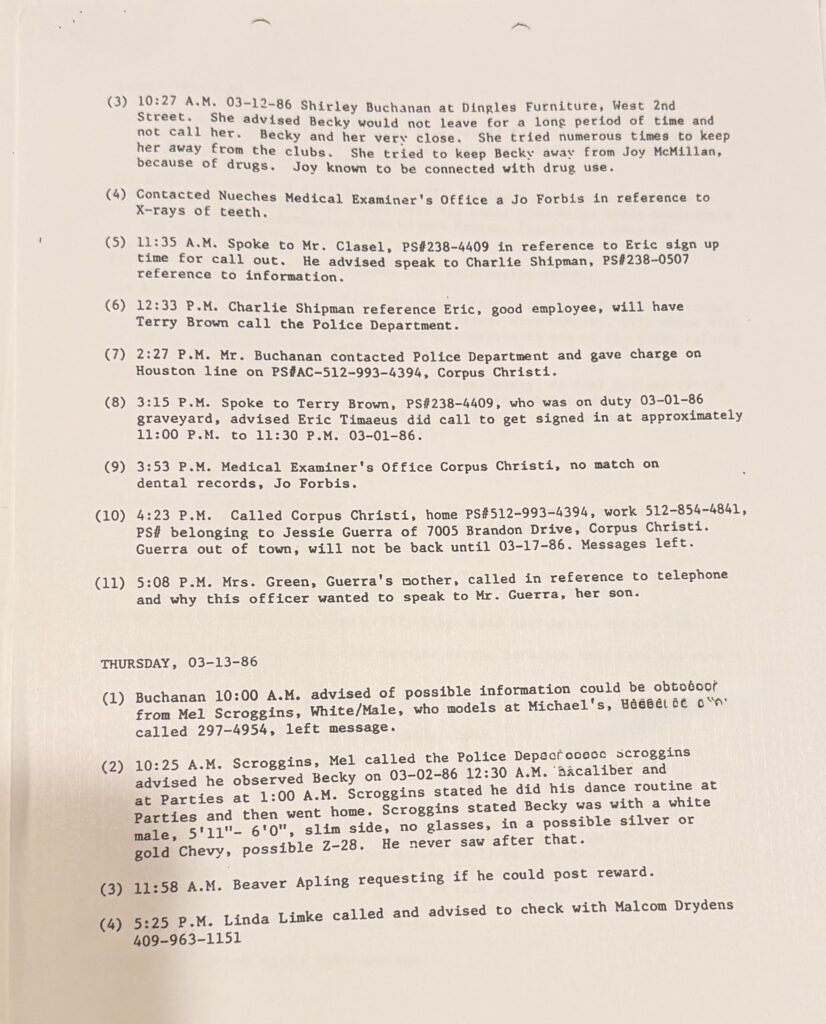
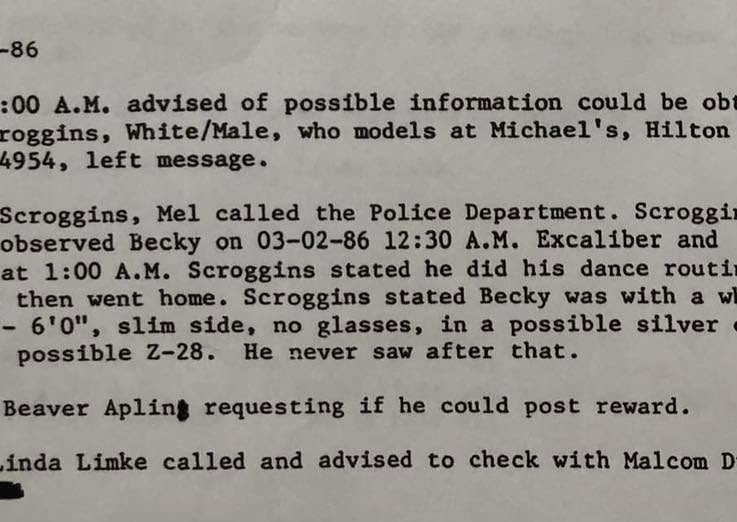
March 13, 1986 police report documenting witness information in the Rebecca Beard investigation, including dancer Mel Scroggins’ account of seeing Becky at Excalibur and later at an after-party.
A March 13, 1986 police report documents dancer Mel Scroggins’ statement that he saw Becky Beard at the Excalibur Club and later at an after-party around 1:00 a.m. The report also notes Beaver Aplin contacted investigators about posting a reward.

Another witness, Mel Scroggins, also described seeing Becky after she left Excalibur.

Scroggins told investigators he saw Becky around 12:30 a.m. at Excalibur before performing his dance routine.

He then reported seeing Becky again around 1:00 a.m. at an after-party.

According to Scroggins, Becky was accompanied by:

a white male,
approximately 5’11” to 6’0”,
slim build,
no glasses,
associated with a possible silver or gold Chevrolet.

Again, the man was not identified as Paul Taylor.

Scroggins said he never saw Becky after that.

When viewed together, these reports show detectives were actively investigating the possibility that Becky continued on to other locations after leaving Excalibur.

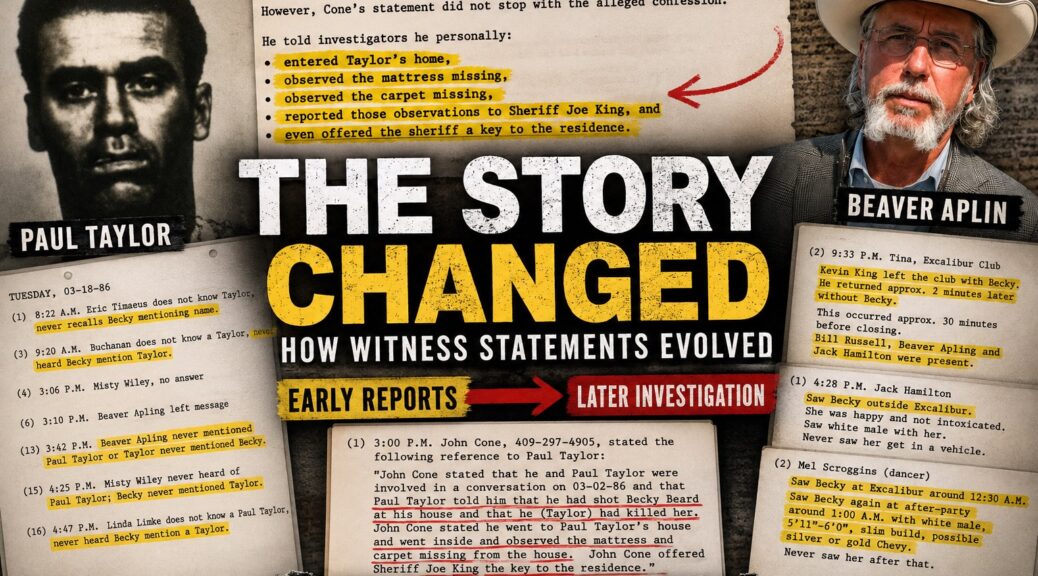
John Cone’s Statement Became a Turning Point
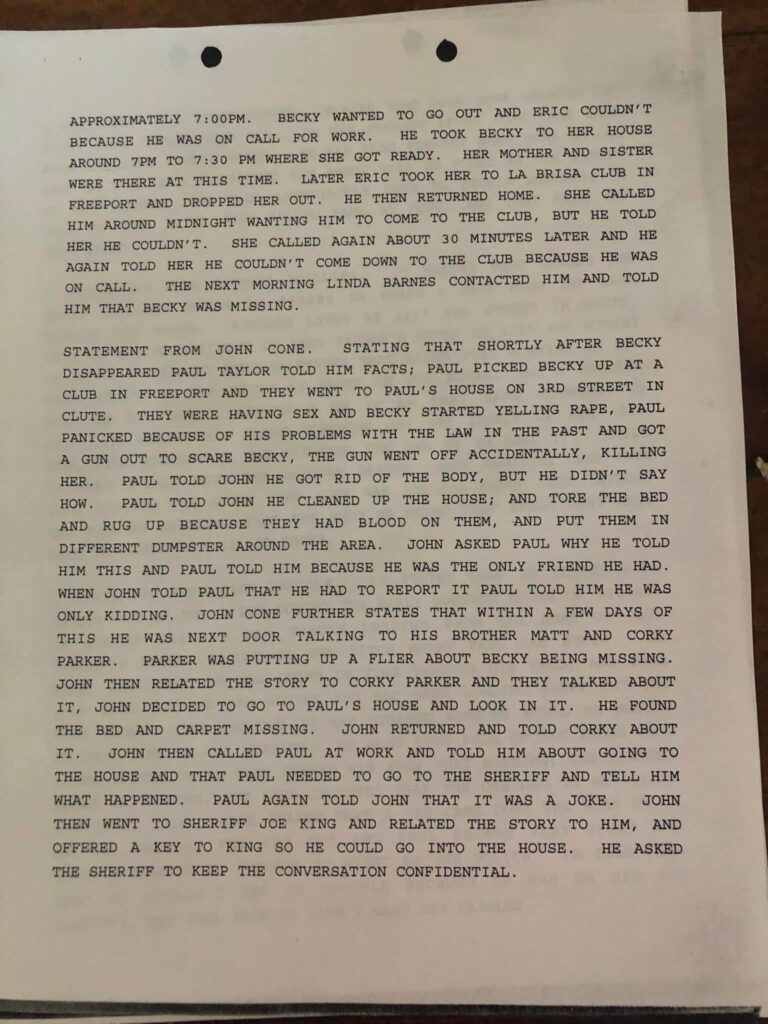
Police report documenting John Cone’s statement in the Rebecca Beard investigation. The statement describes what Cone said Paul Taylor told him and also details Cone’s own observations after entering Taylor’s home, including that the mattress and carpet were missing.
Police records show John Cone told investigators that Paul Taylor admitted Becky Beard died at his home. Cone also stated he personally entered the house, observed the mattress and carpet were missing, and reported those observations to Sheriff Joe King while offering a key to the residence.

Another major development came from John Cone.

Cone told investigators Paul Taylor admitted Becky died inside his Clute home after a gun discharged during an encounter.

However, Cone’s statement did not stop with the alleged confession.

He told investigators he personally:

entered Taylor’s home,
observed the mattress missing,
observed the carpet missing,
reported those observations to Sheriff Joe King, and
even offered the sheriff a key to the residence.

Those observations were based on what Cone said he personally witnessed, not simply what Taylor allegedly told him.

Matt Cone Appears to Corroborate Parts of the Story
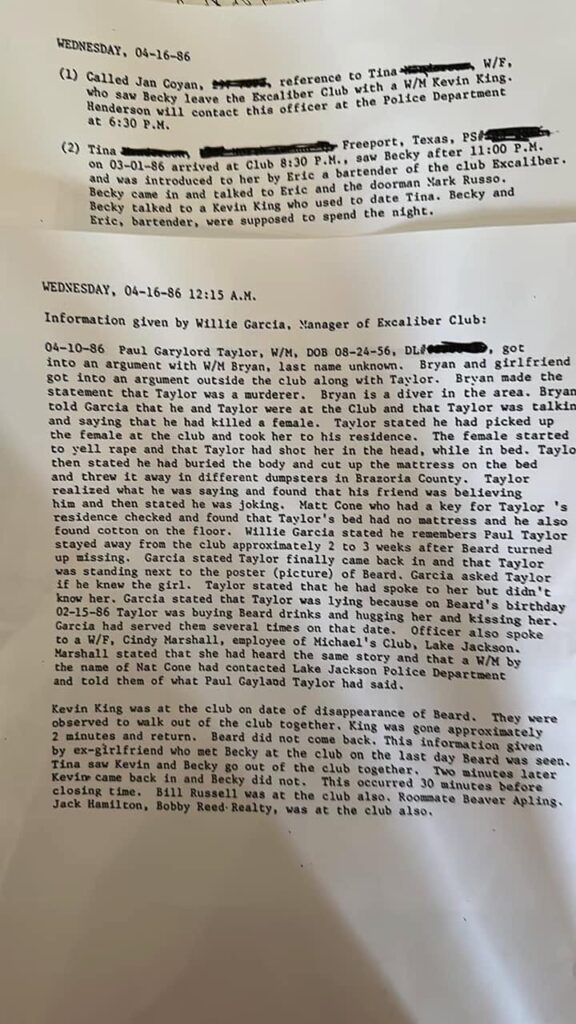
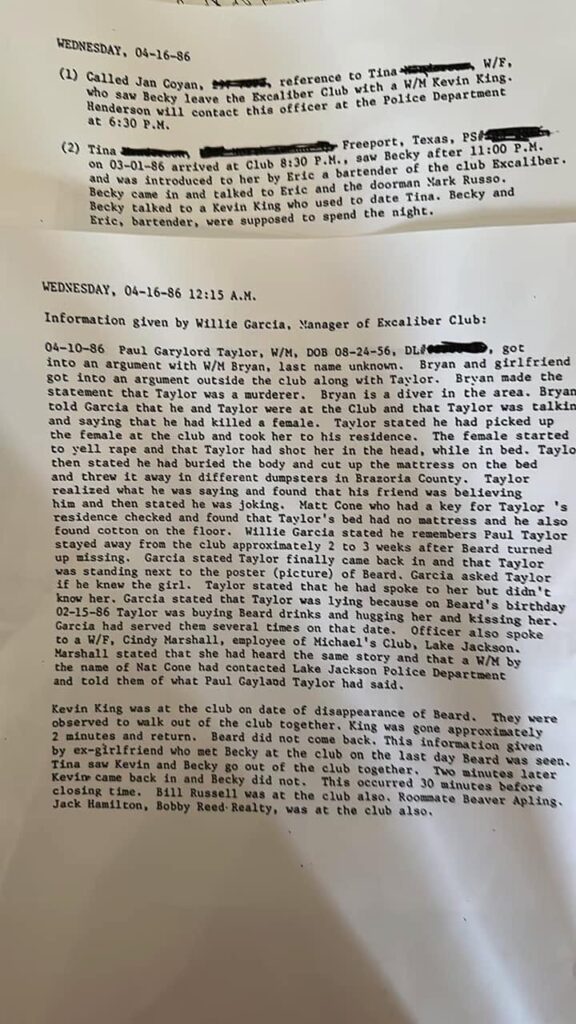
Composite police report pages from the Rebecca Beard investigation. The documents include witness statements from Tina, Willie Garcia, and references to Matt Cone, who is identified as John Cone’s brother, as investigators documented interviews and leads in April 1986.
April 16, 1986 police records include statements from Tina and Excalibur Club manager Willie Garcia. The documents also reference Matt Cone, John Cone’s brother, whose name appears multiple times in the investigation as detectives continued interviewing witnesses and following leads.

The records also repeatedly reference Matt Cone.

John Cone told investigators he discussed the situation with his brother, Matt Cone, and Corky Parker before going to Taylor’s house.

Jack Hamilton also identified Matt Cone as someone he knew.

If Matt Cone independently observed the missing mattress and carpet, that would provide additional corroboration of John’s observations.

Whether Matt entered the home himself or relied on John’s account remains an important question raised by the records.

Beaver Aplin Continued Contacting Investigators
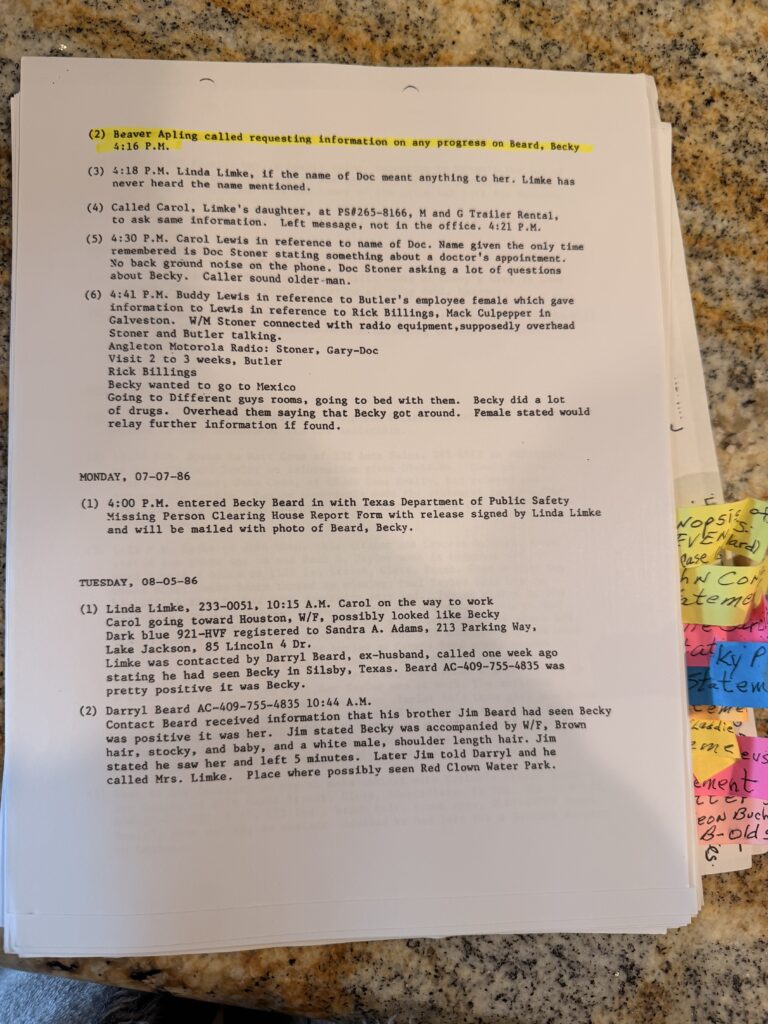
Police records show Beaver Aplin remained in regular contact with investigators after Rebecca Beard disappeared. The reports document Aplin requesting case updates, asking about posting a reward, and continuing to communicate with detectives as the investigation progressed.

Another interesting pattern involves Beaver Aplin.

The investigative file documents that:

Beaver was interviewed during the early stages of the case.
Investigators noted he did not connect Becky to Paul Taylor.
He later left messages for investigators.
Months later, he again contacted police requesting an update on Becky’s case.

Those records do not suggest wrongdoing.

However, they do show Beaver remained engaged with investigators long after Becky disappeared.

The Investigation Evolved

As the investigation continued, the documentary record began shifting.

Later reports increasingly connected Becky to Paul Taylor.

Among them were statements from:

Willie Garcia,
Kevin King,
John Cone,
and other witnesses who later appeared on the prosecution’s witness list.

That witness list outlined how prosecutors intended to build their case, including testimony that Becky left with Taylor, statements that Taylor admitted killing her, and witnesses describing evidence allegedly observed inside Taylor’s home.

That later theory differs considerably from many of the earliest reports documenting possible Surfside sightings, after-party sightings, and witnesses who initially said they did not know Paul Taylor.

Questions That Remain

Reading these records chronologically reveals an investigation that changed significantly over time.

The documents show detectives initially pursued multiple leads, including reports that Becky was seen after leaving Excalibur and accounts from witnesses who did not connect her to Paul Taylor.

As additional interviews were conducted, investigators documented statements that increasingly focused on Taylor and ultimately formed the basis of the prosecution’s case.

The records do not fully explain how every conflicting witness account was evaluated before investigators settled on the final timeline presented in court.

Nearly four decades later, those documents continue to provide important insight into how the Rebecca Beard investigation developed—and why reviewing the original records remains essential.

Read More in This Series

Part 1: Rebecca Beard: John Cone’s Confession and the Early Investigation

Part 2: Rebecca Beard: Early Police Reports Reveal the First Days of the Investigation

https://www.chopperrose.com/2026/07/20/rebecca-beard-part-2-early-police-reports-reveal-the-first-days-of-the-investigation

Recommended Resources

If you’re researching cold cases or organizing public records, these are tools I use during investigations.

Disclosure: As an Amazon Associate, I earn from qualifying purchases at no additional cost to you. Your support helps fund my investigative reporting and allows me to continue researching and publishing stories like this one.
Rebecca Beard Part 2: Early Police Reports Reveal the First Days of the Investigation

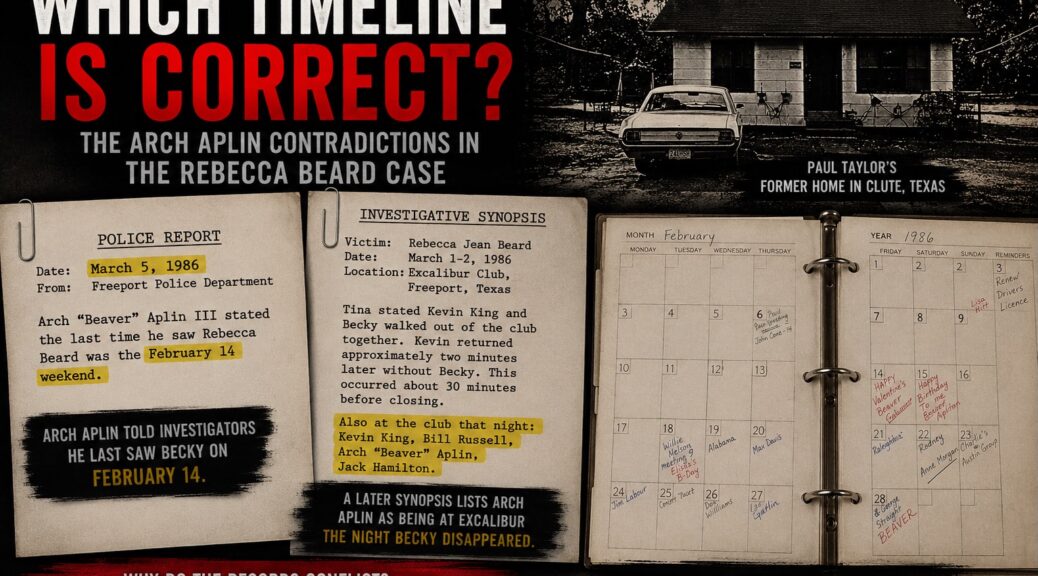
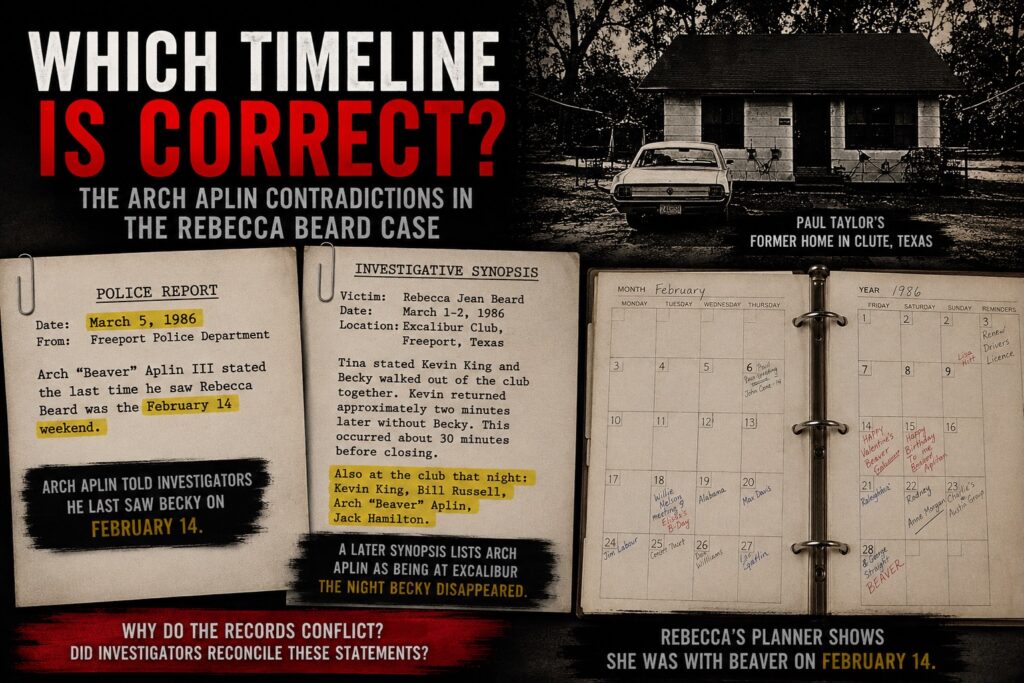
Featured image for “Rebecca Beard Part 2: Early Police Reports Reveal the First Days of the Investigation,” highlighting conflicting timelines involving Arch Aplin, police reports, an investigative synopsis, Rebecca Beard’s 1986 planner, and Paul Taylor’s former home.
Early police records reveal conflicting timelines in the Rebecca Beard investigation. This graphic compares witness statements, investigative documents, and Rebecca’s personal planner to examine how the investigation evolved during its first days. Reporting by Investigative Reporter Tammy Rose.

Rebecca Beard Part 2: Early Police Reports Show How the Investigation Evolved

Rebecca Beard disappeared during the early morning hours of March 2, 1986, after spending the previous evening at the Excalibur Club in Freeport, Texas. During the first days of the investigation, detectives worked to reconstruct her final hours by interviewing friends, coworkers, club patrons, and anyone who may have seen her before she vanished.

The earliest police reports provide a snapshot of where the investigation began. At that stage, detectives had not narrowed their focus to one individual. Instead, they documented numerous interviews, followed multiple leads, and worked to establish Rebecca’s last known movements.

Nearly four decades later, those reports remain important because they show how the investigation developed over time.

Detectives Worked to Build Rebecca Beard’s Timeline

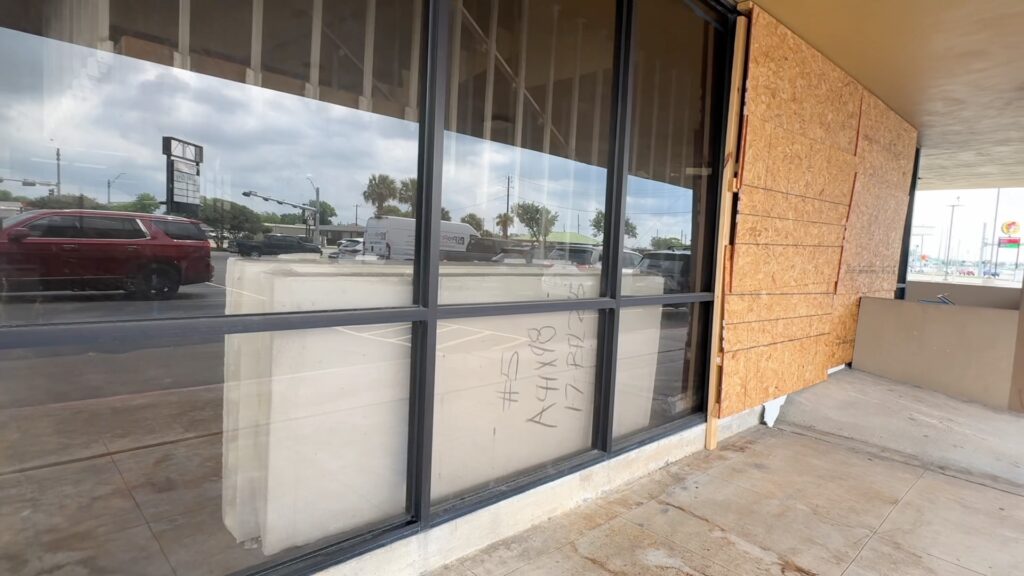
Present-day view of the former Excalibur Club building in Freeport, Texas, showing the storefront with boarded windows and the location where Rebecca Beard was last reported seen before her disappearance in 1986.
The former Excalibur Club in Freeport, Texas, as it appears today. Investigators interviewed witnesses who were at the nightclub as they worked to reconstruct Rebecca Beard’s movements during the early days of the 1986 investigation.

One of the first priorities involved determining Rebecca’s movements after she left the Excalibur Club.

Investigators interviewed witnesses who had been with Rebecca that evening or reported seeing her during the early morning hours. Detectives compared those statements in an effort to establish a reliable timeline.

The reports also reference a gold Chevrolet Camaro Z-28. Detectives attempted to identify the vehicle, determine who owned it, and learn whether it played a role in Rebecca’s disappearance.

Those early efforts demonstrate how investigators attempted to preserve every possible lead.

Arch “Beaver” Aplin Was Among the First Witnesses Interviewed

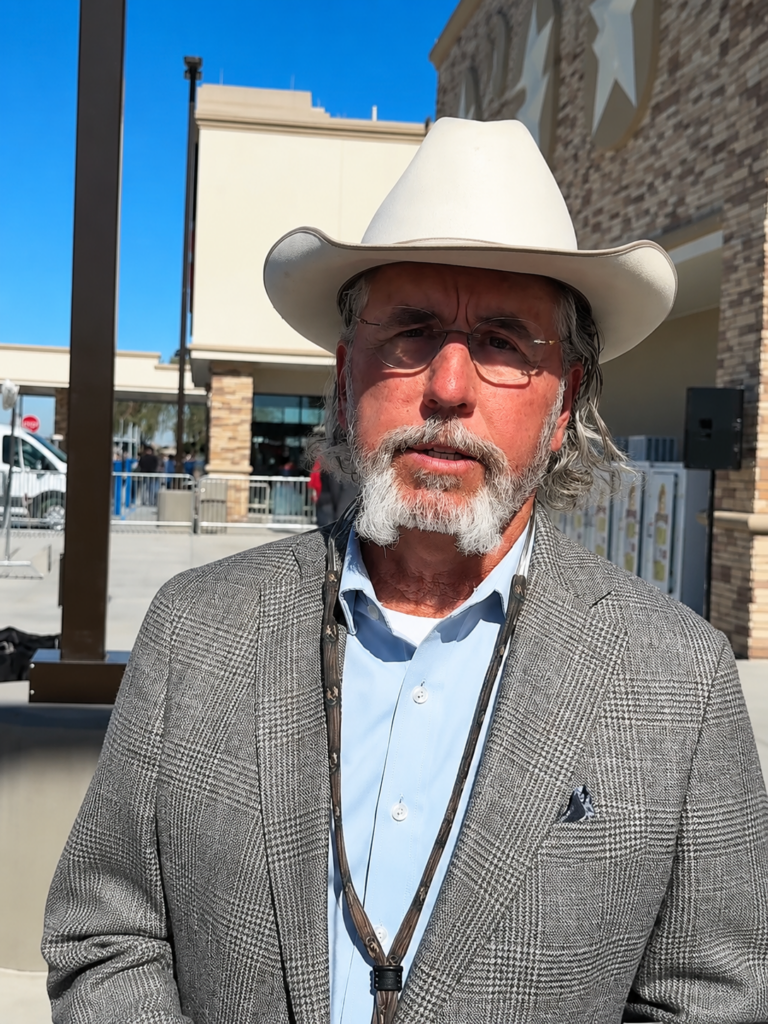
Arch “Beaver” Aplin III speaks during the Buc-ee’s grand opening in Goodyear, Arizona, wearing a white cowboy hat, glasses, and a gray sport coat.
Arch “Beaver” Aplin III at the Buc-ee’s grand opening in Goodyear, Arizona. This image was captured by Investigative Reporter Tammy Rose. Aplin was interviewed by investigators on March 5, 1986, during the early stages of the Rebecca Beard investigation.

After Rebecca Beard disappeared, investigators interviewed Arch “Beaver” Aplin on March 5, 1986.

According to the police report, Aplin told detectives the last time he saw Rebecca was the weekend of February 14, when they had dinner together in Galveston. He also said he had called her several times afterward but never reached her.

At that point in the investigation, detectives documented Aplin’s account as one of many witness statements they were using to reconstruct Rebecca’s final movements.

Later Records Raised New Timeline Questions

Investigative synopsis from the Rebecca Beard case showing the section summarizing Tina’s witness statement, including references to Kevin King, Arch “Beaver” Aplin, Bill Russell, Jack Hamilton, and other individuals reportedly at the Excalibur Club on the night Rebecca Beard disappeared.
This investigative synopsis includes a summary of Tina’s witness statement. According to the document, Tina reported seeing Kevin King leave the Excalibur Club with Rebecca Beard before he returned without her. The synopsis also lists Arch “Beaver” Aplin, Bill Russell, and Jack Hamilton as being at the club that night, raising additional questions about the investigation’s timeline.

This is where the investigation becomes more complicated.

A later investigative synopsis documents witness Tina’s account of the night Rebecca disappeared.

According to that synopsis, Tina told investigators Kevin King walked out of the Excalibur Club with Rebecca about 30 minutes before closing and returned approximately two minutes later without her.

The same synopsis also lists Kevin King, Bill Russell, Arch “Beaver” Aplin and Jack Hamilton as being at Excalibur that night.

When compared with Aplin’s March 5 statement that he had not seen Rebecca since February 14, the two records appear to present different timelines.

The investigative records reviewed for this series do not explain how detectives reconciled those accounts.

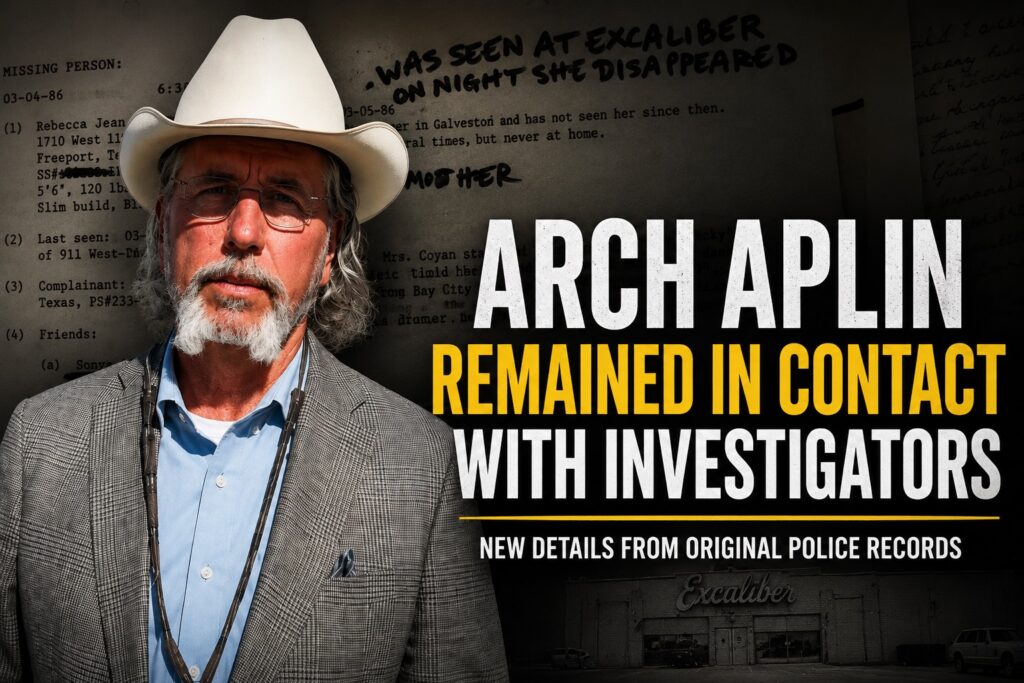
Arch “Beaver” Aplin Remained in Contact With Investigators

Graphic featuring Arch “Beaver” Aplin III alongside the headline “Arch Aplin Remained in Contact With Investigators” over a background of original Rebecca Beard police records and the former Excalibur Club.
This graphic highlights original police records documenting that Arch “Beaver” Aplin remained in contact with investigators after Rebecca Beard disappeared. The records show detectives continued communicating with Aplin as they worked to reconstruct Rebecca’s final known movements during the 1986 investigation.

The early investigative records also document repeated contact between detectives and Arch “Beaver” Aplin, who had been at the Excalibur Club around the time Rebecca Beard disappeared.

Rather than disappearing from the investigation after giving an initial statement, the reports show Aplin continued communicating with law enforcement in the days and weeks that followed.

According to the investigative notes, Aplin contacted detectives seeking updates on the investigation and asked whether he could publicly offer a $10,000 reward for information leading to Rebecca’s whereabouts.

The records indicate detectives discussed the proposed reward with Aplin while continuing to investigate numerous leads.

Those contacts are significant because they demonstrate that investigators maintained communication with Aplin throughout the early stages of the case. The reports do not indicate that detectives viewed him as someone who had withdrawn from the investigation. Instead, the documented contacts suggest he remained interested in learning whether investigators had developed new information.

The investigative files also reflect that detectives continued interviewing numerous witnesses during this same period, including Rebecca’s friends, coworkers, and individuals believed to have seen her during the weekend she disappeared.

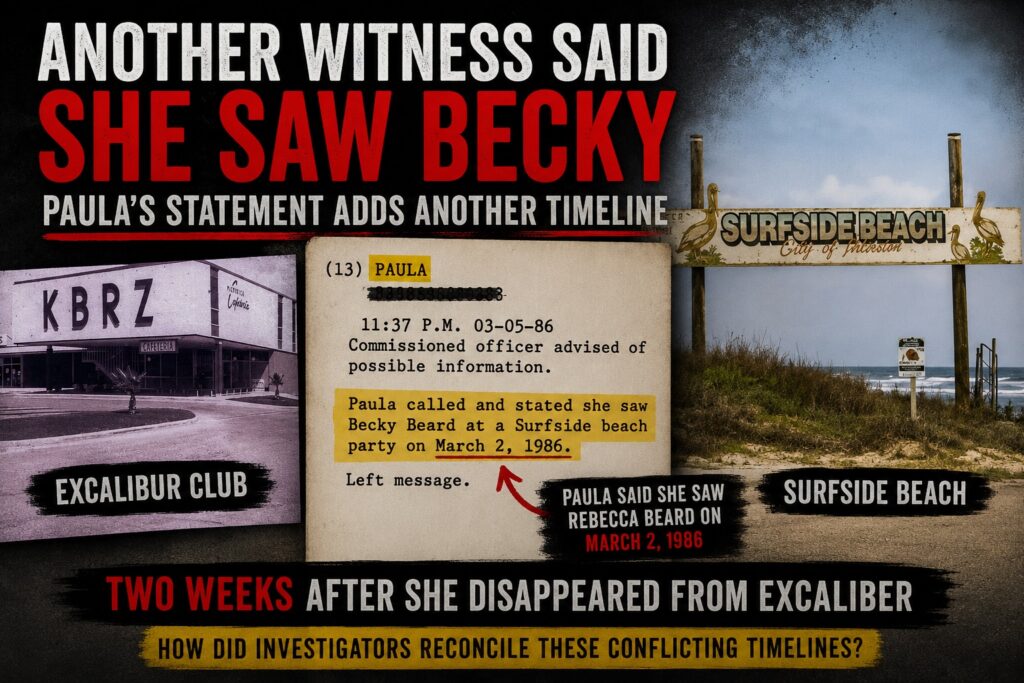
Another Witness Reported Seeing Rebecca Beard at a Surfside Beach Party

Graphic comparing Paula’s witness statement with images of the former Excalibur Club and Surfside Beach. The graphic highlights a police report stating Paula told investigators she saw Rebecca Beard at a Surfside beach party on March 2, 1986.
This graphic highlights Paula’s statement documented in the original police investigation. According to the police report, Paula told investigators she saw Rebecca Beard at a Surfside beach party on March 2, 1986. Her account added another reported timeline for detectives to evaluate as they worked to reconstruct Rebecca’s final known movements.

The original police investigation also documented a statement from another witness, Paula, who told investigators she saw Rebecca Beard at a Surfside beach party on the morning of March 2, 1986.

According to the police report, Paula said she recognized Becky and saw her with two males at the gathering. If her recollection was accurate, it could place Rebecca alive after the time she was believed to have left Excalibur, adding another timeline investigators had to evaluate.

Paula’s account does not prove what happened to Rebecca. However, it is one of several witness statements included in the original case file. When viewed alongside other reported sightings and witness interviews, it illustrates the challenges investigators faced while trying to reconstruct Rebecca’s final known movements.

More than 40 years later, these differing witness accounts continue to raise questions about Rebecca Beard’s disappearance and whether every lead documented in the original investigation was fully reconciled.

The Investigation Was Still Taking Shape

Reading the reports chronologically shows detectives working through dozens of leads while trying to establish Rebecca’s final movements.

Several witnesses interviewed in March 1986 told investigators they did not know Paul Taylor or had never heard Rebecca mention his name. At the same time, detectives continued following information involving several other individuals connected to the case.

These reports should be viewed as a snapshot of the investigation during its earliest weeks. Criminal investigations often evolve as detectives conduct additional interviews, gather new evidence, and revisit earlier leads.

The progression of the Rebecca Beard investigation reflects that process.

Coming in Part 3

The earliest police reports reveal how detectives began piecing together Rebecca Beard’s final known movements through witness interviews, follow-up leads, and investigative records. As the investigation continued, additional witness statements and investigative summaries documented new information and raised further questions.

In Part 3, I examine those later records, including additional witness statements, documented timeline discrepancies, and what they may reveal about the Rebecca Beard investigation nearly four decades later.

Research Tools for Investigative Journalists

Every long-term investigation benefits from careful note-taking. A quality investigator’s notebook or case journal provides a simple way to organize timelines, document interviews, and track developing leads while reviewing historical records.

Related Articles